Key Takeaways
- Sports apparel orders break standard Shopify workflows at the player level.
- OWASP ranks broken access control as the top web risk.
- Coaches place full-team orders without touching the Shopify admin.
- Our San Diego engineers kept Shopify as the storefront foundation.
- Supplier APIs replace manual production handoffs with structured data.
Introduction
A single youth soccer team order can include forty jerseys, forty pairs of shorts, and forty pairs of socks, each with its own size, player name, and number. That’s when a standard storefront stops working, and it is why FLITE Sports needed a sports commerce platform built around how teams actually buy.
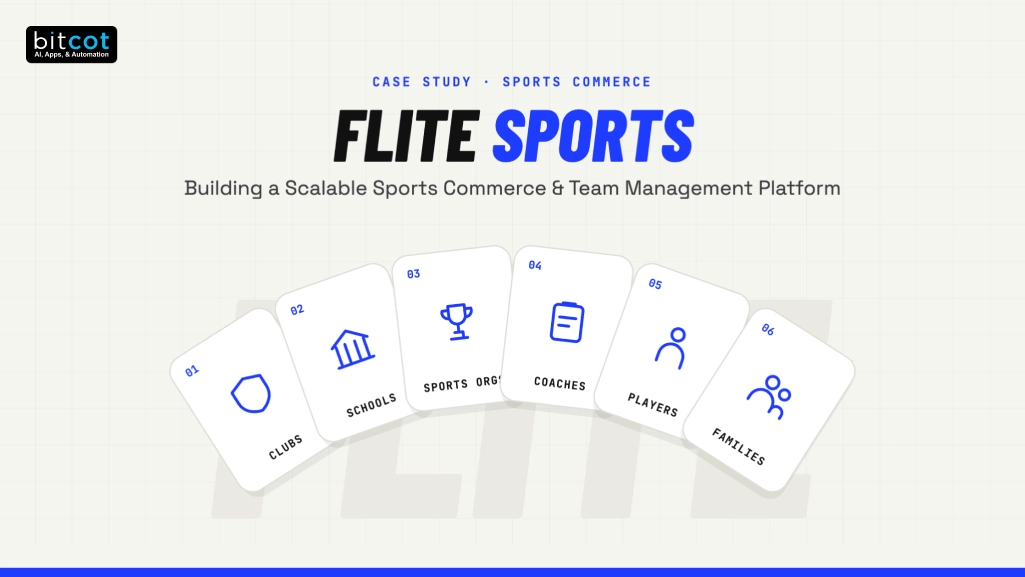
FLITE sells customized apparel to clubs, schools, coaches, players, and families. As the business grew, it was juggling partner stores, team bundles, personalization, commissions, and supplier coordination across tools that did not talk to each other.
Our engineering team in San Diego took a specific position on this build: keep Shopify for what it does well, and move everything sports-specific into a custom layer around it. This case study walks through why we made that call, what we built, and what other apparel and team-commerce businesses can learn from it.
What Makes a Sports Commerce Platform Harder Than Standard Ecommerce?
A sports commerce platform has to track products at the player level, not just the SKU level. One jersey design multiplies into sizes, materials, names, numbers, initials, and production rules, and each combination must stay attached to the right player and the right team.
FLITE faced six connected problems:
- Product complexity: jerseys and uniforms carry far more variant combinations than typical retail items.
- Partner separation: each club or school needs its own products, store, coaches, and orders, while FLITE keeps central control.
- Bulk personalized orders: coaches need to order a full roster at once instead of building every item by hand.
- Catalog sync: the same product can appear across many partners, stores, and bundles, so data drifts easily.
- Supplier handoffs: production details were moving to manufacturers through manual processes.
- Reporting gaps: standard Shopify reports could not show partner performance or player-level purchases.
Volume makes these gaps hurt faster. The U.S. Census Bureau tracks ecommerce as a growing share of total U.S. retail sales in its quarterly reports, and team apparel buyers increasingly expect the same online ordering experience as any other purchase.
These problems compound each other. A personalization error is also a reporting error, a production error, and a customer service problem for the club.
Why We Extended Shopify Instead of Replacing It
We kept Shopify as the customer-facing storefront and built FLITE’s specialized logic in a separate application integrated through Shopify APIs. Replacing a working checkout, payment flow, and storefront would have added risk without solving the real problems.
This is a classic build vs. buy software decision, and the answer here was both. Shopify handles products, orders, customers, and store operations, while the custom application owns partners, personalization, bundles, commissions, supplier data, and reporting.
The split keeps each system focused. FLITE gets Shopify’s reliability for shoppers and custom software solutions for the workflows no app store plugin covers.
Modeling Products, Personalization, and Team Bundles
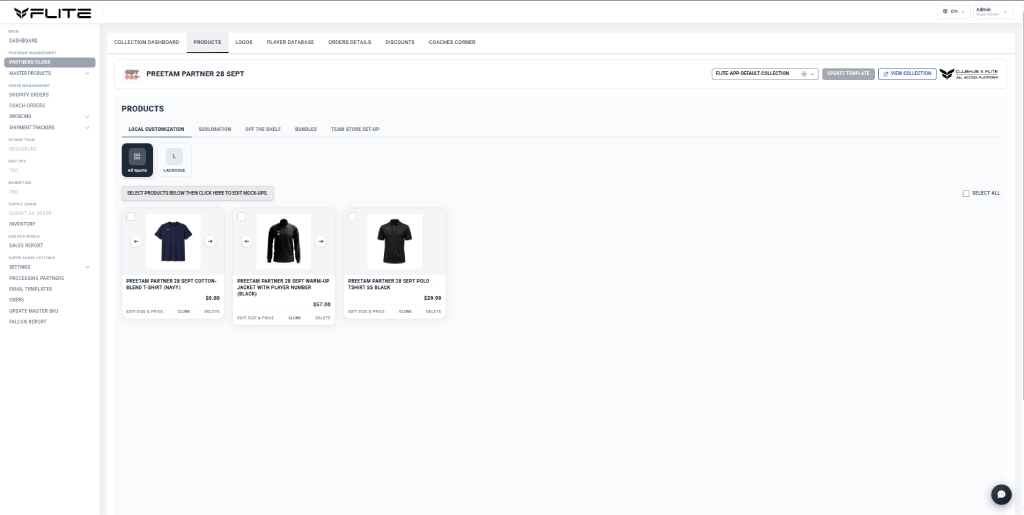
The platform manages a master product catalog where each item holds its variants, sizes, SKUs, supplier, sport, product type, and tags. Partners then receive assigned products from that catalog instead of duplicate copies.
Personalization data, including player name, number, initials, and size, stays attached to the order line. That single decision feeds three downstream needs: accurate production files, player-level reporting for clubs, and fewer reorders caused by missing details.
Team uniform bundles group components, such as a jersey, shorts, and socks, into one purchasable item. The system tracks the relationship between the bundle and each component, so ordering and inventory stay accurate even when the same shorts appear in several bundles.
Partner Stores, Roles, and Controlled Supplier Access
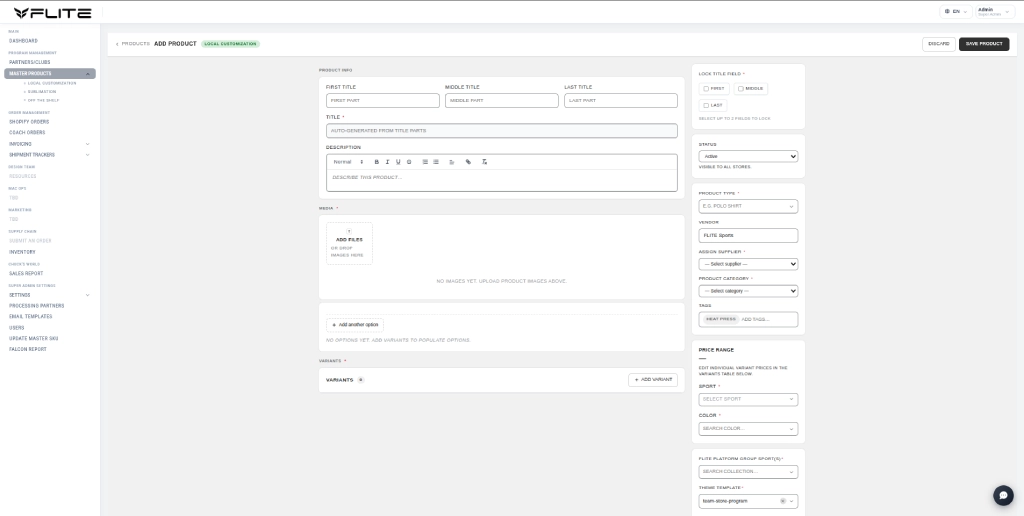
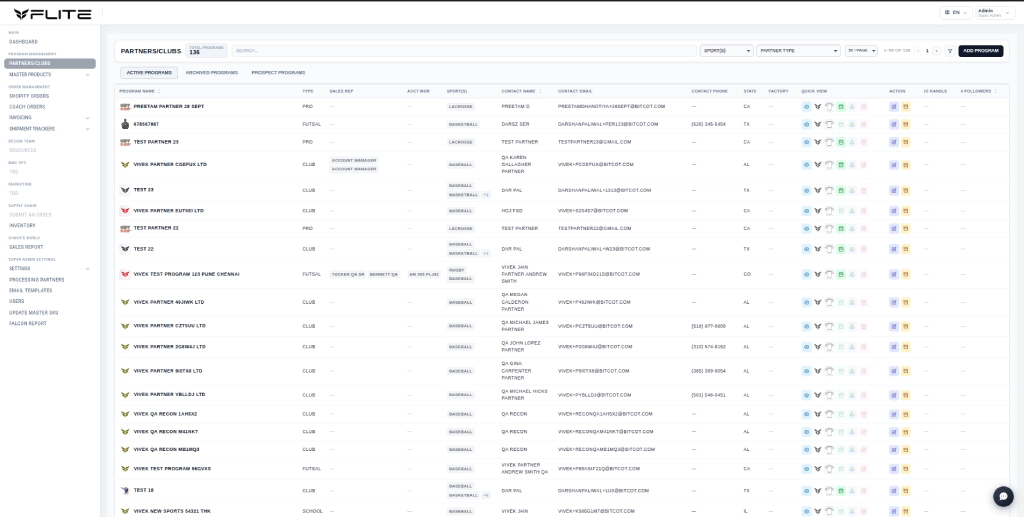
Each club, school, or organization operates as a partner with its own assigned products and team store, synced to Shopify based on business rules. FLITE manages every partner from one central dashboard.
Access control was a design priority from the first sprint. According to the OWASP Top 10 (2021), broken access control is the most serious web application security risk, which matters when coaches, partners, and suppliers all log in to the same system.
We applied role-based permissions throughout. The approach follows the role-based access control model that NIST developed and helped standardize, where permissions attach to roles rather than individual users.
In practice, coaches never see product costs or margins. Suppliers see only the products, designs, and production details assigned to them, while FLITE’s internal pricing and other suppliers’ products stay hidden.

How Coach’s Corner Handles Bulk Team Orders
Coach’s Corner is a dedicated ordering portal where coaches and partners place full team orders from their assigned products. They never need access to the Shopify backend.
A coach can select products and variants, enter player names, numbers, and initials, set sizes and quantities for the whole roster, apply FLITE Funds, and pay through Stripe in one flow. For programs ordering dozens or hundreds of customized items, this replaces a long chain of individual orders.
The portal is built with Vue.js on the frontend, and our Vue.js development work focused on making roster entry fast and forgiving. Validation catches missing sizes or duplicate numbers before the order reaches production.
FLITE Funds: A Built-In Partner Commission System
FLITE Funds lets partners earn commission on sales based on configured rules, then spend that balance on future orders. It turns partner incentives into a tracked, auditable workflow instead of a spreadsheet.
The system supports commission calculation, a running funds balance, order-level commission details, full history, and manual additions or deductions with adjustment notes. Admins can correct a balance without losing the record of why it changed.
Automating this logic is a good example of business process automation paying off in commerce: partners trust the numbers, and FLITE staff stop reconciling commissions by hand.
Connecting Production Through the Healong Supplier API
We built an API integration between FLITE and Healong, its manufacturing partner, to move production communication into structured data. The target flow is: FLITE Order → API → Healong → Production → Shipping → Tracking.
Each order carries product codes, SKUs, pricing, production details, print files, design references, shipping information, and tracking updates. A structured product-code scheme ties every item to the correct design and production data.
The payoff is fewer manual handoffs and a clear audit trail when an order changes. The same pattern scales to additional suppliers as FLITE adds manufacturing relationships.
Reporting That Shows Players, Not Just Sales
The platform separates registered player orders from general fanwear purchases, so clubs can see which players have bought their uniforms. Reports link first name, last name, player number, and jersey details to each registered order.
Beyond player data, reports cover sales, orders, partners, products, and partner performance, with CSV exports for deeper analysis. Clubs get answers to real questions, such as which players still need uniforms before the season starts.
This kind of visibility is where enterprise web app development earns its place in commerce: the data already exists in orders, and the custom layer makes it usable.
Technology Stack Behind the Platform
The platform pairs a Laravel and Vue.js application with Shopify, running on AWS for scale and reliability.
| Layer | Technology |
|---|---|
| Frontend | Vue.js |
| Backend | Laravel (PHP) |
| Ecommerce | Shopify and Shopify APIs |
| Cloud | AWS ECS on Fargate, Amazon RDS, Redis, Application Load Balancer, Amazon CloudWatch |
| Integrations | Shopify APIs, Healong API, Stripe, product sync workflows |
Containerized services on ECS Fargate let the platform scale during peak team-ordering seasons without managing servers. This follows cloud-native application development practices, with CloudWatch monitoring sync jobs and API calls.
How Long Does It Take to Build a Platform Like This?
A comparable full-scope sports commerce platform typically takes about 6 to 9 months to build from scratch. The final timeline depends on scope, number of integrations, design needs, data migration, and testing cycles.
| Phase | Estimated Duration |
|---|---|
| Requirement analysis and planning | 2 to 4 weeks |
| UI/UX and architecture | 2 to 4 weeks |
| Product and partner management | 4 to 6 weeks |
| Shopify integration | 3 to 5 weeks |
| Personalization and ordering | 4 to 6 weeks |
| Coach’s Corner and bulk ordering | 4 to 6 weeks |
| Reporting and FLITE Funds | 3 to 5 weeks |
| Supplier API integration | 4 to 8 weeks |
| QA and UAT | 3 to 5 weeks |
| Production deployment | 1 to 2 weeks |
Several phases run in parallel, which is why the total is shorter than the sum of the rows. We delivered FLITE’s platform in modules, moving each through staging and client UAT before production, a standard approach in software product development that lets the business use finished features early.
What FLITE Gained From the Build
FLITE now runs its sports commerce operations from one centralized platform instead of disconnected tools. The main outcomes:
- One master catalog for products, variants, and SKUs across every partner.
- Structured partner and team-store management with role-based access.
- Player-level personalization carried from order to production to reporting.
- A dedicated team-ordering portal for coaches.
- Automated partner commissions through FLITE Funds.
- Structured supplier integration with less manual coordination.
- Scalable AWS infrastructure ready for new sports and partners.
The platform has supported growth in FLITE’s orders, sales, and active partners since launch, and the modular design makes it straightforward to add sports, products, and suppliers.
Where Off-the-Shelf Commerce Falls Short for Team Apparel
In our experience, team apparel businesses outgrow standard storefronts at the roster, not the catalog. The products fit fine in Shopify; the trouble starts when one order must carry thirty players’ names, numbers, and sizes through checkout, production, and club reporting.
At Bitcot, we see this pattern with apparel, merchandise, and B2B commerce clients across San Diego and through our software development work in Los Angeles. Teams try plugin after plugin, then end up with data scattered across tools that cannot share player-level details.
The fix is rarely a rebuild. A focused custom layer, following sound enterprise application development patterns, can own the complex logic while the storefront keeps doing its job.

Conclusion
FLITE Sports needed a sports commerce platform that could handle personalized team orders, partner stores, commissions, and supplier production without giving up the storefront it already trusted. Extending Shopify with a custom Laravel and Vue.js layer delivered exactly that.
The key lesson for any apparel or team-commerce business is to design around the player, not just the product. When personalization data follows each order from checkout to production to reporting, clubs, coaches, and suppliers all work from the same accurate record.
If your team orders and partner workflows are outgrowing your current setup, start by mapping which logic your storefront handles well and which it does not. That map usually points to the right next step.
Frequently Asked Questions
What is a sports commerce platform?
A sports commerce platform is e-commerce software built to sell team apparel and equipment, with support for partner stores, player personalization, bundles, and bulk team orders. FLITE’s platform adds commissions, supplier integration, and player-level reporting on top of a Shopify storefront.
Should you extend Shopify or replace it with a custom platform?
Extending Shopify is usually the better choice when the storefront and checkout work well, but your business logic does not fit standard workflows. For FLITE, Shopify kept handling products, orders, and customers, while a custom application took over partners, personalization, commissions, and supplier data.
How does bulk team ordering work in Coach's Corner?
Coach’s Corner lets a coach enter an entire roster’s sizes, names, numbers, and initials in one order, then pay with FLITE Funds or Stripe. Validation catches missing sizes or duplicate numbers before the order goes to production.
How do clubs and schools benefit from player-level reporting?
Clubs and schools can see which registered players have purchased their uniforms, separate from general fanwear sales. Reports link player names, numbers, and jersey details to each order and export them to CSV for further analysis.
Is a custom sports commerce platform worth building?
A custom sports commerce platform is worth building when team orders, partner stores, and personalization create manual work that plugins cannot remove. FLITE replaced disconnected processes with one system, and a comparable build typically takes about 6 to 9 months, delivered in modules so that finished features go live early.