A Guide to Its Features, APIs, and Healthcare Integrations
Key Takeaways
- PointClickCare is a cloud-based EHR platform for long-term and post-acute care.
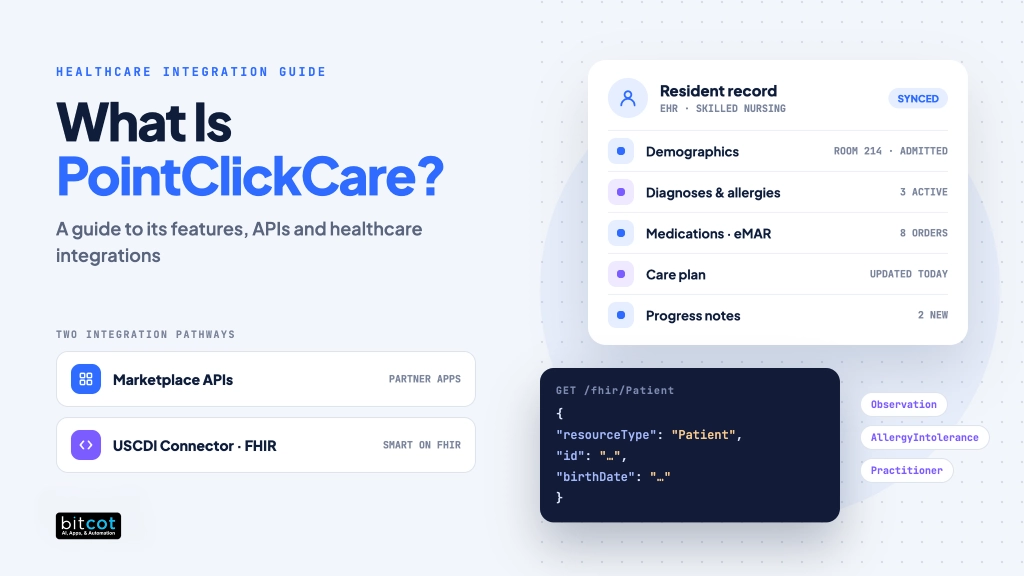
- Marketplace APIs and USCDI Connector FHIR APIs are separate integration pathways.
- Authentication depends on the program, and FHIR apps use SMART on FHIR.
- Plan data mapping, multi-facility access and sandbox testing before production.
- Security and approval requirements should shape the integration from day one.
Healthcare technology is evolving rapidly, and healthcare organizations increasingly depend on digital platforms to manage patient information, coordinate care, streamline operations, and improve clinical outcomes.
However, managing healthcare information across multiple systems remains a significant challenge. Hospitals, skilled nursing facilities, senior living communities, pharmacies, laboratories, and other healthcare providers often use different software platforms. When these systems operate independently, exchanging patient information becomes complicated, time-consuming, and prone to errors.
This is where PointClickCare plays an important role.
PointClickCare is a healthcare technology platform designed to help healthcare providers manage clinical information, administrative operations, billing, and care coordination. It also supports integrations with third-party healthcare applications, allowing organizations to connect different systems and exchange information more efficiently.
For healthcare software companies and developers, PointClickCare offers opportunities to build integrations that connect custom applications with healthcare workflows.
In this guide, we will explore what PointClickCare is, its key features, how its APIs work, the types of healthcare integrations it supports, and the important considerations involved in integrating it with a custom software application.
What Is PointClickCare?
PointClickCare is a cloud-based healthcare technology platform primarily focused on the long-term and post-acute care (LTPAC) industry.
It provides electronic health record (EHR) capabilities and healthcare management solutions that help organizations manage resident information, clinical documentation, medication workflows, billing, and operational activities.
The platform is widely used by:
- Skilled nursing facilities (SNFs)
- Long-term care facilities
- Senior living communities
- Assisted living organizations
- Hospitals and health systems
- Healthcare networks and other care providers
PointClickCare helps healthcare professionals maintain centralized patient and resident records while supporting communication and coordination between different healthcare stakeholders.
For example, when a resident is admitted to a skilled nursing facility, healthcare staff can use PointClickCare to manage demographic information, medical history, diagnoses, medications, assessments, care plans, and progress notes.
Instead of relying entirely on paper documentation or disconnected applications, healthcare teams can work with information available through a centralized digital platform.
Another important aspect of PointClickCare is its integration ecosystem. Through its Marketplace and other approved integration programs, healthcare organizations can connect third-party applications to extend the capabilities of their existing EHR environment.
PointClickCare describes an ecosystem of integration partners that helps healthcare organizations connect solutions across clinical, financial, and operational workflows.
Why Is PointClickCare Important in Healthcare?
Healthcare organizations generate and manage large amounts of information every day. This includes patient demographics, admission details, medication records, diagnoses, laboratory results, clinical notes, billing information, and discharge records.
When this information is distributed across multiple systems, healthcare professionals may need to enter the same information repeatedly or switch between applications to complete routine tasks.
PointClickCare helps address these challenges by bringing important healthcare workflows into a connected technology environment.
Centralized Patient and Resident Information
PointClickCare provides a centralized environment for managing resident and patient information. Authorized healthcare professionals can access relevant records according to their roles and permissions.
Improved Care Coordination
Healthcare providers can coordinate patient care more effectively by accessing relevant clinical information and supporting communication between care teams.
Reduced Manual Data Entry
Integrations with third-party applications can automate information exchange, reducing duplicate data entry and administrative work.
Better Operational Efficiency
Digital workflows help facilities manage admissions, clinical documentation, medication administration, billing, and other operational activities.
Improved Data Accessibility
Approved integrations allow authorized systems to exchange healthcare information, helping providers access relevant data across different stages of the care journey.
Support for Healthcare Interoperability
PointClickCare provides integration pathways that help healthcare organizations connect with external healthcare applications, networks, and service providers.
Key Features of PointClickCare
PointClickCare provides several capabilities designed to support the clinical and operational requirements of healthcare organizations.
Electronic Health Records (EHR)
Electronic Health Records are one of the core components of PointClickCare. The EHR system helps healthcare organizations maintain digital patient and resident records, including:
- Patient and resident demographics
- Medical history
- Diagnoses and allergies
- Vital signs and assessments
- Medication information
- Clinical documentation
- Care plans
- Progress notes
- Immunization records
Having this information available digitally helps healthcare professionals review patient history and make more informed care decisions.
Patient and Resident Management
PointClickCare supports patient and resident management throughout different stages of care. Facilities can manage information associated with new admissions, resident registration, patient transfers, room and bed assignments, discharges, demographic updates, and facility-level resident management. This information is particularly important for applications that need to synchronize patient records between PointClickCare and external healthcare systems.
Clinical Documentation
Clinical documentation is an essential part of healthcare operations. PointClickCare supports workflows that allow authorized healthcare professionals to document patient conditions, assessments, treatment activities, and progress. Examples include clinical notes, nursing documentation, care plans, assessments, diagnosis records, medication-related documentation, and patient progress information. Integrating these workflows with external applications can help reduce repetitive documentation and make relevant clinical information available where it is needed.
Medication Management
Medication management is another important area of healthcare operations. PointClickCare supports medication-related workflows that help facilities manage resident medication information and coordinate with pharmacy services. Depending on the facility’s configuration and available integrations, these workflows can support medication records, medication orders, medication administration, Electronic Medication Administration Records (eMAR), pharmacy coordination, and medication reconciliation. Integration with pharmacy applications can improve communication and help reduce manual information exchange.
Billing and Revenue Cycle Management
Healthcare organizations must manage both clinical and financial operations. PointClickCare provides billing and revenue cycle capabilities that support activities such as billing management, accounts receivable, claims-related workflows, financial reporting, and insurance and eligibility-related workflows. These capabilities help facilities manage administrative processes alongside their clinical operations.
Reporting and Analytics
Healthcare organizations need accurate information to monitor operational performance and make informed decisions. PointClickCare provides reporting and analytics capabilities that help organizations review clinical, financial, and operational information. Depending on the solution and configuration, organizations can use reporting to monitor facility performance, resident information, quality measures, and financial activities.
PointClickCare Marketplace
The PointClickCare Marketplace is an important part of its integration ecosystem. It allows healthcare organizations to discover third-party software solutions that integrate with the PointClickCare platform. Marketplace solutions support different operational requirements, including pharmacy integrations, laboratory and diagnostic services, clinical documentation, therapy management, care coordination, referral management, workforce management, resident and family engagement, and billing and claims management. For healthcare software vendors, becoming an approved PointClickCare integration partner can provide an opportunity to make their applications available to organizations already using the platform.
What Are PointClickCare APIs?
An API (Application Programming Interface) allows two software applications to communicate with each other and exchange information.
PointClickCare provides approved integration pathways that allow third-party applications to connect with its platform and work with authorized healthcare information.
For example, imagine a healthcare organization uses a custom-built patient management application but maintains its official resident records in PointClickCare. Without integration, employees may need to enter the same patient information into both systems.
With an approved API integration, the custom application can communicate with PointClickCare to exchange supported information, subject to authorization, permissions, and the applicable API program.
A typical integration may involve:
- Connecting a third-party application to PointClickCare.
- Authenticating and authorizing the application.
- Retrieving permitted facility or patient information.
- Mapping the information between the two systems.
- Synchronizing supported data.
- Handling updates, errors, and changes.
- Maintaining secure and reliable communication.
PointClickCare API access is governed by its developer programs, approved use cases, and applicable technical requirements. Not every application automatically receives access to every type of data.
Understanding PointClickCare API Integration Options
PointClickCare offers different integration pathways depending on the application, business requirements, and type of information being exchanged. Two important areas to understand are Marketplace integrations and the USCDI Connector FHIR program.
PointClickCare Marketplace APIs
The Marketplace integration program supports approved third-party applications that need to connect with PointClickCare and extend its capabilities. These integrations can support workflows such as patient and resident data synchronization, clinical information exchange, pharmacy communication, therapy application integration, document exchange, referral and admission workflows, and operational data exchange.
For software vendors, the Marketplace pathway is relevant when building an application that needs to integrate with the PointClickCare customer ecosystem. The exact APIs, supported resources, authentication requirements, and access permissions depend on the approved integration program and developer documentation.
PointClickCare FHIR APIs and USCDI Connector
FHIR stands for Fast Healthcare Interoperability Resources. It is a widely used healthcare interoperability standard that defines how healthcare information can be represented and exchanged electronically.
PointClickCare offers a USCDI Connector program for applications that need to build FHIR-based integrations. USCDI refers to the United States Core Data for Interoperability, a standardized set of health data elements intended to support information exchange.
Depending on the application type and authorization, FHIR integrations can support access to standardized healthcare information, including resources such as:
- Patient
- Practitioner
- Organization
- Encounter
- Condition
- AllergyIntolerance
- Observation
- Medication-related resources
The actual resources and operations available must be verified against the current PointClickCare FHIR documentation. FHIR-based integration is especially useful when interoperability and standardized healthcare data exchange are major requirements.
Important: Marketplace APIs and USCDI Connector FHIR APIs are distinct integration pathways. Developers should identify the correct program before beginning implementation rather than assuming that all PointClickCare APIs use the same authentication process or expose the same data.
How Does PointClickCare API Authentication Work?
Authentication is one of the most important parts of any healthcare integration. Since healthcare applications work with sensitive patient information, access must be controlled and authorized.
PointClickCare’s authentication requirements depend on the integration program and application type. For example, FHIR applications use a SMART on FHIR-based authorization approach, while Marketplace integrations follow their applicable developer-program authentication requirements.
An OAuth-based authorization flow may involve the following steps:
- Application registration: The developer registers the application through the appropriate PointClickCare developer program.
- Authorization request: The application initiates the authorization process.
- User authentication: The authorized user signs in to PointClickCare.
- Permission approval: The user grants the requested access, where applicable.
- Authorization code: The application receives an authorization code through the configured redirect URI.
- Token exchange: The application exchanges the authorization code for access and refresh tokens, as supported by the applicable flow.
- API requests: The application uses the access token to make authorized API requests.
- Token management: The application handles token expiration and refresh according to the program’s requirements.
The exact authorization flow, scopes, token lifecycle, and supported grant types must be confirmed from the relevant PointClickCare documentation. For developers, implementing authentication correctly is essential because it determines which data the application can access and how securely that access is maintained.

What Types of Healthcare Applications Can Integrate with PointClickCare?
Custom Healthcare Management Software
Healthcare organizations may use custom-built applications to manage their internal workflows. Integrating these applications with PointClickCare can help synchronize supported patient information and reduce duplicate data entry. For example, a custom patient management application can retrieve authorized patient records and display relevant information within its own interface.
Clinical Documentation Applications
Healthcare organizations may use separate applications for clinical notes, assessments, and documentation. An integration can help transfer supported documents or clinical information between the external application and PointClickCare.
Pharmacy Management Systems
Pharmacies and healthcare facilities need to coordinate medication-related information. PointClickCare integrations can help connect pharmacy systems with relevant medication workflows, subject to the supported integration capabilities.
Laboratory and Diagnostic Systems
Healthcare providers often need to exchange laboratory and diagnostic information with external systems. Integrations can help reduce manual information transfer and improve the availability of relevant results.
Billing and Financial Applications
Custom billing or financial applications can connect with supported PointClickCare workflows to exchange relevant administrative and financial information.
Analytics and Reporting Platforms
Healthcare organizations may use external analytics applications to generate reports and monitor operational performance. With authorized access to supported data, these platforms can help organizations analyze information across different workflows.
How to Integrate PointClickCare with a Custom Healthcare Application
Integrating PointClickCare with a custom application requires more than simply connecting an API endpoint. A successful integration involves understanding the business requirements, obtaining developer access, implementing authentication, mapping healthcare data, and validating the complete workflow.
Step 1: Understand the Business Requirements
Before writing any code, identify what information needs to move between the two systems. Consider whether the application needs patient information, facility information, automatic patient record updates, clinical notes, document synchronization, or support for multiple facilities. Clearly defining the requirements helps determine the appropriate PointClickCare integration program and API resources.
Step 2: Register for the PointClickCare Developer Program
The application developer must follow the appropriate PointClickCare partnership and developer registration process. Depending on the intended use case, this may involve the Marketplace program or USCDI Connector program. The application may need to undergo review and approval before receiving access to the required APIs.
Step 3: Configure Application Authentication
Once access is approved, developers configure the authentication workflow. This may include application credentials, redirect URI configuration, OAuth authorization, access token management, refresh token management where supported, permission and scope configuration, and secure credential storage. Authentication should be implemented according to the exact requirements of the selected integration program.
Step 4: Develop the API Connection
The next step is to establish communication between the custom application and PointClickCare. Developers need to understand the API endpoints, request parameters, response formats, supported operations, and error codes. The application should also implement proper error handling and logging to make troubleshooting easier.
Step 5: Map Healthcare Data Between Systems
Data mapping is one of the most important parts of a healthcare integration. Different applications may represent the same information in different formats. Developers must establish clear mapping rules to ensure that information is transferred accurately. It is also important to preserve source-system identifiers so records can be matched correctly during future synchronization.
Step 6: Implement Data Synchronization
After establishing the connection and mapping rules, developers can implement the required data synchronization workflows. Depending on API capabilities, synchronization may be performed through scheduled API requests, event-driven notifications or webhooks, supported incremental data retrieval, manual synchronization, or bulk data exchange where available. The synchronization strategy should account for new records, updated records, deleted or inactive records, duplicate records, and failed requests. Not every API program supports every synchronization method, so developers should verify the available mechanisms before designing the workflow.
Step 7: Test the Integration in a Sandbox Environment
Testing is essential before moving an integration into production. Developers should validate successful authentication, API request and response handling, patient and facility data mapping, data synchronization, duplicate record prevention, token expiration and refresh, error handling, permission restrictions, multi-facility scenarios, and security controls. Sandbox testing helps identify issues before the integration is used with real healthcare information.
Step 8: Complete Technical Validation and Production Deployment
Depending on the integration program, PointClickCare may require technical validation, security review, or other approval activities. After completing the applicable requirements, the application can proceed toward production activation. The production rollout should include production credentials and configuration, secure environment setup, end-to-end workflow testing, monitoring and logging, error and retry handling, facility authorization and onboarding, and post-deployment validation. A successful deployment should be followed by continuous monitoring to ensure that data synchronization remains reliable.
Common Challenges in PointClickCare Integration
Developer Account and Application Approval
Obtaining access to the required developer program and configuring an application can involve registration, documentation, and approval processes. Developers should identify the required program and its prerequisites before estimating the integration project.
Authentication Changes and Compliance Requirements
Authentication requirements may evolve as platforms introduce new security and compliance standards. An application initially developed using one authentication approach may need to be updated to support a different OAuth authorization flow. Such changes can affect the connection workflow, token management, callback handling, and existing synchronization processes.
Multi-Facility Data Management
Many healthcare organizations operate multiple facilities under one organization. An integration must correctly identify which facility is connected and ensure that information is associated with the appropriate facility. Incorrect facility mapping can result in data being displayed or synchronized in the wrong organizational context.
Data Mapping and Synchronization
Patient information may have different structures across applications. Developers need to handle field mapping, unique identifiers, data formats, missing information, duplicate records, and updates. A clearly defined synchronization strategy is essential for maintaining data accuracy.
API Limitations and Documentation
Not every healthcare workflow is available through every API program. Developers must understand supported endpoints, data permissions, API limitations, and any applicable rate or usage restrictions. Validate assumptions against current technical documentation rather than designing around expected API behavior.
Testing and Technical Validation
Healthcare integrations require detailed testing because errors can affect clinical and operational workflows. Technical validation may involve demonstrating API functionality, explaining individual use cases, answering technical questions, and addressing issues identified during review. Teams should prepare test scenarios and API demonstrations in advance.
Production Environment Differences
An integration that works correctly in a sandbox environment may require additional configuration before production deployment. Production credentials, facility authorization, permissions, configuration, and real-world data scenarios must all be validated.
Security Considerations for PointClickCare Integrations
Healthcare applications process sensitive information, making security a fundamental requirement. When integrating with PointClickCare, developers should consider the following practices:
- Secure authentication: Use the authentication mechanism required by the applicable PointClickCare integration program.
- Access control: Request only the permissions required for the application’s intended functionality.
- Secure token storage: Store access tokens, refresh tokens, and application credentials securely.
- Data encryption: Protect sensitive information during transmission and at rest using appropriate security controls.
- Audit logging: Maintain appropriate records of integration activities and access events.
- Role-based access: Ensure that users can access only the information permitted by their assigned roles.
- Data minimization: Retrieve and retain only the information necessary for the application’s intended purpose.
- Compliance: Evaluate applicable healthcare privacy and security requirements, including HIPAA obligations where applicable.
An integration should be designed with security in mind from the beginning, rather than treating it as a final development step.
Benefits of Integrating PointClickCare with Custom Software
Improved Workflow Automation
Automating supported data exchange reduces repetitive manual tasks and allows healthcare professionals to spend more time on patient care.
Better Data Consistency
Synchronizing information between systems can help reduce inconsistencies caused by maintaining separate records.
Improved Application Functionality
Custom software can extend existing healthcare workflows by connecting its features with information available through PointClickCare.
Reduced Administrative Work
Automated workflows can minimize duplicate data entry and unnecessary switching between applications.
Better Care Coordination
Making relevant information available across authorized systems can support communication and coordination between healthcare stakeholders.
Scalable Healthcare Solutions
A properly designed integration architecture can support additional facilities, users, and workflows as an organization expands, subject to API permissions and platform capabilities.
Why Choose an Experienced Healthcare Integration Development Team?
Building a healthcare integration requires a combination of API development experience, healthcare workflow knowledge, data management expertise, and security awareness.
An experienced development team can help organizations:
- Analyze healthcare integration requirements.
- Select the appropriate PointClickCare integration pathway.
- Implement secure authentication and authorization.
- Develop API communication workflows.
- Map patient, facility, and clinical data.
- Build reliable synchronization mechanisms.
- Handle errors and integration failures.
- Perform sandbox and production testing.
- Support technical validation and deployment.
The goal should not simply be to connect two systems. It should be to build a reliable integration that supports real-world healthcare operations.

Conclusion
PointClickCare plays an important role in the healthcare technology ecosystem, particularly across skilled nursing, senior living, and long-term and post-acute care.
Its EHR capabilities, clinical workflows, medication management features, billing solutions, and integration ecosystem help healthcare organizations manage information and coordinate care more effectively.
For healthcare software companies, PointClickCare APIs provide opportunities to connect custom applications with approved healthcare workflows.
However, successful integration requires careful planning, the right developer program, secure authentication, accurate data mapping, reliable synchronization, and thorough testing.
Whether you are developing a custom healthcare management platform, a clinical documentation application, a pharmacy solution, or an analytics system, understanding the PointClickCare ecosystem is an important first step toward building connected healthcare software.
Frequently Asked Questions (FAQs)
What is PointClickCare used for?
PointClickCare is a healthcare technology platform used primarily by skilled nursing facilities, senior living communities, and other post-acute care providers. It supports electronic health records, clinical documentation, medication management, billing, and care coordination.
Does PointClickCare provide APIs?
Yes. PointClickCare offers approved API integration pathways through programs such as its Marketplace and USCDI Connector. Available APIs and data access depend on the selected program and application approval.
What is PointClickCare FHIR API?
PointClickCare’s FHIR API supports healthcare interoperability through the USCDI Connector program. It enables approved applications to exchange standardized healthcare information using FHIR-based resources.
What is PointClickCare Marketplace?
PointClickCare Marketplace is an ecosystem where healthcare organizations can discover and connect third-party applications that extend the functionality of their existing PointClickCare environment.
Can PointClickCare integrate with custom software?
Yes. Approved third-party applications can integrate with PointClickCare through the applicable developer programs and supported APIs. Custom integrations can support workflows such as patient data exchange, clinical documentation, pharmacy coordination, and reporting.
What authentication method does PointClickCare use?
Authentication depends on the integration program. OAuth-based authorization is used in relevant integration workflows, while FHIR applications use SMART on FHIR authorization. Developers should follow the current documentation for their specific application type.
How long does PointClickCare integration take?
The development timeline depends on the application’s complexity, required APIs, authentication workflow, data mapping, synchronization requirements, and approval or validation process. A simple integration may take less time than a complex multi-facility implementation involving several clinical workflows.
Is PointClickCare integration secure?
PointClickCare provides approved integration programs with defined authentication and access requirements. Developers must implement appropriate authorization, encryption, secure token management, access controls, audit logging, and applicable healthcare privacy safeguards.
Can PointClickCare synchronize patient information in real time?
Real-time or near-real-time exchange depends on the API capabilities and the integration program. Some workflows may support event-driven updates, while others may require scheduled synchronization or API-based retrieval.
What should developers know before starting a PointClickCare integration?
Developers should understand the business requirements, select the correct developer program, review API documentation, confirm authentication requirements, plan data mapping, understand facility-level access, and define a comprehensive testing strategy.