Key Takeaways
- According to IBM’s 2024 Cost of a Data Breach Report, healthcare organizations face the highest average breach cost of any industry at $9.77 million per incident, making security architecture a foundational, non-negotiable requirement before any AI feature is added.
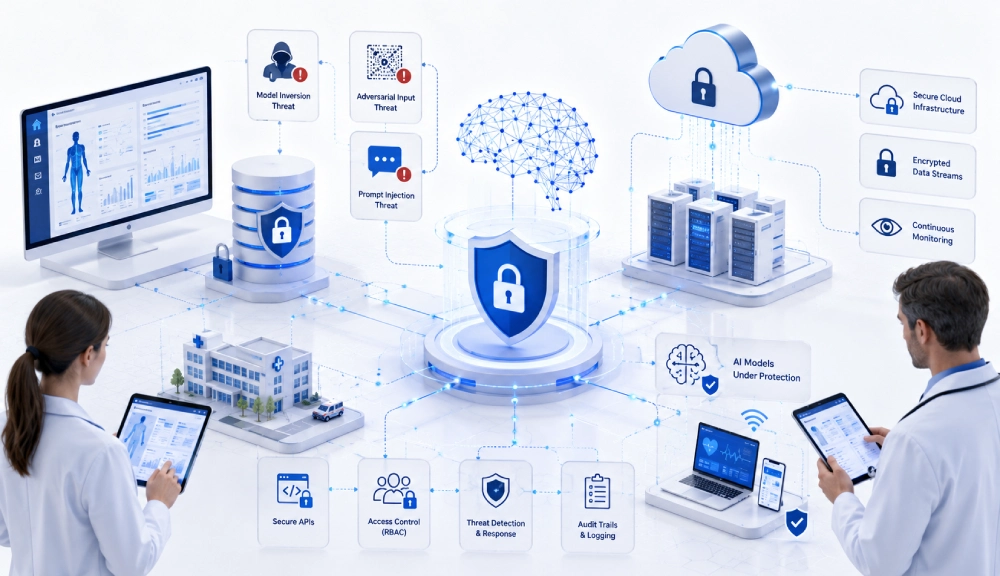
- AI healthcare apps introduce three attack surfaces that traditional security guides ignore: model inversion attacks, adversarial inputs to clinical models, and prompt injection in LLM-based features.
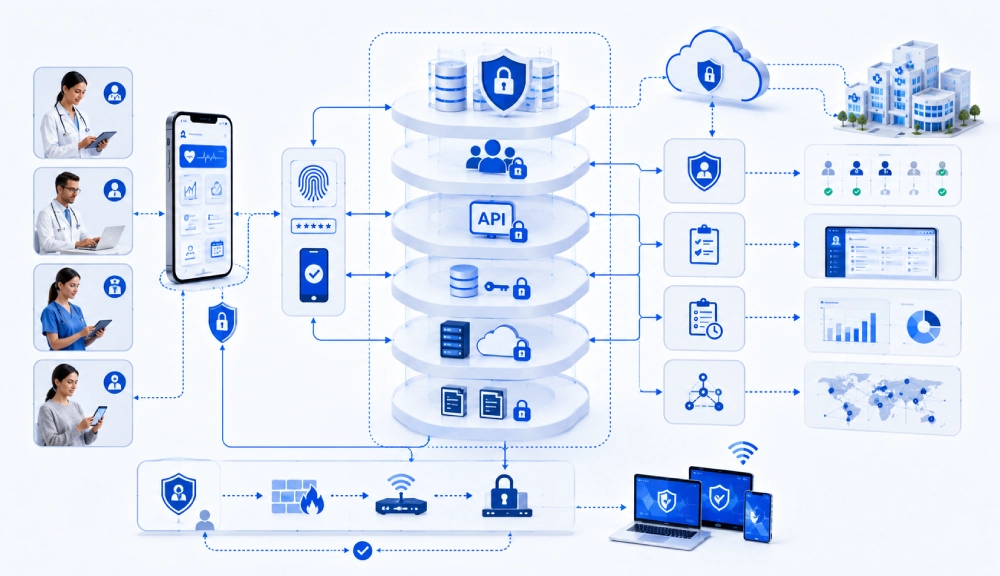
- End-to-end encryption, role-based access control, immutable audit trails, and zero-trust network architecture form the required baseline every secure healthcare app must have before AI capabilities are layered in.
- Healthcare organizations in San Diego, Los Angeles, and San Francisco are among the fastest adopters of AI-powered healthcare apps in the U.S., and those that build security into the architecture from sprint one consistently avoid the costly retrofitting that derails late-stage launches.
- The teams that build trustworthy healthcare AI applications treat security as a design constraint, not a pre-launch checklist. That distinction determines whether an app survives its first year in production.
Introduction
According to IBM’s 2025 Cost of a Data Breach Report, healthcare organizations have held the top position for the most expensive data breaches of any industry for 14 consecutive years, with an average incident cost of $9.77 million. For development teams building AI-powered healthcare applications, that figure is not a background statistic: it is a design constraint that belongs in the first architecture review, not the last.
The challenge facing healthcare app development teams in 2026 is that most available security guidance was written for traditional software. It addresses database encryption, API authentication, and network segmentation, all of which remain necessary. But AI-powered healthcare systems carry threat surfaces that these traditional guides were not designed to address. Machine learning models trained on patient records can expose that data through inference attacks. Clinical AI tools can be manipulated by adversarial inputs. Generative AI features can leak patient records through prompt injection vulnerabilities that simply do not exist in applications without a language model.
This guide covers the specific architecture decisions, technical safeguards, and development practices that healthcare organizations across California and the broader U.S. market are using in 2026 to build AI healthcare applications that are both clinically capable and genuinely secure, starting from the design phase, not the deployment phase.
Why AI Healthcare Apps Face a Different Security Threat Model
Traditional healthcare application security focuses on protecting data at rest and in transit. The approach is well-understood: encrypt the database, secure the API, restrict access by user role, and maintain an audit log of every transaction. That model is correct and foundational, but AI healthcare applications extend the attack surface in three specific ways that most healthcare software vendors have not yet addressed in their standard security offerings.
Model Inversion and Training Data Exposure
A machine learning model trained on patient records can be queried in ways that gradually reconstruct elements of its training data. Security researchers have demonstrated repeatedly that clinical prediction models, those that forecast readmission risk, flag deteriorating patients, or predict diagnosis from symptom data, can be reverse-engineered through structured query patterns, even when the underlying database is fully encrypted and access-controlled. The model itself becomes a data exposure vector that exists entirely outside the controls applied to the storage layer.
Defending against this requires differential privacy techniques applied at the training phase, not controls applied after the model is deployed. Differential privacy adds calibrated statistical noise to training datasets, making it mathematically difficult to reconstruct individual records from model outputs. According to NIST Special Publication 800-188 on de-identifying government datasets, probabilistic anonymization without mathematical privacy guarantees provides substantially weaker protection than formally verified differential privacy, a finding directly applicable to clinical AI models.
Adversarial Inputs to Clinical Models
AI diagnostic tools, those that analyze medical images, classify symptoms, or flag high-risk patients, can be deceived by inputs that have been carefully crafted to produce incorrect outputs. Adversarial machine learning research has shown that small, targeted perturbations to input data can cause a well-trained clinical model to produce a completely different prediction, without any visible change to the input that a human reviewer would detect. In a production healthcare app, this is not an abstract academic concern: a manipulated input that changes a patient’s risk classification from high to low can delay clinical intervention in ways that affect patient outcomes.
Defending against adversarial inputs requires input validation layers that check whether incoming data falls within the distribution of the model’s training set, and uncertainty quantification that flags predictions made on out-of-distribution inputs rather than returning them as high-confidence results.
Prompt Injection in LLM-Based Features
Generative AI features, clinical note summarization, patient communication assistants, and prior authorization drafting tools introduce a vulnerability class that does not exist in traditional healthcare software. Prompt injection attacks embed malicious instructions inside user-supplied content that override the language model’s intended behavior, potentially causing it to retrieve or summarize records it was not authorized to access. Unlike model inversion or adversarial input attacks, prompt injection requires no technical sophistication from the attacker: it can be executed through a patient portal text field by anyone with access to the interface.
Healthcare app development teams that secure only the database and API layers while ignoring these three AI-specific vulnerabilities are building incomplete security models, regardless of how strong their encryption implementation is.
What HIPAA Security Rule Technical Safeguards Require from Healthcare App Development
The HIPAA Security Rule establishes a minimum technical baseline for any software that creates, receives, maintains, or transmits electronic protected health information on behalf of a covered entity or business associate. For healthcare app development teams, the Security Rule’s Technical Safeguards standard is the most directly actionable section: it specifies four categories of control that every healthcare application must implement or formally address.
Access Controls
HIPAA’s Technical Safeguards require that covered entities assign a unique identifier to each user of a healthcare application and establish procedures for obtaining access to ePHI in emergency circumstances. In engineering terms, this means every user action that touches patient data must be traceable to a specific authenticated identity. Shared login credentials, service accounts used by multiple people, and anonymous API keys are all incompatible with this requirement. According to the HHS guidance on access control implementation, automatic logoff, encryption, and decryption are listed as addressable specifications that most healthcare applications should implement as a practical default.
Audit Controls
The Security Rule requires healthcare applications to implement hardware, software, and procedural mechanisms that record and examine activity in information systems that contain or use ePHI. This is not a generic logging requirement: the audit mechanism must produce records that can be analyzed to detect and investigate unauthorized access attempts. Immutable, tamper-evident log storage (append-only storage with cryptographic integrity verification) satisfies this requirement in a way that standard application logs stored in a writable database do not.
Integrity Controls
HIPAA requires that covered entities implement policies and procedures to protect ePHI from improper alteration or destruction. For healthcare applications that include AI-generated outputs (clinical note drafts, automated risk scores, generated care plan recommendations), this extends to ensuring that AI model outputs stored in the patient record are attributable, timestamped, and cannot be silently modified after the fact. Any AI-assisted documentation feature that writes to a patient record must generate an immutable record of what the AI produced, when it produced it, and which model version was used.
Transmission Security
The Security Rule requires that covered entities implement technical security measures to guard against unauthorized access to ePHI during transmission over electronic communications networks. TLS 1.3 is the current standard for meeting this requirement. Older TLS versions (1.0, 1.1) and SSL are no longer considered secure and should not be supported in any healthcare application endpoint. For mobile healthcare applications, this extends to certificate pinning: the app should verify not only that the server’s certificate is valid, but that it matches a specific expected certificate or public key, preventing interception attacks on public or compromised networks.
Understanding these four categories is foundational for any team building AI-powered healthcare applications: the HIPAA Security Rule sets the floor, and the AI-specific attack surfaces described in the previous section represent the ceiling that responsible engineering must also address. A healthcare app that meets the Security Rule baseline but ignores model inversion, adversarial inputs, and prompt injection is technically compliant at the regulatory minimum while remaining genuinely vulnerable in production.

How Do Healthcare Apps Protect Patient Data?
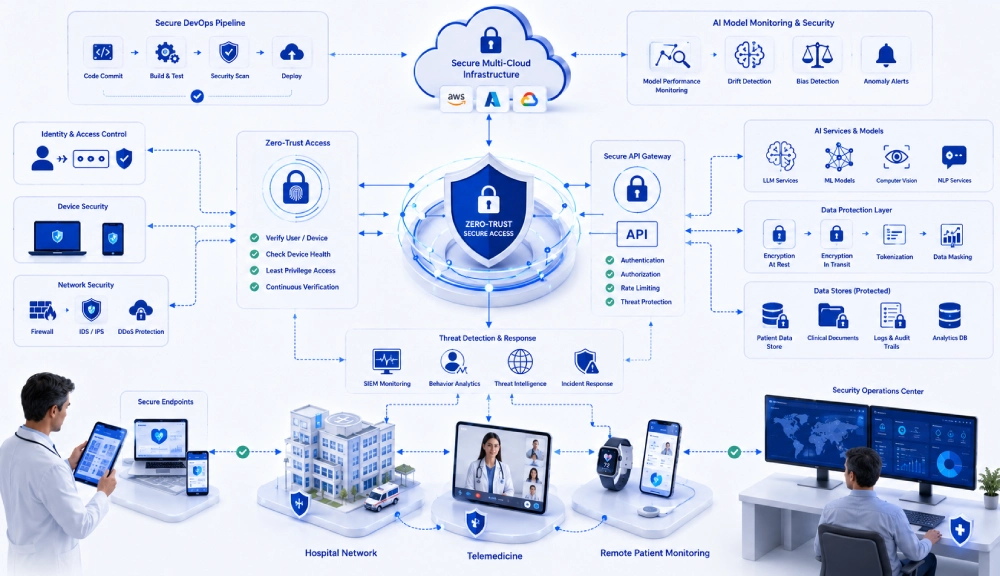
Healthcare apps protect patient data through a layered security architecture that addresses storage, transmission, access control, and, for AI-powered systems, model behavior. The foundational technical layers are non-negotiable requirements for any healthcare application handling electronic protected health information.
Encryption at Rest and in Transit
All patient data must be encrypted using AES-256 for storage and TLS 1.3 for transmission. According to the HIPAA Security Rule published by the U.S. Department of Health and Human Services, encryption of electronic protected health information (ePHI) is an addressable implementation specification under the Technical Safeguards standard. Every healthcare application built in 2026 should treat it as mandatory: the documentation path exists for legacy system constraints, not for new development, where encryption adds no meaningful engineering burden.
Development teams building on AWS, Azure, or Google Cloud Healthcare API can leverage managed encryption key services with automatic key rotation, reducing the operational burden of key management while maintaining cryptographic integrity. The key management architecture, specifically, who controls the encryption keys and under what conditions they can be accessed, is a design decision that has significant security implications and must be resolved before the data model is finalized.
Role-Based Access Control
Not every user of a healthcare application needs access to every record. Role-based access control assigns permissions by function: a patient portal user accesses only their own records, a billing administrator accesses financial records but not clinical notes, and a referring physician accesses only the records shared with them explicitly. OAuth 2.0 and OpenID Connect are the industry-standard protocols for implementing granular, auditable access control in modern healthcare APIs.
The principle of least privilege, each role gets only the access required for its function, and no more, must be enforced at the application logic layer, not only at the database layer. An application that correctly restricts database access but exposes records through an API endpoint that does not check user role is functionally unprotected, regardless of how the database is secured.
Immutable Audit Trails
Every access to a patient record, read, write, export, deletion, or sharing, must be logged in an append-only audit trail that cannot be modified or deleted after the fact. Immutable logging prevents both external attackers and internal users with elevated access from covering their tracks after unauthorized access occurs. Cloud-native services like AWS CloudTrail and Azure Monitor provide this capability with cryptographic integrity guarantees, producing logs that can be verified as unmodified if challenged in a security investigation.
The audit log must capture user identity, timestamp, IP address, record accessed, and the specific action performed. Partial audit logs, those that log writes but not reads, or that log user identity but not record identity, are insufficient for post-incident investigation and create compliance exposure for healthcare organizations subject to federal security requirements.
Zero-Trust Network Architecture
Traditional perimeter-based security assumes that traffic originating inside the network boundary is trusted. Zero-trust architecture assumes it is not, and requires every service-to-service call within the application to authenticate regardless of network origin. For healthcare applications built on microservice architectures, the standard pattern for modern AI-powered systems, zero-trust is especially critical. A single compromised internal service in a perimeter-based system can move laterally through the application and access records it was never designed to handle. In a zero-trust architecture, that lateral movement is blocked by the same authentication requirements that govern external requests.
What AI Features Are Transforming Healthcare Mobile Apps in 2026?
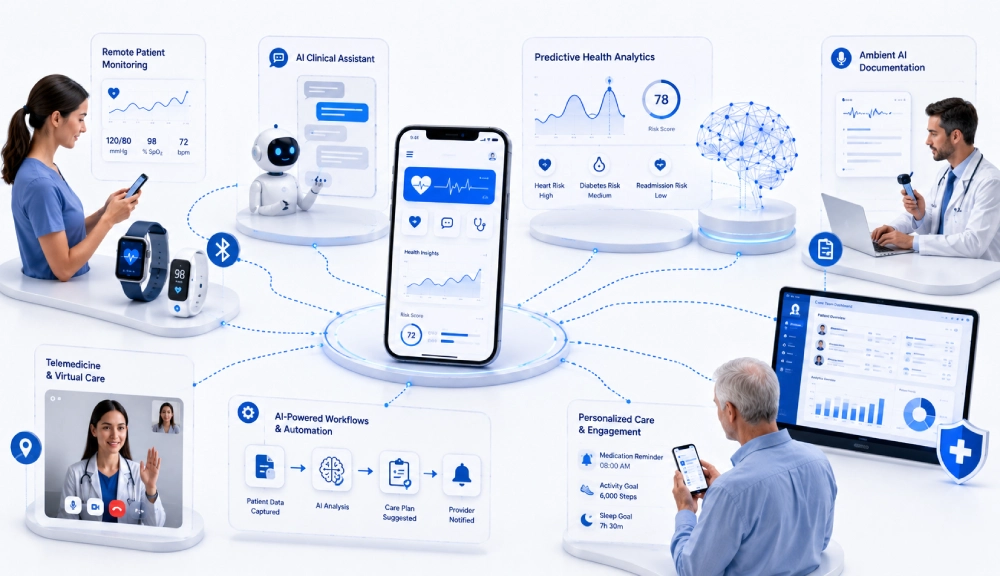
AI is reshaping healthcare mobile applications across five functional areas that were either unavailable or unreliable three years ago. Each of these capabilities creates measurable clinical or operational value, and each introduces specific security requirements that must be addressed at the architecture phase.
Clinical Decision Support at the Point of Care
AI models integrated into EHR-connected mobile apps can surface evidence-based recommendations in real time as a clinician reviews a patient’s record. Drug interaction flags, sepsis risk scores, readmission probability ratings, and differential diagnosis suggestions drawn from similar patient populations are now technically feasible on mobile devices with acceptable latency. According to a 2024 study published in the Journal of the American Medical Informatics Association, AI-assisted clinical decision support tools reduced diagnostic error rates in pilot programs across U.S. academic medical centers, a finding that accelerated adoption timelines for health systems that had been evaluating these tools cautiously.
Automated Prior Authorization
Prior authorization, the process by which insurers must approve procedures before they are performed, is one of the highest-friction administrative workflows in U.S. healthcare. AI-powered prior authorization tools analyze a patient’s clinical record, match it against payer coverage criteria, and submit authorization requests automatically, reducing turnaround from days to hours. Several California-based health systems in Los Angeles and San Diego have reported 60–80% reductions in prior authorization processing time after deploying AI automation layers, according to published case studies from their technology partners. The security requirement here is strict: the AI system is making API calls that carry PHI to external payer systems, and each of those integrations requires its own access control and audit configuration.
Remote Patient Monitoring with Predictive Alerts
Wearable devices paired with AI-powered mobile apps can continuously monitor patients with chronic conditions and generate predictive alerts before a clinical deterioration event occurs. The AI model analyzes trends in biometric data (heart rate variability, blood oxygen saturation, activity patterns) and distinguishes meaningful signals from the noise of normal variation in ways that static threshold-based alert systems cannot. This is particularly valuable for managing high-risk patients outside hospital settings, a priority that has intensified as healthcare organizations in San Francisco, San Jose, and Irvine expand their virtual care programs. According to HealthIT.gov, remote patient monitoring adoption has more than doubled since 2020, creating significant demand for secure, scalable mobile infrastructure to support it.
Ambient AI Documentation
Ambient AI systems that listen to patient-physician conversations and automatically generate structured clinical notes are being integrated into healthcare mobile apps at scale. These systems reduce documentation burden, which, according to HealthIT.gov research on clinician burden, accounts for nearly two hours of after-hours administrative work per physician per day. The security challenge with ambient documentation is that the AI model processes the most sensitive clinical conversation a patient can have (the in-room encounter), and must do so with input filtering, output validation, and session isolation that prevents one patient’s conversation data from influencing or appearing in another patient’s generated notes.
Personalized Patient Engagement Applications
AI-driven patient apps that deliver personalized care plan reminders, medication adherence nudges, and appointment scheduling integrated with educational content tailored to a specific patient’s condition and behavior patterns have demonstrated measurably higher engagement rates than static content delivery. For healthcare organizations in Irvine and Anaheim building direct-to-patient mobile applications, this personalization capability is a key differentiator in a competitive digital health market. Personalizing at the patient level means the AI feature is processing individual health records to generate recommendations, which requires the same inference-layer security controls described in the threat model section above.
How to Prevent Data Leaks in AI-Powered Healthcare Applications
Preventing data leaks in AI healthcare apps requires technical controls at the data layer, the model layer, and the API layer, combined with operational practices that catch the human and third-party vectors that technical controls alone cannot address.
Technical Controls
Data loss prevention tools monitor data flows within and outside the application and block transfers that match patterns associated with protected health information, formats like Social Security numbers, patient name and date of birth combinations, or ICD-10 diagnosis codes. DLP should be deployed at the API gateway, not only at the storage layer, because the most common leak paths in modern healthcare applications run through application logic, not direct database access.
Tokenization replaces sensitive data fields with non-sensitive placeholder values throughout the application, with the actual mapping maintained in a separate, highly secured tokenization vault. A healthcare app can process and display patient data using tokens, with real values resolved only at the moment an authorized function explicitly requires them. This limits the blast radius of any single compromise: an attacker who gains access to a tokenized data store acquires no usable patient information without also compromising the tokenization vault, which is a separate, higher-security target.
For AI-specific leak prevention, model output scanning: applying content classification to every AI-generated response before it is returned to the user, is the most direct technical control. This should be implemented as a standard middleware layer in any healthcare application that uses a language model for any user-facing feature. Output scanning catches prompt injection outcomes, hallucinated record references, and unintended data exposure in generated text before they reach the end user.
Operational Controls
Third-party SDK assessment is one of the most consistently underestimated leak vectors in healthcare mobile development. Healthcare apps routinely integrate third-party libraries for analytics, crash reporting, push notifications, and session recording. Each integration creates a data pipeline to an external party whose security posture is outside the development team’s direct control. Every third-party dependency used in a healthcare application must be assessed for its data handling practices, and the integration must be scoped to share only the minimum data required for that SDK’s specific function, not the default configuration, which is typically optimized for feature richness rather than data minimization.
Access privilege reviews on a quarterly basis catch the gradual accumulation of permissions that occurs when access rights are granted for specific project needs but never revoked after those needs pass. Service accounts, developer accounts, and administrative accounts with access to production patient data are a higher-risk category that warrants monthly review rather than quarterly. The NIST SP 800-53 Access Control family provides a structured framework for implementing periodic access reviews in healthcare technology environments.
For teams engaged in telemedicine software development, the operational challenge is compounded by the fact that the application connects patient-side devices over networks the development team does not control. End-to-end session encryption, certificate pinning to prevent man-in-the-middle interception, and session timeout policies enforced at the server side are required baseline controls for any telehealth application handling live patient data over consumer internet connections.
Choosing the Right Healthcare App Development Company
The decision of which custom software development partner to work with for a healthcare AI application is consequential in ways that extend well beyond technical capability. A development team that builds features correctly but without security architecture built in from the start creates applications that work in testing and fail in production, sometimes in ways that only become visible after a breach.
When evaluating healthcare software vendors in the U.S. market, the questions that matter most are not about feature lists. They are about process: Does the vendor conduct threat modeling before writing code? Do they implement differential privacy for AI training workflows, or do they treat model security as a post-deployment concern? Do they have documented processes for third-party SDK assessment, or do they add dependencies based on convenience? Do they maintain immutable audit trails in staging environments, or only in production?
The answers to these questions reveal whether a vendor treats security as an engineering discipline embedded in their development process, or as a compliance exercise performed at the end of a project. For healthcare organizations in Sacramento, Oakland, and Long Beach building AI applications that handle sensitive patient data at scale, the distinction is not theoretical. It determines the real-world security posture of the application in production.
Organizations looking to build AI/ML-powered healthcare solutions should request to review threat model documentation from previous engagements, ask specifically about AI attack surface coverage, and evaluate whether the vendor’s security architecture discussions happen in the discovery phase or only after functional requirements are locked in. The timing of that conversation is one of the clearest signals of how a vendor actually approaches security, as opposed to how they describe it in a proposal.
Our Perspective
Building secure AI healthcare applications requires a mindset that most development teams have to deliberately cultivate: security as architecture, not security as audit. At Bitcot, we have built healthcare applications for organizations ranging from specialty practices in San Diego to multi-state telehealth platforms serving patients across California and New York. The pattern we encounter most consistently is that security planning is deferred to the wrong phase.
Teams design the data model, the AI features, the user experience, and the third-party integrations, and then bring in a security review as a pre-launch gate. By that point, the decisions that matter most have already been made and deployed to staging. The data schema determines what is stored and, therefore, what can be exposed. The model architecture determines which attack surfaces exist. The API design determines what can be queried and how often. A late-stage security review can catch misconfigured permissions and missing encryption headers, but it cannot rebuild the architecture that those decisions produced.
The teams that build healthcare AI applications, we are confident in treating security as a constraint on feature design from the first sprint. That single shift, security architecture before feature architecture, is what separates applications that remain trustworthy in production from applications that require emergency patching six months after launch.
Conclusion
Healthcare app development in 2026 is AI development, and AI development in healthcare is security development. The threat surface has expanded beyond what traditional healthcare software security models were designed to address. Model inversion attacks, adversarial inputs, and prompt injection are real, documented vulnerabilities that require specific architectural responses, and those responses must be designed before the first feature is built, not discovered after the first incident.
The organizations building AI healthcare applications that hold up in production are the ones that understand this sequence: security architecture first, then feature development, then deployment. For healthcare organizations and technology teams across California and the United States, the path to a trustworthy, capable AI healthcare application runs through the design phase. Building that foundation with the right architecture and the right development partner is what makes the difference between an application that serves patients well and one that creates exposure they never consented to carry.
Frequently Asked Questions
What is healthcare app development?
Healthcare app development is the process of designing, building, and deploying software applications that serve patients, clinicians, and healthcare organizations, spanning patient portals, clinical decision support tools, telehealth platforms, EHR integrations, remote monitoring systems, and AI-powered administrative and diagnostic features. Modern healthcare app development requires integrating data security controls, interoperability standards like HL7 FHIR, and increasingly, AI and machine learning capabilities that analyze clinical data and support real-time decision-making at the point of care.
What is the difference between AI healthcare app security and traditional healthcare app security?
Traditional healthcare app security focuses on protecting data at rest and in transit through encryption, role-based access control, and audit logging. AI healthcare app security requires all of those same controls plus three additional layers: differential privacy for model training datasets, input validation and adversarial detection for clinical AI models, and prompt injection filtering for any application feature that uses a language model. Skipping the AI-specific layers while implementing only the traditional controls leaves the application technically encrypted but functionally exposed through its machine learning components.
How does AI improve security in healthcare mobile applications?
AI improves healthcare application security by enabling anomaly detection systems that identify unusual access patterns in real time and flag potential data exfiltration attempts before they complete. AI-powered security monitoring can analyze millions of access and query events per day, surfacing the small subset that represent genuine threats: a task that is impractical for rules-based systems at the transaction volumes modern healthcare applications generate. As described in this article, AI can also be applied to output scanning and input validation to catch AI-specific vulnerabilities like prompt injection before they reach the end user.
How are California healthcare organizations approaching AI healthcare app development in 2026?
Healthcare organizations in San Diego, Los Angeles, San Francisco, and San Jose are among the fastest adopters of AI-powered healthcare applications in the United States, driven by a dense concentration of health systems, venture-backed digital health companies, and proximity to the technology sector. California’s strong data privacy environment creates additional pressure on development teams to implement rigorous data minimization and access control practices, pushing California-based healthcare software vendors to build security architecture that exceeds the standards common in other markets. Remote patient monitoring, ambient AI documentation, and automated prior authorization are the three AI capabilities seeing the most active deployment across California health systems in 2026.
Is custom healthcare app development worth the investment compared to off-the-shelf platforms?
Custom healthcare app development is worth the investment when your organization’s clinical workflows, data model, or AI security requirements do not align with what packaged platforms offer, which is the case for most healthcare organizations operating at scale or with specialized clinical needs. Off-the-shelf platforms optimize for the median use case, which means they make architecture decisions for you, including security architecture decisions. Custom development gives healthcare organizations full control over the security model, specifically over AI attack surface coverage, third-party integration scope, and data minimization strategy, in ways that SaaS platforms with shared infrastructure cannot provide.