Key Takeaways
- A healthcare CRM strengthens patient engagement by automating communication, follow-ups, referral management, and care coordination throughout the patient journey.
- Unlike an EHR or patient portal, it focuses on relationship management, helping healthcare organizations improve retention, operational efficiency, and patient experience.
- Core capabilities include patient management, workflow automation, AI-powered insights, analytics, interoperability, and HIPAA-compliant security.
- Development success depends on aligning business goals, clinical workflows, system integrations, compliance requirements, and long-term scalability before implementation.
- Whether customizing an existing platform or building one from scratch, the right approach should support your organization’s workflows, technology ecosystem, and future growth.
When patient communication relies on spreadsheets, manual reminders, and disconnected systems, operational problems begin to surface quickly.
Calls go unanswered, referrals get delayed, follow-ups are missed, and staff spend more time searching for information than supporting patients.
The issue isn’t staff effort. It’s that the underlying tools weren’t designed to support patient engagement at scale. It happens because patient relationships are being run on tools that were never built for healthcare.
That’s the gap a patient engagement platform is designed to address. It doesn’t replace your EHR, and it isn’t another dashboard nobody opens. It sits between “the patient has an appointment” and “the patient actually shows up, understands their care plan, and comes back when they need to”, the relationship layer most clinical software ignores.
Our healthcare software development team gets pulled into this conversation almost always at the same moment: a practice or health system has outgrown spreadsheets and call logs, and their EHR simply isn’t built to manage engagement at scale.
Whether you’re building a CRM for a hospital, clinic, multi-specialty practice, or pharmaceutical organization, the next step is determining what your platform should actually solve, what it should include, what it costs, and how to avoid turning it into a compliance headache. That’s what this guide walks through.
What Is Healthcare CRM Software?
Healthcare CRM software helps hospitals, outpatient clinics, specialty practices, diagnostic centers, and pharmaceutical companies manage patient and customer relationships throughout the healthcare journey. , separate from the clinical documentation an EHR handles. Where a clinical records system records what happened during a visit, a Healthcare Relationship Management Platform manages what happens between visits: the reminders, follow-ups, and outreach that keep a patient engaged and coming back.
It works by pulling patient and interaction data from multiple sources: the electronic health record, the patient portal, call logs, website forms, marketing campaigns, and organizing that data around the patient rather than a single encounter. From there, it triggers automated or staff-driven actions: a reminder text before an appointment, a re-engagement email after a missed visit, a referral alert to a coordinator.
Most systems include a unified patient record for communication history, rules-based or AI-driven outreach automation, dashboards tracking engagement and retention, and integration pipelines that sync with clinical systems, billing platforms, and telehealth solutions.
The purpose behind all of it is simple: reduce the gap between care recommended and care received, because every missed follow-up is lost revenue and a missed chance to keep someone healthy.
How Healthcare CRM Software Improves Patient Engagement and Operations
Each provider has unique operational requirements, patient engagement goals, and technology needs, which is why there is no one-size-fits-all approach. Successful implementations begin by aligning workflows, patient engagement goals, integration needs, and compliance requirements.
As demand for connected care grows, healthcare organizations are adopting solutions that improve patient relationships and streamline operations.
According to Grand View Research, the global healthcare CRM market size was estimated at USD 21.5 billion in 2025 and is projected to reach USD 35.7 billion by 2033, growing at a CAGR of 6.2% from 2026 to 2033. Growth is driven by rising demand for structured data and automation in healthcare organizations.
Core Business and Operational Benefits:
- Improve Patient Engagement: Automates appointment reminders, follow-up messages, health education, and medication adherence reminders, keeping patients engaged throughout their care journey without increasing administrative workload.
- Reduce Referral Leakage: Tracks referral status, alerts care coordinators to incomplete referrals, and automates reminder workflows, helping more patients complete specialist visits while reducing lost revenue.
- Automate Administrative Workflows: Handles repetitive tasks such as appointment confirmations, insurance verification reminders, patient intake communication, and routine follow-ups, allowing staff to spend more time on patient care.
- Strengthen Care Coordination: Provides a unified view of patient interactions across providers, departments, and locations, making it easier for care teams to collaborate and maintain continuity of care.
- Increase Patient Retention: Identifies patients at risk of disengagement by monitoring missed appointments, declining portal activity, and communication history, enabling proactive outreach before patients leave the practice.

Healthcare CRM vs EHR vs Patient Portal: What’s the Difference
An EHR, a patient portal, and a Healthcare Relationship Management Platform each serve a different purpose, even though all three use patient data. An EHR manages clinical records and care documentation. A patient portal provides secure patient access and self-service. A CRM drives patient engagement through communication automation, referral management, care coordination, and personalized follow-up throughout the patient journey.
By now, you may be wondering, “If I already have an EHR, do I really need a healthcare CRM?” It’s a fair question because these systems often work with the same patient information. The difference lies in what they’re designed to accomplish.
| System | Primary Purpose | Who Uses It Most | Core Data |
|---|---|---|---|
| EHR | Clinical documentation and care delivery | Physicians, nurses, clinical staff | Diagnoses, treatment history, lab results, prescriptions |
| Patient Portal | Patient self-service access | Patients | Scheduling, lab results, secure messaging |
| Healthcare CRM | Relationship management and engagement | Marketing, front desk, care coordination | Communication history, engagement behavior, referral status |
Each system plays a different role, and together they create a more connected patient experience.
Also Read: How to Build Patient Portal Software for Healthcare Organizations: Services & Cost
Healthcare CRM software development Features Every Healthcare Organization Should Prioritize
What matters most isn’t how many features you include, but whether each one helps solve real operational challenges, improves the patient experience, and supports more efficient day-to-day healthcare operations.
However, most successful platforms include the following core capabilities:
- Patient Management: Creates a unified patient profile by combining demographics, communication history, engagement data, and clinical information from connected EHR systems such as Epic, Oracle Health (Cerner), and athenahealth through FHIR and HL7 integrations.
- Communication Automation: Automates appointment reminders, follow-up messages, health campaigns, SMS, email, and patient portal notifications using workflow automation, communication APIs like Twilio, and configurable patient engagement rules.
- Appointment & Follow-Up Management: Reduces missed appointments with scheduling integrations, automated reminders, waitlist management, no-show recovery, and recall campaigns connected through APIs with existing healthcare systems.
- Referral Management: Tracks referrals from initiation to completed visits by connecting with EHR platforms, provider networks, and healthcare data exchange systems using interoperability standards such as FHIR and HL7.
- Care Coordination: Helps providers, specialists, and care teams collaborate through shared patient information, secure messaging, care management workflows, and integrations with clinical systems.
- Analytics & Reporting: Measures patient engagement, no-show rates, referral performance, and operational KPIs through real-time dashboards powered by analytics tools such as Power BI or Tableau.
- AI-Powered Automation: Uses AI and predictive analytics technologies to identify patient risks, recommend outreach actions, automate communication workflows, and support data-driven decisions.
- Security & Compliance: Protects protected health information (PHI) through role-based access control, encryption, audit logs, secure cloud infrastructure such as AWS or Azure, and HIPAA-compliant security practices.
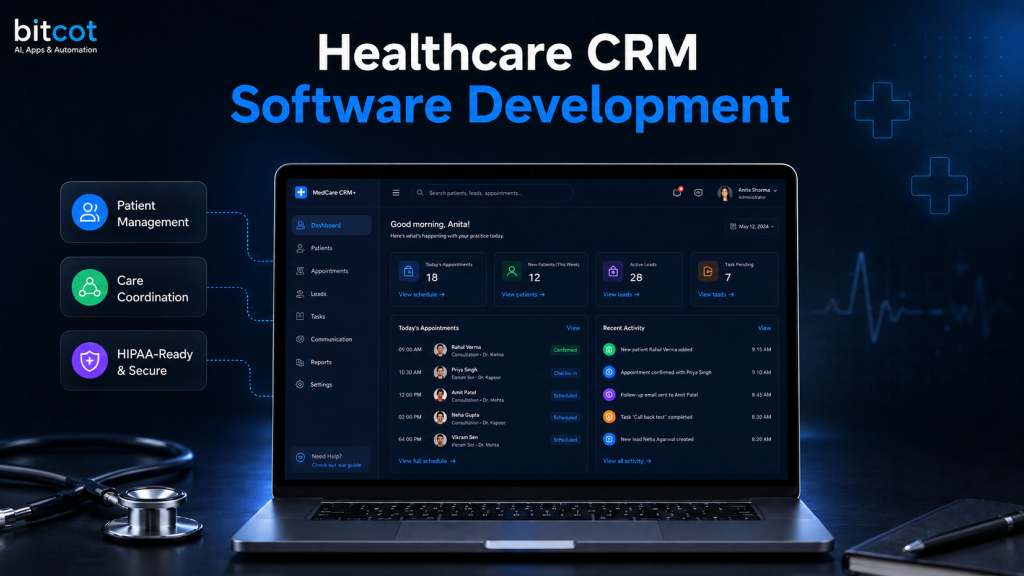
Individually, these capabilities solve specific problems. Together, they create a connected patient engagement workflow. MD NeCT illustrates how these capabilities work together in a single platform.
The platform combines patient management, appointment scheduling, secure communication, and care coordination into one connected workflow, giving providers better visibility into patient interactions while making the care experience simpler for patients.
Building Healthcare CRM Software: A Step-by-Step Process
Every healthcare industry, including hospitals, outpatient clinics, and pharmaceutical divisions, has unique workflows, patient engagement challenges, and technology ecosystems.
That’s why successful implementations begin with discovery, aligning business objectives, clinical operations, integration requirements, and compliance expectations before moving into execution.
That’s why the development process begins with understanding your organization’s goals and workflows before a single line of code is written.
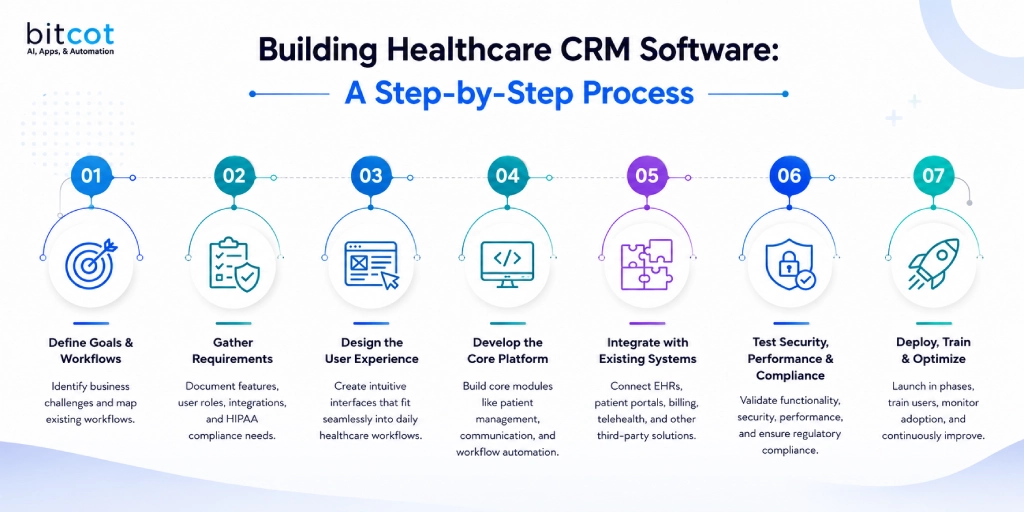
Step 1: Define Business Goals and Workflow Requirements
Start by identifying the challenges you want to solve, such as missed follow-ups, referral leakage, or inefficient patient communication. Map existing workflows and determine how they will support staff and patient interactions.
Step 2: Gather Functional and Compliance Requirements
Define user roles, required features, integrations, automation rules, and HIPAA compliance requirements. This stage creates the blueprint for the entire project.
Step 3: Design the User Experience
Create intuitive interfaces that fit naturally into daily healthcare workflows. Interfaces should fit naturally into everyday workflows, allowing staff to complete common tasks with fewer steps and encourage user adoption across clinical and administrative teams.
Step 4: Develop the Core Platform
Build the Customer Relationship Management software in iterative phases, starting with core modules such as patient management, communication, and workflow automation before expanding to advanced capabilities.
Step 5: Integrate with Existing Healthcare Systems
Connect the software with EHRs, patient portals, billing platforms, telehealth solutions, and other third-party applications to ensure seamless data exchange and interoperability.
Step 6: Test Security, Performance, and Compliance
Validate every workflow through functional, integration, performance, and security testing while ensuring the platform meets HIPAA and other regulatory requirements.
Step 7: Deploy, Train, and Optimize
Launch the software in phases, provide staff training, monitor adoption, collect feedback, and continuously improve the platform as workflows, integrations, and compliance requirements evolve.
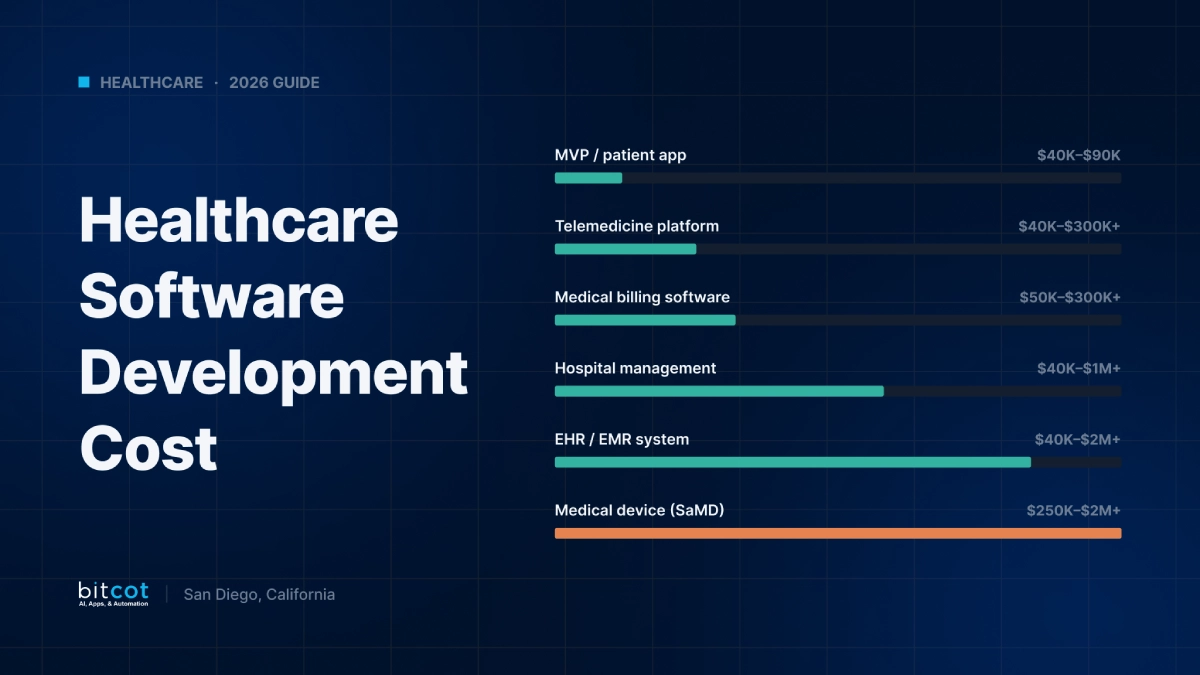
What Really Drives Healthcare CRM Development Costs?
Overall investment depends on what you want the platform to achieve, the level of customization required, and the complexity of the workflows involved.
A solution built around essential patient engagement needs may require a smaller budget, while a more advanced platform with intelligent automation, seamless system connectivity, data-driven insights, and enterprise-level security demands a higher level of planning, development, and ongoing support.
| Cost Factor | How It Impacts Development Cost |
|---|---|
| Features and Complexity | A basic CRM with patient records, reminders, and communication tools costs less than a platform with AI analytics, automation, and advanced care coordination workflows. |
| Healthcare System Integrations | Connecting with EHRs, billing platforms, telehealth tools, and other systems often requires additional development, testing, and compliance considerations. |
| Security and Compliance | HIPAA requirements, encryption, access controls, and audit logs increase development effort to protect sensitive patient information. |
| AI and Automation Features | Predictive analytics, intelligent recommendations, and automated workflows add both initial development costs and ongoing optimization needs. |
| Data Migration and Customization | Moving existing data and tailoring workflows to match your organization’s processes can impact project timelines and budget. |
Should You Build Custom or Configure an Existing CRM Platform?
An early strategic decision is whether to customize an existing platform or build one from scratch.
Neither approach is universally better; the right choice depends on your operational requirements.
It comes down to how your teams work today, how much flexibility you need tomorrow, and whether an existing platform can support your long-term goals without forcing compromises.
A better way to evaluate both options is to compare them against your workflows, integrations, and long-term growth plans and ask which one fits your organization better. The table below compares how each approach differs across healthcare workflows, integrations, implementation time, scalability, and long-term cost.
| Factor | Existing/Configured | Custom-Built |
|---|---|---|
| Healthcare workflows | Limited to platform defaults; often needs workarounds | Built precisely around your care model |
| Integrations | Additional configuration or connectors needed | Built natively for your EHR and billing stack |
| Time to launch | Faster initial deployment | Longer build, less rework later |
| Scalability | Dependent on vendor roadmap | Full control |
| Ongoing cost | Predictable licensing, can scale with users | Higher upfront, no per-user markup |
If your organization follows well-established workflows and needs to move quickly, customizing an existing CRM is often the most practical choice. But if your care model is highly specialized, your operations span multiple locations, or you need complete control over workflows and integrations, a custom-built Healthcare Relationship Management Platform is usually the better long-term investment.
Every medical sector operates differently, so the right CRM strategy starts with understanding how yours works. Our specialists evaluate your care workflows, existing systems, and integration needs before recommending whether customizing an existing platform or building a custom CRM is the better fit. If you’re ready to explore the right approach for your organization, get in touch with our team.
Conclusion
A healthcare CRM is more than a communication platform. When designed around the way your organization delivers care, it strengthens patient engagement, supports care coordination, and helps reduce the operational gaps that affect both outcomes and revenue. Whether you customize an existing platform or build a solution from the ground up, long-term success depends on choosing technology that fits your workflows, not forcing your workflows to fit the technology.
Understanding how patients move through your organization provides the foundation for every successful CRM initiative. Once those workflows are mapped, it becomes much easier to identify the capabilities, integrations, and automation needed to create a more connected and efficient patient experience.
Frequently Asked Questions
How does a healthcare CRM integrate with existing systems?
A healthcare CRM works as an engagement layer that connects with existing systems instead of replacing them. It uses APIs and standards like HL7 and FHIR to exchange data with EHRs, billing platforms, patient portals, and telehealth tools. This allows healthcare organizations to automate communication, track referrals, and coordinate care using accurate patient information across their technology ecosystem.
What are the HIPAA compliance requirements for a healthcare CRM?
A HIPAA-compliant healthcare CRM must protect protected health information (PHI) through security measures such as encryption, role-based access controls, audit logs, secure authentication, and activity monitoring. These controls help prevent unauthorized access while ensuring patient information remains secure across communication workflows, integrations, and data storage environments.
How does healthcare CRM differ from traditional CRM?
A traditional CRM is designed to manage sales, marketing, and customer relationships, while a healthcare CRM is built around patient engagement and care workflows. Healthcare organizations require specialized capabilities such as EHR integration, referral tracking, secure communication, appointment outreach, and compliance-focused data management that general CRM platforms typically do not provide.
What role does AI play in patient engagement and care coordination?
AI helps healthcare organizations move from reactive communication to proactive patient engagement. It can identify patients who may miss appointments, highlight care gaps, prioritize outreach, and automate routine interactions. By analyzing patient behavior and engagement patterns, AI helps care teams deliver more timely support while reducing administrative workload.
What should you look for in a healthcare CRM development partner?
A healthcare CRM development partner should have experience with healthcare workflows, interoperability standards, security requirements, and compliance regulations. Look for expertise in HL7/FHIR integrations, secure architectures built with HIPAA guidelines, cloud security, and scalable software development. The right partner helps build a solution that fits your operational needs rather than forcing your workflows into a generic platform.
What should you consider when developing a mobile healthcare CRM Application?
A mobile healthcare CRM application should make patient engagement and care coordination accessible beyond the desktop. Organizations should consider secure authentication, real-time data synchronization, mobile notifications, secure messaging, role-based access, and integration with existing healthcare systems. The goal is to help providers and care teams manage interactions efficiently from anywhere.
What are the latest healthcare CRM software development trends for 2026?
Healthcare CRM development in 2026 is moving toward AI-powered engagement, predictive analytics, workflow automation, and deeper system interoperability. Organizations are focusing on platforms that can identify patient needs earlier, automate repetitive tasks, provide real-time insights, and create more connected experiences across the healthcare journey.
How much does it cost to develop healthcare CRM Software?
Healthcare CRM software typically takes 3 to 9 months to develop, depending on the platform’s complexity, features, EHR integrations, customization, security requirements, AI capabilities, and compliance needs. Simpler patient engagement solutions can be delivered more quickly, while enterprise platforms with workflow automation, advanced analytics, and custom integrations require additional planning, development, testing, and validation to ensure long-term scalability, performance, and regulatory compliance.