Key Takeaways
- Over 540 healthcare PHI breaches were reported to HHS in 2023 alone.
- Most breaches trace to organizational gaps, not missing technical tools.
- HIPAA security rules define a minimum baseline, not complete PHI protection.
- San Diego healthcare organizations face growing cross-system PHI exposure risk.
- Medical data compliance built into procurement outlasts compliance added after deployment.
Introduction
The HHS Office for Civil Rights received reports of more than 540 healthcare data breaches in 2023, collectively exposing the records of over 112 million patients. That number does not reflect a failure of technology alone. It reflects a pattern visible across healthcare organizations of every size: PHI data protection is documented on paper, reviewed in audits, and then routinely undermined by how people, vendors, and systems actually behave in practice. The organizations that protect patient data most effectively are not the ones with the most sophisticated tools. They are the ones where PHI protection is treated as an organizational discipline rather than a compliance checkbox.
Healthcare organizations in San Diego and across California operate in one of the most active digital health markets in the country, which also makes them high-value targets for PHI data exposure incidents. The stakes are high because healthcare data is permanent: a patient’s diagnosis history, insurance identifiers, and care records cannot be reissued or invalidated after exposure the way a credit card can. How healthcare companies protect PHI data in practice involves a combination of regulatory requirements, security controls, vendor governance, and workforce behavior that no single framework fully covers.
This article examines the real-world gap between what healthcare risk management programs document and what they actually enforce, focusing on the organizational and operational decisions that determine whether patient data privacy holds up under real conditions.

What PHI Data Is and Why Healthcare Organizations Are Persistently Targeted
Protected Health Information includes any data that links an identifiable individual to their health status, care history, treatment details, or payment records. This definition is broader than most people expect: appointment scheduling records, insurance claim identifiers, prescription histories, billing data, and even patient intake forms all qualify as PHI when they can be tied to an individual’s identity. The breadth of what counts as PHI creates a data protection surface that extends across every operational system in a healthcare organization’s ecosystem.
Healthcare data commands significantly higher value in illicit markets than financial data because of its permanence and the density of exploitable information it contains. According to IBM’s Cost of a Data Breach Report, healthcare organizations have recorded the highest average breach cost of any industry for 14 consecutive years. That financial exposure reflects both the value of the underlying data and the operational complexity of containing a breach across a large, interconnected healthcare environment.
PHI data protection begins with knowing exactly where all patient data resides within an organization’s systems. Many healthcare organizations cannot answer that question with confidence because PHI accumulates across EHR platforms, billing systems, scheduling tools, laboratory applications, and vendor integrations without a centralized inventory. Healthcare automation solutions can map data flows across interconnected clinical and operational systems, making it possible to identify where PHI is stored, transmitted, and accessed before an incident exposes those gaps.
How Healthcare Companies Conduct PHI Risk Assessments
A PHI risk assessment is a structured analysis of where Protected Health Information exists within an organization, how it moves between systems, who can access it under what conditions, and which events could lead to unauthorized exposure. Healthcare risk management programs that treat risk assessments as a continuous operational practice rather than an annual documentation exercise consistently demonstrate fewer PHI incidents over time. The distinction matters because the threat environment changes continuously while point-in-time audits capture only a snapshot.
Effective risk assessments evaluate four distinct exposure categories: unauthorized access from external attackers or internal misuse; transmission risks from data moving between systems, vendors, or devices; physical access risks from unsecured endpoints and removable media; and application vulnerabilities from unpatched software or misconfigured integrations. According to NIST Special Publication 800-66, conducting a meaningful risk assessment requires direct engagement with the technical teams managing each system, not just a policy review at the organizational level. A risk assessment that does not examine individual system configurations and integration points produces a false sense of PHI data protection coverage.
Healthcare organizations in Los Angeles and San Diego that operate across multiple care settings face compounded exposure: PHI flows between hospital information systems, telemedicine software development environments, remote care platforms, and third-party diagnostic tools, and each integration point represents a potential gap in healthcare risk management coverage. A risk assessment framework that maps these data flows explicitly, rather than treating each system in isolation, identifies the cross-system exposure pathways that single-system audits consistently miss. Organizations that complete this exercise discover that their highest-risk PHI exposure points are almost never the ones that received the most security investment.
HIPAA Security Rules Explained: What They Require and What They Leave Open
The HIPAA Security Rule establishes three categories of required safeguards for covered entities and business associates. Administrative safeguards address how organizations manage workforce access, conduct training, and respond to incidents. Physical safeguards govern facility access controls, workstation policies, and device security. Technical safeguards define requirements for access controls, audit controls, integrity controls, and transmission security. These three categories create a compliance floor, not a complete PHI data protection program.
According to the HHS HIPAA Security Rule guidance, the most frequently cited violations in enforcement actions involve failure to conduct risk analyses, inadequate audit controls, and unauthorized access stemming from insufficient workforce training. These are organizational failures, not technical ones. HIPAA security rules explained at the enforcement level consistently show that organizations fail most often not because their technology was insufficient but because their governance of that technology was not functioning as documented.
The gap between HIPAA requirements and fully effective PHI data protection is significant and intentional: the rule is designed to be scalable across organizations of very different sizes and technical capabilities, which means it cannot prescribe the level of detail that robust PHI protection requires. The rule requires audit controls but does not specify what behavioral anomalies must trigger review. It requires access controls but does not define how granular those controls must be at the field or service level. EHR EMR software development teams must make these implementation decisions independently, and those decisions determine whether the organization’s patient data privacy is structurally sound or merely documented.
Security Practices Healthcare Organizations Use to Protect Patient Data Privacy
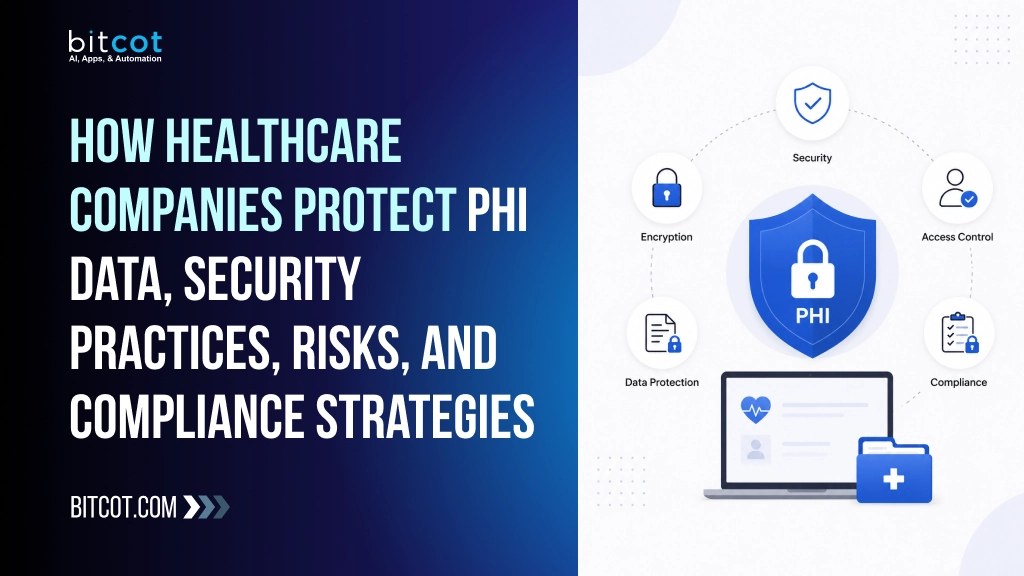
Effective PHI data protection combines technical controls with organizational governance, and neither layer alone is sufficient. On the technical side, this means role-scoped access credentials, encrypted data transmission, behavioral audit logging, automated anomaly detection, and configuration management for all systems that touch PHI. On the governance side, it means documented workforce training, third-party data use agreements, formal incident response procedures, and internal audits that verify controls are functioning as designed rather than as documented.
Workforce behavior is the most underinvested area in most healthcare risk management programs. Organizations that run quarterly security awareness training, including phishing simulations and scenario-based PHI handling exercises, see measurably lower rates of employee-driven PHI disclosure than those that rely on annual training modules alone. AI automation in healthcare is increasingly used to deliver role-adaptive security training: clinical staff, administrative staff, and technical teams receive training calibrated to the specific PHI they access, the systems they use, and the threat patterns most relevant to their function.
Patient data privacy also depends on how healthcare organizations govern their vendor relationships. Every third-party application that accesses, stores, or transmits PHI extends the organization’s protection perimeter into an environment it does not directly control. Organizations that define specific PHI handling requirements in vendor contracts, audit vendor access logs independently, and require vendors to notify them of incidents within defined windows are significantly better positioned than those that rely on general contractual language to convey PHI data protection expectations. Custom software development engagements involving PHI should include data handling specifications as acceptance criteria, not post-deployment additions.

How Hospitals Ensure Patient Data Privacy Across Distributed Systems
Large hospital systems operate dozens of connected applications simultaneously: EHR platforms, billing systems, laboratory information systems, imaging platforms, scheduling tools, and patient communication portals. PHI flows continuously between these systems, and each integration point is a potential patient data privacy gap. How hospitals ensure patient data privacy across this environment depends almost entirely on whether data access boundaries are enforced at the integration layer or whether each connected system is assumed to be trusted once it is inside the network.
According to the FTC Health Breach Notification Rule, the obligation to protect and disclose PHI exposure extends to health technology vendors and application developers, not only to traditional covered entities. This regulatory scope reflects a structural shift: patient data privacy in modern healthcare is no longer determined by a single health system’s controls but by every application that connects to a patient’s record. Hospitals that map their integration architecture to identify where PHI crosses organizational boundaries are both better prepared to prevent breaches and better equipped to respond when one occurs.
Role-based access at the integration layer is the most direct way hospitals ensure patient data privacy across connected systems: each application receives only the specific PHI fields necessary for its function. A scheduling platform does not need access to diagnosis codes, and a billing system does not require clinical notes. OpenEMR development and similar EHR configuration work regularly surfaces this issue: default integration configurations often grant broader data access than any individual workflow requires, and restricting access at the integration boundary rather than relying on user-level controls is what closes the gap.
Digital healthcare solutions serving multiple facilities or regional care networks face additional patient data privacy risk from shared data environments where a breach in one facility can expose records across the network. Segmenting patient data by facility, enforcing consistent access policies across all network nodes, and centralizing behavioral audit log monitoring are the operational practices that separate hospital systems with strong patient data privacy outcomes from those with recurring incidents at scale.
Medical Data Compliance: Building It Into Systems, Not Onto Them
Medical data compliance in most healthcare organizations is approached as a documentation and reporting exercise: policies are written, training records are maintained, and audit logs are generated to demonstrate that controls exist. This approach satisfies a review process but does not produce the PHI data protection outcomes that compliance programs are designed to achieve. The healthcare organizations with the fewest PHI incidents are the ones where compliance requirements are embedded into system design and procurement specifications from the start, not added as overlays after deployment.
When healthcare organizations procure or commission clinical software, the technical specifications should treat PHI data protection requirements as non-negotiable acceptance criteria. This means defining the encryption standard required for data at rest and in transit, the access scoping model the system must support, the audit log format and retention period the system must produce, and the incident notification timeline the vendor must meet. Treating these as post-procurement additions creates the technical debt that HHS enforcement actions most frequently identify as the root cause of reportable incidents.
Healthcare organizations undertaking digital transformation programs frequently encounter this problem at scale: legacy systems acquired before current data governance standards existed require significant remediation to meet modern PHI data protection expectations. A digital transformation roadmap that evaluates each system against PHI data protection criteria as part of its sequencing, rather than treating medical data compliance as a separate workstream, reduces the compounding PHI exposure risk that comes from modernizing infrastructure while leaving governance frameworks unchanged.
Healthcare technology trends increasingly reflect this shift in procurement behavior: enterprise health systems now evaluate vendors on data governance capabilities and PHI data protection architecture alongside clinical functionality. Vendors that cannot demonstrate role-scoped access, behavioral audit logging, and field-level data controls at the design level are being disqualified earlier in the procurement process. Organizations that embed medical data compliance criteria into procurement scoring today are building a portfolio of systems that is structurally easier to protect and audit over time.
Where PHI Governance Breaks Down Even in Compliant Organizations
Across healthcare software engagements in San Diego and Los Angeles, a specific governance failure appears in organizations that have completed formal compliance reviews: audit logs are present and documented, but they capture authentication events rather than behavioral patterns. A staff member who logs in normally and then queries 200 patient records in a single session generates no alert because the system evaluates each record access individually rather than as part of a behavioral sequence. The organization believes its PHI data protection program is functioning because the logs exist. The logs simply do not surface the anomaly that would matter most during an investigation.
Correcting this requires more than a configuration change. It requires redefining what the audit architecture is designed to detect and assigning ownership of that detection to a specific operational role rather than leaving it as a shared infrastructure responsibility. Healthcare organizations that review behavioral audit patterns as part of ongoing operations, not only during incident response, consistently identify PHI exposure risks that their formal compliance programs had not flagged. Moving from authentication-based audit logging to behavior-based audit monitoring is the single most impactful governance change available to healthcare organizations that have already satisfied the technical baseline for medical data compliance.

Conclusion
PHI data protection is not a technology problem with a technology solution. It is an organizational discipline where security practices, healthcare risk management, and medical data compliance requirements must reinforce each other continuously to produce outcomes that hold up under real-world conditions.
Healthcare companies that protect patient data privacy most effectively are not always those with the largest security budgets. They are the ones where PHI risk is assessed regularly and specifically, where compliance requirements are built into system selection and procurement, and where workforce behavior is treated as a security variable with the same operational attention as technical controls.
For healthcare organizations building, purchasing, or modernizing software that handles PHI across multiple systems, evaluating your current data protection architecture before the next major deployment is a significantly lower-cost intervention than managing the breach that follows when that evaluation is skipped.
Frequently Asked Questions
What is PHI data protection in healthcare?
PHI data protection refers to the combination of technical controls, organizational governance, and operational practices that prevent unauthorized access to or disclosure of Protected Health Information throughout a healthcare organization’s systems. It encompasses encryption, access controls, audit logging, workforce training, vendor management, and incident response procedures. Effective PHI data protection requires all of these elements to function together consistently, not just to exist on paper in a compliance document.
What is the difference between HIPAA compliance and actual PHI data protection?
HIPAA compliance satisfies the minimum regulatory requirements set by the HIPAA Security Rule: administrative, physical, and technical safeguards must be documented and implemented. Actual PHI data protection goes further by enforcing behavioral audit monitoring, granular access controls at the field and service level, and vendor governance practices that HIPAA does not specify in detail. An organization can pass a HIPAA audit and still have significant patient data privacy gaps if its governance of day-to-day system behavior does not match its documented policies.
How do healthcare companies protect PHI data in practice?
Healthcare companies protect PHI data through a layered approach that combines role-scoped access credentials, encrypted data transmission, behavioral audit logging, workforce security training, and third-party vendor data use agreements. The most effective organizations also conduct ongoing PHI risk assessments that map data flows across every system and integration point, not just individual applications. Medical data compliance programs that include system procurement criteria alongside policy documentation produce better PHI data protection outcomes than those that focus primarily on documentation and annual reviews.
How do hospitals in California ensure patient data privacy across connected systems?
Hospitals in California ensure patient data privacy by enforcing access boundaries at the integration layer between connected systems, so that each application receives only the PHI fields necessary for its specific function. San Diego and Los Angeles health systems with strong patient data privacy outcomes also segment patient data environments by facility, centralize behavioral audit log monitoring across all connected nodes, and require third-party vendors to meet specific PHI handling standards as contract terms rather than general guidance. The California healthcare market’s regulatory environment and competitive landscape have accelerated adoption of these practices relative to national averages.
Is medical data compliance enough to prevent PHI breaches?
Medical data compliance establishes a baseline of required controls, but it is not sufficient on its own to prevent PHI breaches. The most common breach patterns in healthcare involve failures of organizational governance: employees accessing records outside their care relationship, vendors with broader data access than their function requires, and audit logs that capture authentication events but not behavioral anomalies. Organizations that treat compliance as the ceiling of their PHI data protection program consistently experience more incidents than those that treat it as the floor and build operational governance practices on top of it.