Key Takeaways
- Choose healthcare expertise over general development experience. Look for partners who understand clinical workflows, healthcare regulations, interoperability, and patient data security, not just software engineering.
- Evaluate beyond portfolios. Assess experience with HL7, FHIR, EHR integrations, security practices, discovery, testing, and long-term maintenance before making a decision.
- Match the partner to your project. Startups, mid-sized healthcare organizations, and enterprises have different technical, compliance, and collaboration needs.
- Plan for the full lifecycle. Budget for ongoing maintenance, security updates, integrations, and product enhancements, not just the initial development cost.
- Prioritize long-term value over short-term features. The right healthcare software development partner helps you reduce risk, accelerate delivery, and build a scalable product that supports future growth.
The success of a healthcare software project often depends on one decision made long before development begins: choosing the right technology partner.
Unlike traditional software projects, healthcare applications must balance technical innovation with clinical workflows, interoperability, data security, and evolving regulatory expectations. A development team without healthcare experience may still build a functional product, but delivering a solution that works reliably in real-world healthcare environments is an entirely different challenge.
That’s why comparing healthcare software development companies requires looking beyond polished case studies and competitive pricing.
The right partner should understand the operational, technical, and compliance complexities that shape modern healthcare technology, not just how to write code.
To help healthcare organizations make a more informed decision, we examined San Diego healthcare software development companies based on how they handle the complexities that define healthcare technology projects: compliance, interoperability, security, and clinical workflow requirements.
Why Medical Platforms Require Specialized Expertise?
Modern healthcare platforms are built on the same technical foundations as most enterprise applications: APIs, databases, cloud infrastructure, and web or mobile interfaces.
What distinguishes them is the complexity introduced by clinical workflows, regulatory obligations, interoperability standards, and the secure handling of health data.
The complexity comes from everything happening behind the interface.
Digital health solutions often handle sensitive patient information, connect with existing clinical systems, and support workflows where mistakes can directly affect care delivery.
According to the Office of the National Coordinator for Health Information Technology (ONC), interoperability and the secure exchange and use of electronic health information are a foundational requirement for improving care coordination and patient outcomes.
For example, a patient portal is not simply a login screen with appointment features. It may need secure authentication, access controls, medical record synchronization, messaging workflows, and integration with an organization’s EHR system.
Similarly, a remote patient monitoring platform is not just a mobile application. It must collect device-generated health data, transfer that information securely, provide meaningful insights to clinicians, and operate reliably at scale.
The need for this level of expertise is only becoming more important as healthcare software investment continues to grow. Grand View Research projects the global digital health market to increase from approximately USD 347.4 billion in 2025 to USD 1.83 trillion by 2033, reflecting the rapid expansion of digital health initiatives worldwide.
As organizations invest more in healthcare technology, choosing a development partner with proven healthcare expertise becomes a strategic advantage rather than simply a technical consideration.
A capable healthcare development partner understands these technical, regulatory, and interoperability challenges before writing the first line of code.
What to Look for When Choosing a Healthcare Software Company
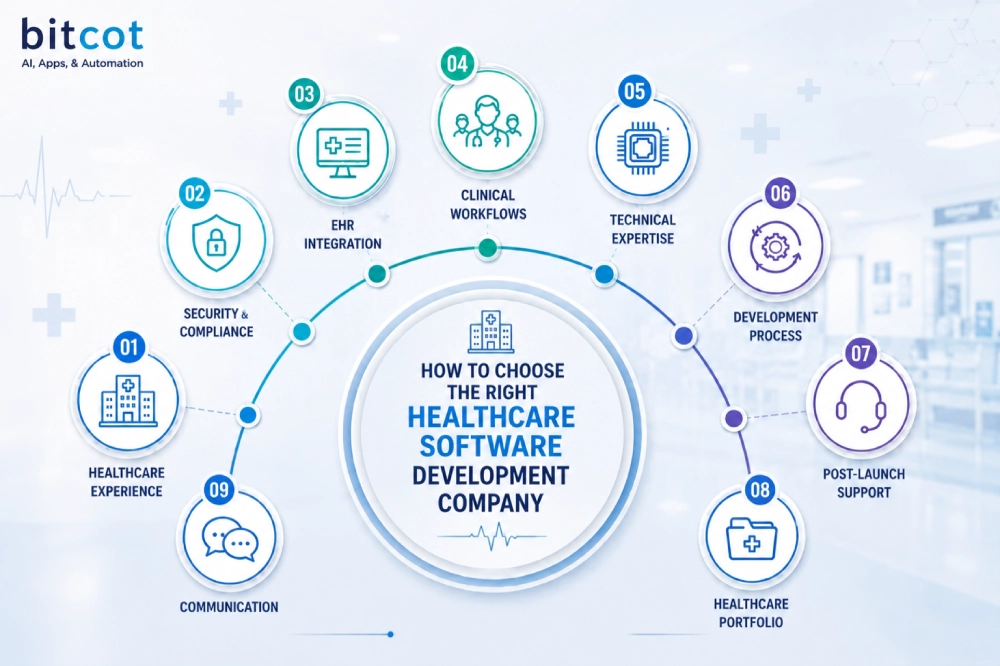
Choosing a partner requires looking beyond coding skills. The right company should understand healthcare regulations, data security, integrations, and the workflows of providers and patients.
Use these criteria to evaluate potential partners:
| Evaluation Criteria | What to Check |
|---|---|
| Healthcare Experience | Look for experience building healthcare products such as telehealth platforms, patient portals, RPM solutions, EHR integrations, or healthcare SaaS. |
| HIPAA & Security Knowledge | Ensure they understand PHI protection, encryption, access controls, security testing, and compliance requirements. |
| EHR Integration Expertise | Check experience with HL7, FHIR APIs, and connecting with systems like Epic or Oracle Health (Cerner). |
| Clinical Workflow Understanding | Choose a partner that understands how healthcare teams and patients actually use technology. |
| Technical Capability | Evaluate expertise in cloud, mobile apps, APIs, AI, analytics, and scalable software architecture. |
| Development Process | Look for a structured approach covering discovery, design, development, testing, and deployment. |
| Post-Launch Support | Confirm they provide ongoing maintenance, security updates, and future enhancements. |
| Healthcare Portfolio | Review relevant case studies and projects instead of relying only on company claims. |
| Communication & Collaboration | Ensure they provide clear timelines, regular updates, and direct access to the development team. |
Also Read: Top Medical Software Development Companies in California (2026)
Top Healthcare Software Development Companies in San Diego to Evaluate in 2026
Now that you know what separates a strong healthcare technology partner from a general software provider, let’s look at the companies worth considering and where they make the most sense for different healthcare needs.
Bitcot
Bitcot is one of the trusted healthcare software development companies headquartered in San Diego, California, that designs and builds secure, scalable digital health solutions like patient portals, telehealth platforms, remote patient monitoring systems, and EHR-integrated applications for organizations that need production-ready healthcare software without enterprise-consulting overhead.
Backed by over a decade of dedicated healthcare delivery and 3000+ shipped projects, the team partners directly with healthcare founders, providers, and product leaders from discovery through development and post-launch support.
- Healthcare expertise: Strong experience across telemedicine, patient engagement, remote monitoring, healthcare SaaS, and workflow-driven applications designed around real clinical needs.
- Security and compliance approach: Builds healthcare applications with HIPAA guidelines in mind, incorporating encryption, role-based access controls, secure authentication, audit logging, and safeguards for protected health information (PHI) throughout the development process.
- Interoperability capabilities: Experience developing healthcare integrations using HL7 and FHIR standards to connect modern applications with existing EHR/EMR ecosystems.
- Consider when: Healthcare startups, digital health companies, and mid-sized organizations looking for a hands-on digital health solution partner with direct collaboration, faster execution, and product development expertise without the complexity and overhead of large enterprise consulting firms.
Accenture
Accenture runs one of the largest health-industry consulting and technology practices globally, working primarily with payers, large hospital systems, and life sciences companies on digital transformation, cloud migration, and AI-enabled clinical operations.
- Domain depth: Very strong at the enterprise and payer level; less suited to founder-stage builds.
- Compliance posture: Mature governance frameworks, though engagements typically run through formal procurement processes.
- Interoperability: Deep experience with large-scale EHR modernization and data platform work.
- Consider when: Health systems and payers with multi-year, multi-million-dollar transformation budgets.
Deloitte
Deloitte’s healthcare arm focuses heavily on regulatory strategy, digital health transformation, and analytics for hospital networks and government health programs, often pairing technology delivery with policy and reimbursement consulting.
- Domain depth: Strong on the strategy and regulatory side; technology delivery is typically bundled with broader consulting engagements.
- Compliance posture: Extensive experience with healthcare regulatory frameworks at scale.
- Interoperability: Works on large data interoperability initiatives, often for government or multi-hospital systems.
- Consider when: Organizations that need strategy plus delivery together, not a pure engineering vendor.
Cognizant
Cognizant has one of the longer-standing healthcare IT practices among global systems integrators, with dedicated business units for payers, providers, and life sciences, plus a large delivery bench for EHR support and claims platforms.
- Domain depth: Broad, especially in payer administration and claims processing systems.
- Compliance posture: Established regulatory practices at enterprise scale.
- Interoperability: Significant experience with legacy EHR and claims system integration.
- Consider when: Large payers and providers needing sustained, high-volume engineering capacity.
EPAM Systems
EPAM is an engineering-led development team (rather than a strategy-first consultancy) with a healthcare and life sciences unit focused on digital health platforms, clinical trial technology, and data engineering.
- Domain depth: Solid, particularly in life sciences and data-heavy clinical applications.
- Interoperability: Active FHIR and HL7 work, often for platform and SaaS clients rather than single hospitals.
- Consider when: Health tech companies that want strong engineering execution without a heavy strategy layer.
Infosys
Infosys operates a large healthcare and life sciences vertical, primarily serving US payers and providers through offshore-heavy delivery models, along with a growing healthcare AI and analytics practice.
- Domain depth: Broad exposure across payer, provider, and pharmacy systems.
- Compliance posture: Standardized compliance frameworks suited to large, long-running contracts.
- Interoperability: Established EHR integration and data warehousing experience.
- Consider when: Enterprises prioritizing scale and cost efficiency over close, local collaboration.
Tata Consultancy Services (TCS)
TCS supports healthcare payers and providers with core administration systems, claims platforms, and increasingly, AI-driven clinical analytics, typically through large managed-services contracts.
- Domain depth: Strong at the systems-of-record level for payers and large providers.
- Compliance posture: Enterprise-grade compliance processes built for regulated, high-volume operations.
- Interoperability: Deep legacy-system integration experience, particularly for claims and administrative data.
- Consider when: Large organizations modernizing core administrative or claims infrastructure.
Wipro
Wipro’s healthcare practice spans provider IT services, payer administration, and digital health platform engineering, with delivery teams that scale up quickly for large modernization programs.
- Domain depth: Solid provider- and payer-side experience, particularly in system modernization.
- Compliance posture: Formal compliance and security governance suited to enterprise procurement.
- Interoperability: Established EHR and claims integration capability at scale.
- Consider when: Organizations running large IT modernization programs rather than a single focused product build.
HCLTech
HCLTech provides healthcare application development, cloud modernization, and data engineering services, with a growing focus on AI-assisted clinical and administrative workflows for provider and payer clients.
- Domain depth: Broad technical capability across cloud and data platforms; healthcare specialization varies by engagement team.
- Compliance posture: Enterprise compliance processes, generally handled through formal contracts.
- Interoperability: Active in cloud-based interoperability and data platform modernization.
- Consider when: Enterprises consolidating multiple legacy systems onto modern cloud infrastructure.
NTT DATA
NTT DATA supports large healthcare payers and providers with core system integration, data platforms, and increasingly, AI and analytics for population health and clinical operations.
- Domain depth: Strong at the infrastructure and systems-integration level for large healthcare enterprises.
- Compliance posture: Mature global compliance frameworks adapted for US healthcare regulation.
- Interoperability: Extensive experience integrating disparate hospital and payer systems.
- Consider when: Large healthcare enterprises needing global delivery scale and infrastructure depth.
What Separates a Strong Healthcare Partner From a Generalist Agency?
Teams often weigh portfolio aesthetics how polished the case study looks over the compliance and interoperability questions above. A beautiful app that mishandles PHI or can’t pass a HIPAA risk assessment isn’t a shippable product; it’s a liability with good typography.
Use this as your evaluation framework before you look at any specific company.
- Real interoperability work hands-on experience with HL7 v2, FHIR APIs, and at least one major EHR ecosystem (Epic, Cerner/Oracle Health, Allscripts).
- Clinical domain fluency: engineers and product leads who understand a clinical workflow well enough to challenge your assumptions, not just implement your spec literally.
- A named security and compliance process: encryption standards, access controls, audit logging, and how they handle a breach if one occurs.
- Post-launch commitment: a support model, not a handoff. Ask what happens in month seven.
- References you can actually call healthcare clients, not just logos on a homepage.
- Transparent pricing structure: fixed-bid for well-scoped MVPs, time-and-materials for evolving platforms, with a clear rationale for which applies to you.

Healthcare IT Development Cost Overview: Typical Pricing Models and Project Expenses
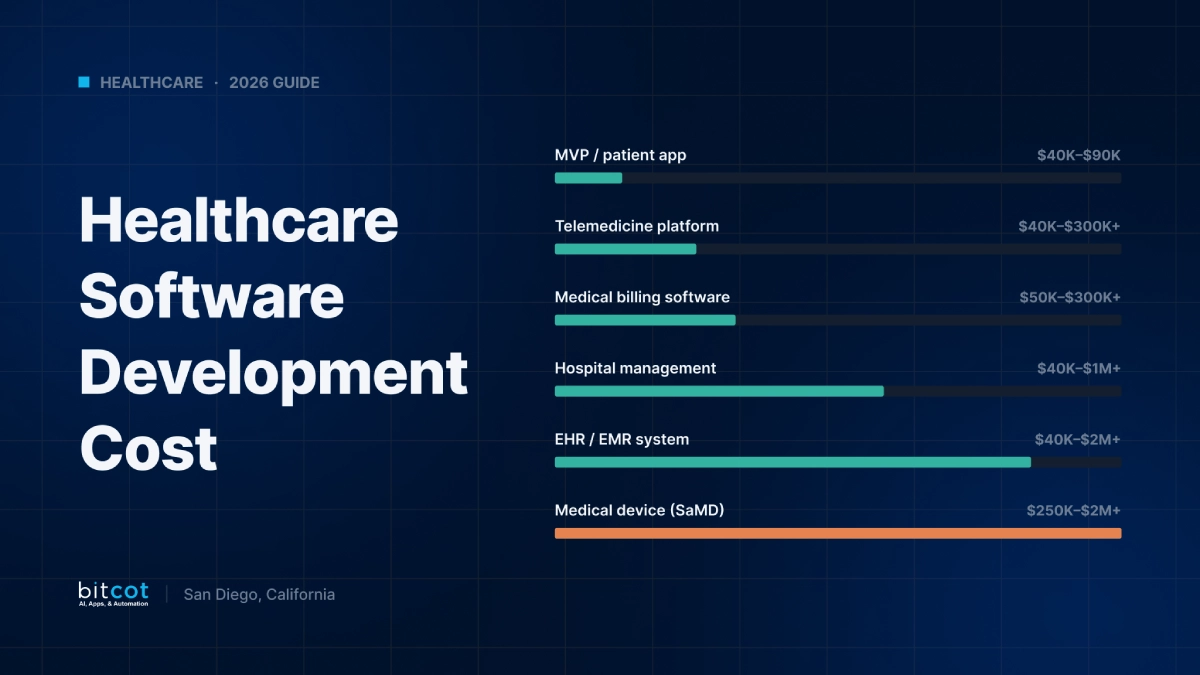
Budgeting for a healthcare software project involves much more than estimating development hours. Medical software development expenses are shaped by factors such as product scope, interoperability requirements, security architecture, third-party integrations, implementation complexity, and ongoing maintenance. As a result, there is no universal average cost that applies to every project.
Instead of relying on headline estimates, organizations should understand the typical pricing models and the primary cost drivers that influence overall investment. The ranges below are intended as illustrative market benchmarks to support budget planning and vendor evaluation rather than fixed project quotes.
| Project Type | Typical Cost Range | What Drives the Range |
|---|---|---|
| Patient portal MVP | $40,000 – $120,000 | EHR integration depth, authentication complexity |
| Telemedicine platform | $80,000 – $250,000 | Video infrastructure, e-prescribing, state licensure logic |
| Remote patient monitoring platform | $100,000 – $300,000+ | Device integrations, real-time alerting, data volume |
| EHR/EMR module or extension | $150,000 – $500,000+ | FHIR/HL7 depth, clinical workflow complexity |
| Healthcare AI or clinical decision support | $120,000 – $400,000+ | Model training, validation, explainability requirements |
| Medical device software (SaMD) | $200,000 – $600,000+ | FDA classification, validation and documentation burden |
Why Consider a San Diego-Based Partner Specifically?
San Diego isn’t a random location on this list; it’s one of the country’s more concentrated biotech and health tech corridors, home to a dense cluster of health systems, life sciences companies, and digital health startups. That concentration matters in a few practical ways:
- Talent depth in regulated software engineers in the market has frequently worked on HIPAA- guideline and FDA-relevant projects before, shortening the ramp-up time on compliance conversations
- Time zone and in-person access for teams based on the West Coast; same-time-zone collaboration reduces the friction that comes with offshore-only delivery models
- Local ecosystem awareness: a San Diego partner is more likely to already understand regional payer relationships, academic medical center dynamics (UC San Diego Health, Scripps, Sharp), and the local biotech investor landscape
None of that replaces due diligence on compliance and technical depth, but all else being equal, proximity to a strong regulated-software talent pool is a real advantage, not just a marketing line.
What Makes Bitcot a Trusted Healthcare Software Development Partner?
For organizations looking for a collaborative healthcare software partner rather than a large consulting firm, Bitcot builds healthcare applications with HIPAA guidelines in mind while addressing security, interoperability, and clinical workflow requirements from the earliest stages of development.
The team has built healthcare solutions across telemedicine, patient engagement, remote monitoring, and healthcare workflow platforms. For example, Bitcot developed Temocare TeleHealth, a healthcare platform designed to connect patients and practitioners through features such as video consultations, appointment scheduling, practitioner availability management, and access to medical reports.
If your priority is a senior team, direct communication, and a build that can move from discovery to launch without layers of account management in between, it’s a reasonable place to start that conversation. You can review Bitcot’s medical software development work or its telemedicine development services to see how the team scopes these engagements.
Common Mistakes to Avoid When Hiring a Partner
Selecting a healthcare software vendor requires more than reviewing portfolios and comparing pricing. The qualification process should focus on whether a potential health IT partner understands healthcare regulations, clinical workflows, interoperability requirements, and the long-term responsibilities of maintaining a healthcare product.
- Choosing a company based on portfolio polish alone. Ask what specifically was compliance-tested, not just what looks good in a screenshot.
- Skipping the post-launch conversation. A technology partner with no maintenance model is planning to hand you a product you can’t safely operate alone.
- Underestimating interoperability effort. EHR integration is consistently where healthcare projects run over budget and over timeline scope explicitly, early.
- Picking enterprise scale for a startup problem, or vice versa. A global systems integrator is often the wrong fit for a 12-person startup MVP, just as a boutique company may be the wrong fit for a national payer rollout.
Conclusion
Choosing a healthcare software development partner is about more than building technology; it’s about reducing risk and setting your product up for long-term success. Look for a team with proven healthcare experience, compliance and interoperability expertise, strong security practices, and a clear understanding of clinical workflows.
Before making a decision, review healthcare case studies, speak with past clients, and understand how the vendor approaches compliance, integrations, and post-launch support. A thoughtful evaluation today can help you avoid costly challenges tomorrow.
If you’re planning a healthcare software project and want expert guidance before selecting a development partner, connect with the Bitcot team. We offer a free consultation to discuss your requirements, timeline, budget, and technical approach so you can move forward with confidence.
Frequently Asked Questions
Can a healthcare software company integrate with our existing EHR system?
Healthcare organizations often use established EHR platforms to manage clinical data, workflows, and patient records. A healthcare software company should be able to assess existing systems and build secure connections using interoperability standards such as HL7 and FHIR. Successful integration depends on understanding data exchange requirements, system architecture, and compliance needs.
How do I know if a healthcare software company has real healthcare experience?
Choosing a healthcare software partner requires more than reviewing a list of healthcare clients or industry claims. Organizations should evaluate whether the company understands clinical workflows, healthcare regulations, PHI security requirements, and healthcare integrations. Real experience is demonstrated through relevant projects, technical expertise, and the ability to address healthcare-specific challenges.
Can healthcare software companies help define the product strategy before development starts?
Healthcare software projects often require careful planning before development begins because clinical needs, compliance requirements, and technical decisions impact the final product. Experienced software companies can support discovery by defining user requirements, evaluating workflows, planning architecture, and prioritizing features to create a solution aligned with business and healthcare goals.
What happens after a healthcare software product is launched?
Launching a healthcare software product is only the beginning of its lifecycle, as healthcare requirements and technology environments continue to evolve. Organizations need ongoing support for security updates, performance improvements, regulatory changes, integrations, and feature enhancements to ensure the software remains reliable and effective over time.
How can healthcare organizations protect patient data when working with an external software company?
Protecting patient information requires strong security practices throughout the software development process. Healthcare organizations should evaluate how a partner manages encryption, access controls, authentication, audit logs, and cloud security. Companies handling protected health information (PHI) must also follow appropriate compliance practices and establish agreements such as Business Associate Agreements (BAAs).
Should healthcare organizations build a mobile app or a web-based healthcare platform?
Healthcare technology solutions can be delivered through mobile applications, web platforms, or a combination of both depending on user needs and operational goals. Mobile apps are often used for patient engagement, remote monitoring, and convenient access, while web platforms support provider workflows, administrative tasks, and complex data management requirements.