Key Takeaways
- Healthcare software development costs typically range from $40,000 to $2M+, depending on software type, complexity, integrations, compliance needs, and scalability requirements.
- Healthcare solutions cost more than standard software because they require stronger security, HIPAA guidelines, interoperability, and extensive testing.
- Major cost drivers include features, EHR integrations, AI capabilities, technology choices, compliance requirements, and development expertise.
- Organizations should evaluate SaaS, custom, and hybrid approaches based on workflow needs, long-term goals, and total cost of ownership.
- Choosing an experienced healthcare software development partner helps reduce risks, avoid costly rework, and build secure, scalable solutions.
If you’re a healthcare provider, hospital, or medical startup in San Diego, California, you’re not alone. Across the United States, healthcare organizations are rapidly embracing digital transformation.
The real challenge, however, is no longer whether to modernize how to do it without overspending, risking compliance, or investing in technology that quickly becomes outdated.
In 2026, development costs are influenced by far more than the feature list. Compliance requirements, EHR integration, interoperability, cybersecurity, AI capabilities, and scalability all affect the overall investment.
So, what does a realistic budget look like in 2026?
The answer depends on your product, goals, and technical requirements. Whether you’re building a telemedicine platform, patient portal, hospital management system, medical billing software, or an AI-powered healthcare solution, understanding what drives development costs is essential.
Learn what influences healthcare software development costs in 2026, why pricing varies, the hidden expenses to expect, and how to make cost-effective decisions without sacrificing quality, security, or compliance.
Development Cost at a Glance: How Much Should You Budget
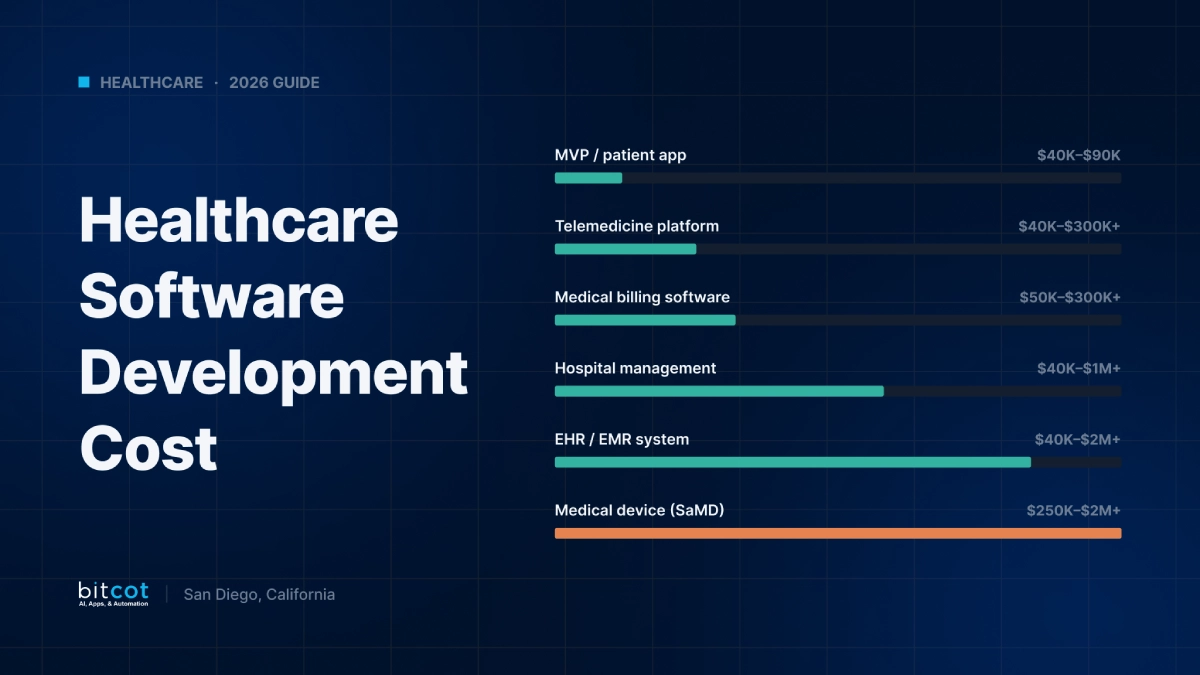
Investment for healthcare digital solutions typically spans from $40,000 for MVPs to upwards of $2,000,000 for enterprise systems in 2026. Total project expenditure is primarily dictated by software category, functional depth, necessary external integrations, and the rigorous demands of compliance frameworks like HIPAA, FHIR, or FDA SaMD.
In comparison to equivalent software in consumer or business segments, building for healthcare necessitates a more substantial commitment to compliance and data security. As highlighted by IBM’s Cost of a Data Breach analysis, the healthcare field persistently ranks as the most financially burdened sector regarding data compromise. This financial risk underscores the absolute necessity of integrating rigorous testing, thorough audit tracking, robust encryption, and well-fortified architectures from the ground up.
Here’s the quick-reference breakdown before we get into specifics:
| Software Type | Typical Cost Range | Typical Timeline |
|---|---|---|
| MVP / basic patient app | $40,000 – $90,000 | 2 – 4 months |
| Telemedicine platform | $40,000 – $300,000+ | 3 – 9 months |
| Patient portal (standalone) | $30,000 – $80,000 | 2 – 4 months |
| Remote patient monitoring (RPM) | $50,000 – $400,000+ | 4 – 9 months |
| Medical billing software | $50,000 – $300,000+ | 4 – 8 months |
| EHR/EMR system | $40,000 – $2,000,000+ | 6 – 24 months |
| Hospital management system | $40,000 – $1,000,000+ | 6 – 24 months |
| Medical device software (SaMD) | $250,000 – $2,000,000+ | 9 – 24 months |
How Medical Software Development Differs From Standard Software Development
Unlike standard business software, healthcare applications must satisfy strict regulatory requirements, securely manage sensitive patient data, integrate with clinical systems using standards such as HL7 and FHIR, and undergo extensive testing.
These additional requirements demand specialized expertise and have a direct impact on development costs. Here are the three key factors that make it more complex, regulated, and expensive to develop:
- Compliance is load-bearing, not optional. HIPAA’s Security Rule dictates specific technical safeguards (access controls, audit logs, encryption at rest and in transit) that have to be designed in from day one. Retrofitting compliance into an existing codebase later typically costs more than building it correctly the first time.
- Interoperability is a requirement, not a feature. Most software needs to exchange data with an EHR, a lab system, a pharmacy network, or a health information exchange. That means working with HL7 and FHIR standards, which most consumer app developers have never touched.
- The cost of a bug is higher. A shopping cart bug loses a sale. A dosage calculation bug or a missed critical alert in an RPM platform can cause real harm. That raises the bar for testing, clinical validation, and code review across the entire build, which shows up directly in development hours and cost.
Development Rates Across Major Cities in the USA
In 2026, healthcare organizations from independent clinics to large hospital systems across California and the United States are accelerating their digital transformation initiatives. As demand for digital healthcare solutions continues to grow, development rates vary across U.S. healthcare technology hubs based on talent availability, operating costs, and market demand.
Healthcare projects typically command higher rates than general software development because they require specialized expertise in compliance, interoperability, security, and clinical workflows.
| Location | Typical Hourly Rate (USD) | Why Businesses Choose This Market |
| San Diego | $175–$275/hr | Strong healthcare, AI, and custom software expertise with close collaboration and experience building a mature health tech ecosystem. |
| Los Angeles | $150–$250/hr | Large engineering talent pool with experience in enterprise software, digital health, and healthcare platforms. |
| Orange County | $140–$240/hr | Growing healthcare and medtech ecosystem offering experienced development teams and competitive pricing. |
| San Francisco | $180–$300+/hr | Premium engineering market known for AI, health tech innovation, and enterprise. |
| Las Vegas | $110–$180/hr | Lower operating costs with access to skilled software teams, making it a cost-effective nearshore option. |
| San Jose | $180–$300+/hr | Silicon Valley expertise in cloud, AI, and scalable healthcare technology solutions. |
| Denver | $120–$200/hr | Expanding technology ecosystem offering experienced developers at more moderate rates than coastal markets. |
Cost by Project Size and Complexity
These estimates provide a general benchmark for software development in the US.
Actual costs depend on regulatory requirements, interoperability with healthcare systems, security architecture, and the complexity of the solution.
| Project Size | Estimated Cost (USD) | Timeline | Typical Development Hours | Example Projects |
| Small / MVP | $40,000–$120,000 | 2–4 months | 300–800 hours | Patient intake app, appointment scheduling platform, single-specialty telehealth MVP |
| Mid-Size Application | $120,000–$350,000 | 4–9 months | 1,000–2,500 hours | Telemedicine platform with EHR integration, patient portal, practice management system |
| Enterprise Platform | $350,000–$1M+ | 9–24 months | 2,500–6,000+ hours | Hospital management systems, enterprise EHR platforms, multi-location healthcare solutions |
| FDA-Regulated Medical Software | $750,000–$2M+ | 12–30 months | 5,000+ hours | Software as a Medical Device (SaMD), connected medical devices, Class II/III medical software requiring regulatory validation |
Key Factors That Affect Healthcare Application Development Pricing
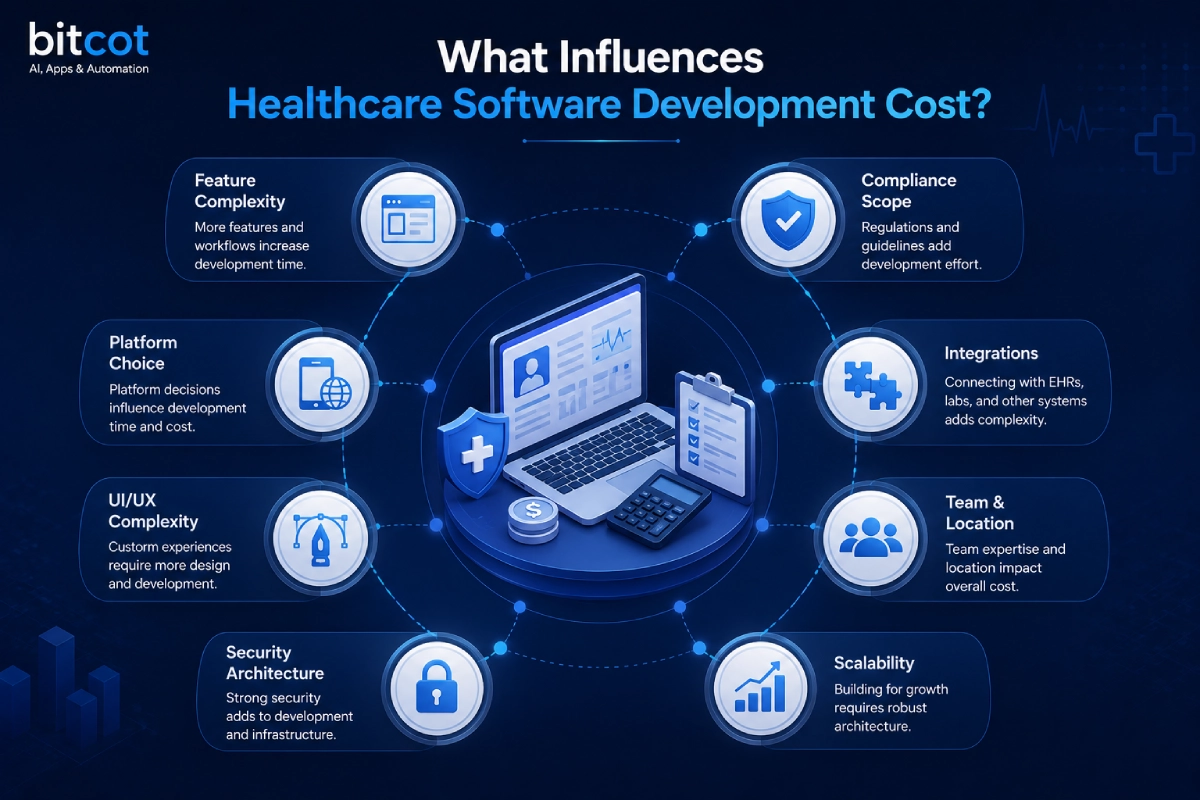
Software type sets the range. These factors determine where you actually land inside it.
- Feature complexity: More workflows, user roles, and screens increase development and testing time.
- Compliance scope: Beyond HIPAA guidelines, projects may also require the 21st Century Cures Act, FDA SaMD, ONC certification, SOC 2, or state-specific telehealth requirements, adding development and validation effort.
- Integrations: Connecting with Epic, Cerner (Oracle Health), labs, pharmacies, or health information exchanges increases project complexity and cost.
- Team composition and location: Costs vary based on team expertise, size, and whether development is onshore, offshore, or a blended model.
- Platform choice: Web applications cost less than native iOS and Android apps, while React Native and Flutter provide a cost-effective cross-platform approach.
- UI/UX complexity: Custom workflows for physicians, nurses, and patients require more design and development than standard interfaces.
- Scalability: Supporting larger user volumes requires stronger architecture, infrastructure, and performance testing.
- Security architecture: Features such as role-based access control, multi-factor authentication, encryption, and continuous monitoring are essential when handling PHI.
Must-Have Features and Their Cost Impact
Not every feature costs the same to build, and knowing the relative weight of each one helps you prioritize an MVP instead of guessing.
Here’s how the common building blocks of HealthTech solutions break down:
| Feature | What It Covers | Typical Cost Range |
| Patient registration | Demographics, insurance capture, consent management | $8,000 – $22,000 |
| Appointment scheduling | Multi-provider calendars, waitlists, reminders | $15,000 – $38,000 |
| Secure messaging | Encrypted patient-provider communication | $15,000 – $35,000 |
| ePrescribing | E-prescription generation, pharmacy routing | $20,000 – $45,000 |
| Telehealth video | HIPAA-compliant video, virtual waiting room | $25,000 – $65,000 |
| Billing and claims | Insurance claim generation, payment processing | $10,000 – $22,000 |
| EHR/FHIR integration | Per-system connection, read or bidirectional | $15,000 – $150,000+ |
| RPM device sync | Wearable and medical device data ingestion | $20,000 – $60,000 |
| Clinical decision support / AI | Predictive analytics, documentation assist | $80,000 – $250,000 |
| FDA regulatory work (if SaMD) | Classification strategy, submission prep | $50,000 – $250,000 |
Technology, Integrations & Compliance Costs
Your technology choices don’t just affect performance; they also influence development time, integration complexity, long-term maintenance, and overall project cost.
- Technology Stack
The technology stack determines how quickly your software can be developed and scaled. Many healthcare organizations choose React Native or Flutter for cross-platform apps, cloud platforms like AWS, Azure, or Google Cloud, and API-first architectures to reduce development costs while supporting future integrations.
- EHR Integrations (HL7 & FHIR)
Integrating with EHRs such as Epic or Oracle Health is one of the biggest healthcare-specific cost drivers. Modern FHIR-based integrations are generally faster and more cost-effective than legacy HL7 interfaces, but the final cost depends on the number of systems, data exchange requirements, and level of customization.
- Compliance & Security
Building HIPAA guidelines into the software from day one is significantly more cost-effective than retrofitting it later. Features such as encryption, role-based access control, audit logs, multi-factor authentication, and secure API architecture require additional development effort but are essential for protecting patient data and meeting regulatory requirements.
Also Read: Healthcare CRM Software Development: Complete Guide, Features & Cost (2026)
AI Features: How Much Do They Add to Development Costs?
AI is becoming a standard feature in modern healthcare software, but it also increases development costs. Depending on the complexity of the solution, adding AI capabilities can increase your project budget by $80,000 to $250,000+.
| AI Feature | Estimated Additional Cost |
| AI chatbot for patient support or intake | $20,000–$60,000 |
| Clinical documentation & ambient AI | $50,000–$150,000 |
| Predictive analytics & risk scoring | $75,000–$200,000 |
| AI-powered medical imaging or diagnostics | $150,000–$500,000+ |
Beyond model integration, healthcare AI requires additional investment in data security, validation, testing, governance, and human oversight to ensure reliable and compliant performance.
Hidden Costs and Long-Term Maintenance
The initial development cost is only one part of your investment. To accurately estimate the total cost of ownership (TCO), healthcare organizations should also account for ongoing maintenance, HIPAA compliance, cloud infrastructure, third-party licensing, and long-term support throughout the software lifecycle.
The National Institute of Standards and Technology emphasizes that cybersecurity and risk management are ongoing processes, making continuous maintenance and security investments essential.
Some of the most commonly overlooked long-term costs include:
- Ongoing maintenance and support: Typically 15–25% of the initial development cost per year for bug fixes, security updates, performance improvements, and feature enhancements.
- Cloud infrastructure: HIPAA-eligible hosting, encrypted storage, backups, monitoring, and disaster recovery services that scale with your application.
- Third-party licensing: Recurring fees for EHR integrations, telehealth platforms, e-prescribing services, payment gateways, and other healthcare APIs.
- Compliance and security: Annual HIPAA risk assessments, penetration testing, vulnerability scans, and security audits to maintain regulatory compliance.
- Data migration and staff training: Migrating legacy patient data and training clinical and administrative teams are often underestimated but can significantly impact implementation costs and timelines.
Planning Tip: Request a 3–5 year total cost of ownership (TCO) estimate instead of focusing only on the initial development quote. This provides a more realistic view of the long-term investment required to build, maintain, and scale Clinical software.
Build vs. Buy vs. Custom Healthcare Software: Which Approach Delivers Better ROI?
Before estimating development costs, organizations must decide how they want to build their solution. The right choice depends on factors such as workflow complexity, integration requirements, budget, scalability needs, and long-term business goals.
While off-the-shelf healthcare software offers lower upfront costs and faster deployment, it may involve limitations in customization and flexibility. Custom healthcare software requires a higher initial investment but can provide greater long-term value for organizations with complex workflows, multiple locations, or specialized operational needs.
| Factor | Off-the-Shelf (SaaS) | Custom Healthcare Software | Hybrid Solution |
| Upfront Cost | Lower | Higher | Moderate |
| Time to Launch | Weeks | Months | Moderate |
| Customization | Limited to vendor features | Fully tailored to business needs | Selective customization |
| Scalability | Depends on vendor capabilities | Built for long-term growth | Flexible based on requirements |
| Best For | Small practices and organizations with standard workflows | Hospitals, multi-location providers, and organizations with complex requirements | Growing healthcare businesses needing speed and flexibility |
Which Option Offers the Best ROI?
The most cost-effective approach depends on your operational needs:
- Choose SaaS software if you need a fast implementation, predictable costs, and your workflows align with existing solutions.
- Choose custom software development if you need advanced automation, deep EHR integrations, specialized workflows, or complete control over data, security, and user experience.
- Choose a hybrid approach if you want faster deployment while customizing the areas that create the most business value.
For many healthcare organizations, the lowest upfront cost is not always the most economical choice. The right investment is the one that reduces operational inefficiencies, supports compliance requirements, and scales with future growth.
How to Choose the Right Healthcare Software Development Company
The right development partner can significantly impact your development cost. An inexperienced vendor can lead to costly rework caused by poor architecture, compliance gaps, integration issues, or workflow misunderstandings.
Look beyond portfolios and case studies. A reliable company should have experience with healthcare regulations, secure data handling, EHR integrations, and standards like HL7 and FHIR. They should understand your clinical workflows and identify technical risks before development begins.
Red Flags to Watch For
Be cautious of vendors that:
- Provide fixed estimates without understanding your requirements
- Treat HIPAA compliance as a final checklist
- Lack experience with healthcare integrations or similar projects
- Offer unusually low quotes without explaining exclusions
The lowest upfront cost does not always deliver the best value. Missing security, compliance, or integration requirements often create higher costs later.
Choosing the right development partner can help reduce development risks and avoid costly mistakes. Bitcot works with healthcare organizations to build secure, scalable solutions, including EHR/EMR platforms, telehealth applications, and remote patient monitoring systems. Our experience with healthcare workflows, interoperability, and security-focused development helps organizations build solutions prepared for long-term growth.
Conclusion
Healthcare software development cost is not a fixed number because every solution has different goals, complexity, and compliance requirements. A focused telehealth MVP may cost around $40,000–$120,000, while platforms with advanced integrations can range from $120,000–$500,000. Enterprise healthcare systems and FDA-regulated solutions can exceed $500,000 depending on scope and requirements.
The final investment depends on factors such as compliance needs, integration complexity, customization, scalability, and long-term maintenance costs. Understanding these factors helps you choose the right development approach and avoid unexpected expenses later.
Frequently Asked Questions
How much does healthcare software development cost in 2026?
Software development costs depend on the solution type, complexity, integrations, security requirements, and level of customization. A simple healthcare application may require a smaller investment, while enterprise platforms with EHR integrations, AI capabilities, and advanced analytics need more development effort. The final cost depends on business goals, technical requirements, compliance needs, and the chosen development approach.
What factors affect development costs?
Several factors influence costs, including software complexity, required features, third-party integrations, security measures, compliance requirements, technology stack, and development team expertise. For example, a patient portal may cost less than a complete healthcare management platform with EHR connectivity and AI-driven features. Understanding these factors early helps organizations create realistic budgets and avoid unexpected expenses during development.
How long does it take to develop healthcare software?
The timeline for developing healthcare software usually ranges from a few months to over a year, depending on project scope and complexity. A basic healthcare application may take 3–6 months, while larger platforms with integrations, security testing, and advanced functionality require more time. The development process typically includes planning, design, development, testing, compliance reviews, deployment, and ongoing improvements.
Is custom healthcare software more expensive than ready-made solutions?
Custom healthcare software usually requires a higher initial investment compared with ready-made solutions, but it provides greater flexibility, scalability, and control. Off-the-shelf platforms may have lower upfront costs but can involve licensing fees, limited customization, and additional expenses for modifications. Organizations should choose based on their workflow needs, long-term goals, security requirements, and expected return on investment.
Does HIPAA compliance increase Healthcare application costs?
Yes, HIPAA guidelines and requirements can increase development costs because they require additional security measures, testing, documentation, and privacy controls. Features such as encryption, access management, audit logs, and secure data handling are essential for protecting patient information. These investments help healthcare organizations reduce security risks and build software that supports safe handling of sensitive health data.
How much does EHR integration cost for healthcare software?
The cost of EHR integration depends on factors such as the number of systems involved,API complexity, data requirements, and customization needs. Integrating with platforms like EHR systems requires careful planning, testing, and security considerations. Simple integrations may require less effort, while complex workflows involving patient records, clinical data exchange, and multiple healthcare systems can significantly increase development time and cost.
How do I choose the right healthcare software development company?
Choosing the right healthcare software development company requires evaluating technical expertise, healthcare industry experience, security practices, integration capabilities, and previous project outcomes. Look for a partner that understands healthcare workflows, compliance considerations, and scalability requirements. A reliable development team should focus not only on building software but also on creating a secure, maintainable solution aligned with your organization’s long-term goals.