Key Takeaways
- Path-Now uses match-percentage ranking to surface compatible IDD service providers.
- OTP-based login reduces registration drop-off for families under care pressure.
- Consent-driven connections ensure every relationship is mutually approved first.
- San Diego-based engineering teams benefit from verified-seal trust architecture.
- Tiered subscriptions let nonprofits scale features without rebuilding the platform.
Introduction
According to the National Council on Disability, families supporting individuals with intellectual and developmental disabilities (IDD) consistently rank service discovery and coordination as among their most significant unmet needs. The gap isn’t primarily clinical; it’s structural. Finding a compatible provider, establishing trust, and maintaining reliable communication all require infrastructure that most existing platforms simply weren’t designed to deliver for this population.
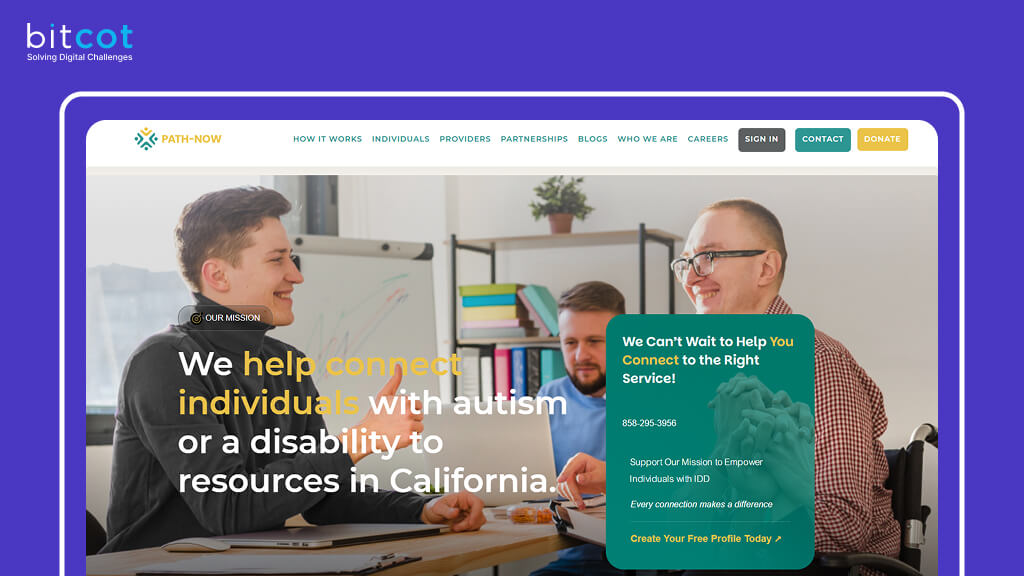
Path-Now was built to close exactly that gap. It is a purpose-built platform for IDD clients and the organizations that serve them, connecting both sides through verified profiles, a compatibility-based matching system, and secure in-platform communication. Our engineering team designed the architecture from the ground up to address four specific failure points: complex registration, limited provider visibility, fragmented communication, and trust deficits that make service discovery so difficult for IDD families.
This post walks through exactly how each part of the platform works: how clients and organizations register, how connections are initiated and managed, how in-platform messaging protects sensitive data, and how the subscription structure lets organizations scale without rebuilding from scratch.
The Challenges Faced by the Intellectual and Developmental Disabilities (IDD) Community in Service Discovery
Finding the right support for an individual with IDD is rarely a straightforward search. Families navigate a fragmented landscape of service providers, each operating on different systems, with inconsistent information and no shared standard for how trust is established. The result is a discovery process that is slower, more stressful, and more error-prone than it needs to be.
The four challenges below shaped every architectural decision made in building Path-Now. Each represents a specific pain point that the platform’s core features were designed to eliminate, not just reduce.
Complex and Lengthy Registration Processes
The first barrier most families encounter is the registration process itself. Existing platforms often require multiple verification steps, long intake forms, and manual review windows that can take days. For families already managing the demands of IDD caregiving, this overhead creates immediate friction that causes abandonment before the search even begins.
The platform challenge here isn’t just UX, it’s authentication architecture. A registration flow that balances accessibility, security, and speed requires deliberate design decisions around what data to collect upfront versus what can be deferred to later in the user journey.
Limited Visibility and Access to Trustworthy Service Providers
Even when families successfully register, locating the right provider remains difficult. Directories list organizations without ranking or filtering by compatibility. Families are left doing manual comparisons across multiple platforms, with no signal about whether a given provider is a strong match for their specific needs or geographic area.
Solving this required more than a search bar; it required a matching algorithm that could weight provider attributes against client preferences and surface results in a ranked, actionable format.
Fragmented Communication Channels
After a provider is identified, communication typically moves off-platform. Phone calls, emails, and third-party messaging apps introduce delays, reduce accountability, and create risk when sensitive information about an IDD individual is shared across unsecured channels. This fragmentation is especially problematic when session coordination and service requests need to be tracked over time.
Trust and Transparency Gaps
Trust is the central variable in any IDD service relationship. Families need verifiable signals that a provider is qualified, accountable, and aligned with their expectations. Without a structured verification mechanism, clients rely on word of mouth or self-reported credentials, neither of which scales on a platform serving diverse geographies and service categories.
Bitcot’s Custom Solution for Path-Now
Building Path-Now required translating each of these structural problems into a specific set of engineering decisions. The solution isn’t a single feature; it’s a system where registration, discovery, communication, and monetization each solve a discrete piece of the IDD coordination problem. Here is how each component was architected and why.
Simplified Registration Process
Registration is the first moment a platform either earns or loses a user. For Path-Now clients, the team stripped the sign-up flow down to the minimum viable data set, basic contact details, and service preferences, and backed it with both email verification and OTP-based login as parallel authentication paths. OTP login in particular reduces drop-off for users who may not have immediate access to their email during a mobile session.
For organizations, a “Refer Your Organization” model was implemented, where initial registration is reviewed and approved by platform administrators before full account access is granted. This introduces a quality gate at the point of entry, which feeds directly into the trust architecture on the client-facing side.
Effortless Connection Requests and Matching
The matching system surfaces organizations ranked by compatibility percentage rather than alphabetically or by recency. Clients can apply additional filters, such as location, service type, and specialization, to narrow results before initiating contact. This ranking-first display model was a deliberate choice: it reduces the cognitive load of comparison and surfaces the highest-probability match at the top of the screen rather than requiring the user to build their own evaluation framework.
Connection requests are initiated by the client and require an explicit acceptance action from the organization before any direct communication is enabled. This consent-driven architecture means that every active connection on the platform reflects a mutual agreement, which is a meaningful signal for families who need to know a provider is actively engaged and not just listed. The custom software solutions approach here was to model the connection layer like a mutual consent graph rather than a one-directional directory lookup.
Organizations manage incoming requests through a structured interface with three options: accept, decline, or initiate messaging to gather additional information before deciding. This third option message before deciding turns out to be used frequently in practice, particularly for cases where organizations need to assess service fit before committing to an active relationship.
Secure, In-Platform Communication
Once a connection is approved, encrypted in-platform messaging replaces the need for off-platform communication channels. Clients and organizations can exchange service preferences, coordinate session times, and submit service requests directly through the chat interface. End-to-end encryption and data anonymization are applied to all message content, which is a baseline requirement when the platform serves a population that includes vulnerable individuals with sensitive care needs.
The decision to build messaging natively rather than integrate a third-party service was deliberate. Third-party integrations introduce dependency risk, data-sharing agreements that must be disclosed to users, and latency that degrades the real-time coordination experience. A native messaging layer gives the platform full control over encryption standards, retention policies, and the data that flows between parties. Teams evaluating healthcare secure messaging platform requirements will recognize this tradeoff immediately.
Subscription Models to Scale for Organizations
Path-Now’s monetization layer is built on a tiered subscription model that lets organizations enter the platform on a free plan and upgrade as their operational needs grow. Free-tier access covers basic service provision and client management. Paid tiers unlock features that address the operational bottlenecks that emerge as an organization’s client volume increases.
Advanced features available on paid plans include multiple admin accounts for distributed team management, custom service forms for structured data collection, client engagement tracking to monitor interaction patterns, and analytics dashboards for service performance reporting. These aren’t convenience features; they are the tools organizations need once they move beyond a handful of active client relationships and need to manage workflows at scale. This is the same architectural pattern our team applies when building SaaS platform development for nonprofits and social service organizations.
Add-ons complement the subscription tiers. The Verified Seal ($75) signals to clients that an organization has been reviewed and meets the platform’s credibility standards. Promo codes and referral programs are also built into the payment layer, giving organizations a mechanism to drive referrals and reduce the cost barrier for smaller providers who might otherwise avoid a paid plan.
Verified Organizations for Greater Trust
The verification system closes the trust gap that directory-only platforms leave open. Only organizations that complete the admin review process and maintain an active status appear as verified on client-facing search results. This creates a curated supply side that families can rely on, rather than an open registry where credential claims are unverified.
The verification badge is visible in search results and on organization profiles, giving clients an immediate signal before they initiate a connection request. When paired with the community ratings and reviews system, the platform builds a layered trust architecture, institutional verification, plus peer feedback, that addresses both the formal and social dimensions of how families evaluate service providers.

The Process Behind Our Inclusive Solution for Path-Now
Designing a platform for inclusive communities requires a different starting point than most B2B or consumer SaaS projects. The user population includes individuals for whom registration friction alone can result in permanent abandonment, and organizations that may have no dedicated IT staff to manage complex admin tools. Every feature decision had to be tested against both ends of that spectrum.
The architecture was designed in parallel layers: an accessibility-first client-facing experience, a structured organization management interface, and a backend consent model that governs how and when data flows between the two sides. The sections below walk through the process behind each major component.
User Registration
Path-Now streamlines the onboarding process through its dedicated registration portal, providing distinct pathways for both clients and organizations to join the platform.
a) Client Registration Process
Clients seeking trusted services begin their Path-Now journey through a registration process designed with accessibility and ease of use as the primary constraints.
Account Creation Steps:
- Clients navigate to the registration portal to initiate their account setup
- Basic personal details are collected, including contact information and service preferences
- Email verification ensures secure account access and protects user information
- Alternative OTP-based login options provide flexible authentication methods
The client registration flow is specifically designed to accommodate individuals seeking various support services. By deferring non-essential data collection to later in the journey, the platform reduces the upfront burden without compromising the integrity of the account setup. This approach mirrors patterns our engineers use when designing secure web app development for populations where accessibility and data sensitivity must both be prioritized.
b) Organization Registration Process
Organizations follow a specialized registration pathway that introduces a quality review step before full access is granted.
“Refer Your Organization” Registration Model:
- Organizations begin registration through the “Refer Your Organization” option
- Initial registration is processed and reviewed by platform admins
- Once approved, organizations can claim and activate their full account access
Supported organizations include healthcare providers, schools, social service agencies, and specialist support services. The admin review step is what feeds the trust architecture on the client side. It is the mechanism that makes the Verified Seal meaningful rather than self-reported.
Connection Requests and Intelligent Matching
Path-Now’s matching system creates connections between clients and organizations through a process that prioritizes compatibility and mutual consent over speed. The design decision to show match percentages rather than a flat list was based on the observation that families often feel overwhelmed by options without a clear signal about which ones are most relevant to their situation.
a) Clients Send Requests to Organizations
- Service Discovery and Organization Matching:
Once logged in, clients access Path-Now’s matching system, which presents organizations in a compatibility-ranked format:- Compatibility-Based Ordering:
Organizations appear listed by matching percentage, with the most compatible services displayed prominently. - Advanced Filter Options:
Clients can refine their search using location-based filters, specific service types, specialization areas, and availability criteria. - Connect Request Functionality:
The “Connect Request” feature allows clients to initiate contact with preferred organizations. - Community Feedback Integration:
A ratings and review system enables clients to share experiences and inform future decisions for other families.
- Compatibility-Based Ordering:
- Connection Management:
Clients maintain full visibility and control over their connection activities through comprehensive tracking tools:- Pending Connections (Settings Menu):
Complete overview of sent requests with the option to withdraw or modify requests as needed. - Your Connections:
Active connections display accepted relationships and mutual agreements between clients and organizations. - Proposal Requests:
Incoming requests from organizations seeking to connect with the client, providing an opportunity for organizations to initiate contact.
- Pending Connections (Settings Menu):
This structure gives clients agency throughout the process. They are never passively assigned; every active connection to a provider reflects a request that was sent and accepted by both sides. For enterprise application development teams designing platforms for sensitive social service contexts, this mutual consent pattern is a model worth studying carefully.
b) Organization Response and Connection Management
- Request Processing Workflow: Organizations receive and manage client connection requests through their dedicated administrative interface:
- Waiting Approval Section: Centralized location for all incoming client connection requests
- Response Options: Organizations can accept requests, decline with professional courtesy, or initiate messaging to gather additional information
- Active Connections: Approved clients appear in “Your Connections” for ongoing relationship management
- Settings Management: Organizations have a comprehensive settings screen that centralizes all connection and account management functions:
- Pending Connections: Organizations can track clients they have requested but who have not yet responded
- Notifications Center: Comprehensive notification system for all request-related communications and platform updates
- Complete Profile Option: Tools for maintaining current, detailed organizational profiles that enhance matching accuracy
The mutual connection architecture ensures that every relationship formed on Path-Now is based on informed consent and compatibility assessment. This is not just a UX preference; it is a structural requirement for platforms operating in social service contexts, where mismatched or unsolicited connections can erode trust in the platform itself.
In-Platform Communication
Once a connection is approved, secure chat is enabled between the client and the organization. The messaging layer serves three distinct operational functions: exchanging details about service needs, coordinating session logistics, and submitting service requests.
- Exchanging Details: Clients and organizations can share important information such as personal details, service requirements, or session preferences, ensuring both sides are aligned on expectations before services begin.
- Coordinating Sessions: The messaging system supports scheduling, rescheduling, and confirmation of session times without requiring any off-platform communication.
- Requesting Services: Clients can directly request specific services through the chat interface, creating a documented record of requests that both sides can reference over time.
End-to-end encryption and data anonymization are applied to all message content. According to the FTC’s Safeguards Rule, platforms handling personal data for vulnerable populations are expected to implement technical safeguards that protect information from unauthorized access. Native messaging with embedded encryption is the architectural choice that satisfies this requirement without routing sensitive data through third-party systems.
For organizations comparing platform options, the in-platform messaging approach also reduces coordination overhead. When session scheduling and service requests are centralized in one interface, staff spend less time switching between tools and more time on direct service delivery. Teams exploring similar infrastructure for social service organizations can review related patterns in our work on non-profit software solutions.
Subscription Plans for Organizations
Organizations select from free or paid subscription tiers based on their client volume and feature requirements. The tiered model was designed to serve two distinct segments simultaneously: small community organizations with limited budgets and larger service providers that need enterprise-grade workflow tools.
- Free Tier: Provides essential tools for basic service provision and client management, giving smaller organizations access to the platform without a financial barrier to entry.
- Paid Tiers: Unlock advanced features that address the operational challenges that emerge at higher client volumes, including:
- Multiple Admin Accounts: Enables role-based access management for teams with distributed responsibilities.
- Custom Service Forms: Organizations can create intake forms tailored to specific service types, improving the quality and consistency of data collected from clients.
- Client Engagement Tracking: Monitors interaction patterns to help organizations identify clients who may need proactive outreach.
- Analytics and Reporting: Provides service performance metrics, client satisfaction indicators, and operational efficiency data through structured dashboards.
- Add-Ons: The Verified Seal ($75) increases client-facing credibility by signaling that an organization has passed the platform’s review process. It functions as a trust layer that operates independently of the subscription tier.
- Promo Codes and Referral Programs: Built into the payment layer to drive platform growth and reduce the cost barrier for organizations with limited discretionary budgets.
The SaaS pricing strategy behind this model reflects a core principle: the free tier needs to deliver real value, not just enough to frustrate users into upgrading. Organizations that stay on the free plan are still verified, still searchable, and still able to manage client relationships. The paid tier earns its upgrade by unlocking features that address specific operational bottlenecks, not by withholding basic functionality.
The Client’s Major Impact and Success with the Path-Now Platform
Measuring the impact of a platform like Path-Now requires looking at both sides of the connection: how clients experience the discovery and coordination process, and how organizations manage their service delivery at scale. The outcomes below reflect what happened when the architecture described above was deployed against real user behavior.
Accelerated Platform Adoption
The simplified registration flow and match-percentage ranking reduced the time from sign-up to first connection request significantly. Families that previously spent days searching across multiple platforms and directories were completing their first connection request within a single session. Faster time-to-value drove higher retention and word-of-mouth referrals, both of which contributed to compounding user growth without paid acquisition spending.
Increased Revenue Streams through Subscription Plans
The tiered subscription model created a monetization structure that captured revenue from organizations at different maturity levels. Smaller community organizations joined on free plans, generating supply-side density that made the platform more valuable to clients. Larger organizations paid for advanced workflow features, generating predictable subscription revenue. The Verified Seal add-on created an additional upsell path that organizations pursued voluntarily to improve their visibility in search rankings.
Improved Operational Efficiency for Clients, Leading to Better Retention
Organizations using paid-tier features managed higher client volumes without proportional increases in administrative overhead. Custom service forms reduced back-and-forth during intake. Engagement tracking helped staff identify clients who needed proactive outreach before issues escalated. The result was better service delivery at scale, which translated directly into longer client relationships and higher platform retention on both sides.
Enhanced Trust and Credibility Leading to Brand Growth
The Verified Seal and community ratings system worked in combination to build platform-level trust. As more verified organizations accumulated positive reviews, the platform’s reputation for quality grew independently of any single organization’s marketing. New clients arriving through referrals found a supply side that was already vetted and socially endorsed, shortening their evaluation cycle and accelerating the path to a first connection.
Scalable Business Model Supporting Sustainable Growth
The subscription architecture allowed the platform to serve both small and large organizations without requiring different infrastructure for each. As the user base grew, the platform’s matching accuracy improved because more verified organizations meant better coverage across geographic areas and service types. This virtuous cycle, where more supply improves match quality, which attracts more demand, which attracts more supply, is the structural basis for sustainable platform growth.
What We’ve Observed Across Inclusive Platform Builds in San Diego and Beyond
Our engineering team has worked on platforms serving social service, healthcare, and non-profit contexts across San Diego and other California markets. One pattern that appears consistently is this: the technical complexity of these projects is rarely in the features themselves; it’s in the consent architecture that governs how data moves between parties.
For Path-Now, the most consequential design decision was not the messaging system or the subscription model. It was building the connection layer as a mutual consent graph rather than a simple client-to-provider directory. Every feature downstream of that decision, the matching interface, the request workflow, and the messaging activation only works because the consent model was defined correctly from the start. When that foundational layer is built correctly, everything else becomes an incremental addition rather than a structural retrofit.
Teams building platforms for populations with elevated trust requirements should define their consent architecture before they write a single line of feature code. The alternative, adding consent controls to an existing system, is significantly more expensive and often produces a user experience that feels like compliance theater rather than genuine protection. The software we build for inclusive communities starts from the assumption that trust is a system property, not a feature.
Conclusion
Path-Now solves a problem that affects millions of families: how to find, evaluate, and coordinate with trusted service providers for individuals with intellectual and developmental disabilities by addressing four discrete structural failures: complex registration, limited provider visibility, fragmented communication, and trust deficits. Each of those failures required a specific engineering response, and the platform’s effectiveness comes from how those responses work together as an integrated system.
The lessons from this build apply beyond the IDD space. Any platform connecting vulnerable populations with service providers, whether in healthcare, education, or social services, faces the same core challenge: building a trust architecture that serves both sides of the relationship simultaneously. The Path-Now model, from consent-driven connections to tiered subscriptions with a Verified Seal, is one proven approach to that challenge. If you are evaluating how to build or improve a similar platform, the architecture described here is a starting point worth examining closely.
Frequently Asked Questions
What is Path-Now and who is it designed for?
Path-Now is a purpose-built platform that connects individuals with intellectual and developmental disabilities (IDD) with verified service organizations through a compatibility-based matching system, secure in-platform messaging, and a consent-driven connection model. It serves two primary user groups: IDD clients and their families seeking trusted support services, and organizations, including healthcare providers, schools, and social service agencies that want to reach and manage clients through a single structured platform. The platform was designed specifically to address the registration friction, limited provider visibility, fragmented communication, and trust deficits that make service discovery difficult for IDD families.
How does Path-Now's matching system differ from a standard service directory?
Standard service directories display organizations in flat lists sorted by name or recency, which shifts the burden of evaluation entirely onto the client. Path-Now ranks organizations by compatibility percentage based on the client’s profile, service preferences, and location, surfacing the most relevant matches at the top of the interface. This ranking-first display model reduces the cognitive effort required to evaluate options and increases the probability that a client’s first connection request goes to a genuinely compatible provider. The difference matters most for IDD families, who may lack the time or capacity to manually compare dozens of listings.
How does the connection request workflow work between clients and organizations?
Clients initiate connection requests after reviewing an organization’s profile and compatibility ranking. Organizations receive those requests in a dedicated “Waiting Approval” interface and can accept, decline, or initiate a pre-acceptance message to gather additional information before deciding. Only after both sides have confirmed the connection does in-platform messaging become available. This mutual consent model means every active relationship on the platform reflects a deliberate agreement from both parties, which is a meaningful trust signal for families who need to know a provider is actively engaged.
How does Path-Now handle in-platform communication for IDD service coordination in San Diego and other markets?
Path-Now uses a natively built, encrypted messaging system that replaces off-platform communication channels for all coordination between connected clients and organizations. Session scheduling, service requests, and information exchange all happen within the platform’s secure chat interface. End-to-end encryption and data anonymization are applied to all message content, which is a baseline requirement for platforms handling sensitive personal information in social service contexts. For organizations operating in regulated markets, including San Diego, Los Angeles, and San Francisco, centralizing communication within the platform also creates a documented record of client interactions that supports accountability and service quality management.
Is a paid subscription required for organizations to use Path-Now?
No. Organizations can access core platform functionality, including verified profile listings, client connection management, and in-platform messaging on the free tier. Paid tiers unlock advanced operational features such as multiple admin accounts, custom service forms, client engagement tracking, and analytics dashboards, which are designed for organizations managing higher client volumes or distributed teams. The tiered model was built deliberately so that smaller community organizations can participate without a financial barrier, while larger providers can access enterprise-grade workflow tools as their needs scale.