Key Takeaways
- Healthcare breaches average $9.77M, the costliest of any industry.
- Field-level encryption protects PHI where volume encryption cannot.
- Zero-trust architecture blocks lateral movement inside healthcare apps.
- San Diego healthtech teams are adopting architecture-first PHI security.
- Application-layer audit logs surface threats that perimeter tools miss.
Introduction
According to IBM’s 2024 Cost of a Data Breach Report, healthcare organizations recorded the highest average breach cost of any industry for 14 consecutive years, reaching $9.77 million per incident. That figure tells only part of the story. The more instructive pattern is where these breaches originate: not at the firewall, but inside the application layer, in misconfigured service accounts, unencrypted fields passed between internal APIs, and access controls that were never validated against realistic threat scenarios.
Healthcare software teams in San Diego and across California are increasingly treating PHI security as an architectural problem rather than a policy one. The shift matters because perimeter-level controls cannot compensate for application-layer vulnerabilities once an attacker has navigated inside the system. Embedding encryption, zero-trust access boundaries, and behavioral audit logging at design time closes exposure gaps that bolt-on security tools consistently miss.
The architectural decisions described in this article reflect patterns observed across enterprise healthcare application builds. The core question is not whether to encrypt PHI, but at what layer: volume, database, or field-level. That choice, combined with how access scoping and audit capture are structured during development, determines whether an application protects patient data by design or scrambles to address it after a breach report.

Why Healthcare Applications Are High-Value Targets for Data Exposure
Healthcare records contain a uniquely persistent combination of personal data: government identification numbers, insurance account identifiers, diagnosis and procedure codes, and, in some cases, biometric measurements. Unlike a compromised payment card, a patient’s complete health history cannot be reissued or invalidated after exposure. This permanence makes PHI significantly more valuable per record in illicit markets than financial data alone.
According to IBM Security’s annual research, healthcare data consistently yields the highest exploitation value among record types. This factor directly drives the frequency and sophistication of attacks targeting healthcare applications. Most of these attacks do not penetrate the network edge via brute force. They exploit weaknesses inside the application itself: overprivileged service accounts, unencrypted fields passed between internal APIs, and session tokens with excessive scope and lifetime.
Three structural vulnerabilities appear in healthcare application architectures with enough regularity to qualify as systemic patterns. The first is shared service accounts that grant internal processes access to far more PHI than any single workflow requires. The second is encryption applied only at the storage volume or database level, which leaves data readable once an attacker navigates inside the application layer. The third is audit logging limited to authentication events, which cannot surface behavioral anomalies until after damage is done.
These patterns are not unique to legacy codebases. Modern healthcare web application development projects can inherit the same vulnerabilities when security architecture is deferred to a later phase or delegated entirely to the infrastructure team. The application must enforce its own security boundaries at every service boundary, not assume the network layer will catch everything that arrives inside the perimeter.
Zero-Trust Architecture as the Security Foundation for PHI Systems
Zero-trust architecture operates on the principle that no component inside a system is implicitly trusted, regardless of whether it sits behind the firewall or holds a valid session token. In the context of healthcare software, this means every service-to-service call is authenticated, every token is scoped to the minimum necessary operation, and every access decision is logged at the moment it occurs. The goal is to eliminate lateral movement: the ability of an attacker who has compromised one service to navigate freely through adjacent ones.
According to the NIST Cybersecurity Framework, identity verification and least-privilege access at every system boundary are foundational controls for protecting sensitive health data. In practice, this translates to mutual TLS for internal service-to-service communication, short-lived bearer tokens scoped to a specific operation rather than a broad user session, and per-service authorization policies that reject any request outside their defined scope. Each of these controls limits how far a breach can propagate even after initial entry.
Applied to EHR EMR software development, zero-trust architecture means a billing service querying patient records for insurance identifiers cannot also retrieve clinical notes or prescription histories. The access boundary is defined at the service level, not the database role level. This scoping prevents a common attack vector: compromising a low-privilege service and escalating PHI access by querying the same underlying data store with broader parameters.
PHI Encryption: Why Field-Level Protection Outperforms Volume Encryption
Volume encryption secures data at rest at the storage layer: the disk or database volume is encrypted, and the key is managed separately from the application. This approach is widely deployed because it is operationally straightforward and protects data if storage media is physically accessed or removed. However, once an attacker is operating inside the application with a valid session, volume encryption provides no additional protection: the data appears in cleartext to the application query, exactly as it would to an authorized user.
Field-level encryption addresses this gap by encrypting individual PHI attributes such as a patient’s diagnosis code, insurance identifier, or date of birth, using keys specific to that field type or even to a specific record context. According to CISA’s Healthcare Cybersecurity guidance, targeted encryption at the data element level is among the most effective controls for reducing the blast radius of an application-layer intrusion. Even with full application access, an attacker retrieves encrypted values unless they also hold the decryption key for that specific field context.
In telemedicine software development, field-level encryption is particularly relevant for video session metadata, diagnosis notes attached to remote consultations, and patient-identifying information embedded in API payloads exchanged between scheduling, clinical, and billing services. A practical implementation uses envelope encryption: each PHI field is encrypted with a data encryption key, and that key is itself encrypted with a root key stored in a managed key service or hardware security module. Key rotation schedules should be defined in the application’s architecture documentation before any PHI-handling code is written, not added during a post-launch security review.
TLS 1.3 should be enforced for all external API traffic carrying PHI. Internal service-to-service communication should use mutual TLS, where both the client and server present certificates, eliminating the assumption that any traffic arriving inside the network boundary is implicitly trustworthy. Certificate pinning for mobile clients connecting to healthcare backends provides an additional layer of protection against interception attacks on user-facing endpoints.

Access Control Patterns for Multi-Role Healthcare Platforms
Role-based access control (RBAC) assigns permissions based on a user’s defined organizational role: physician, nurse, billing staff, or administrator. For systems with stable, clearly bounded roles, RBAC is sufficient and straightforward to manage. Healthcare platforms serving large organizations with overlapping specialties, multi-facility operations, or dynamic patient assignments quickly reveal their limits: an ICU nurse and a telehealth intake nurse both carry the “nurse” role, but should access entirely different PHI scopes.
Attribute-based access control (ABAC) evaluates access decisions against a combination of factors: the user’s role, their department, their active patient assignment, the sensitivity classification of the requested data, and the time of access. According to the Verizon Data Breach Investigations Report, privilege misuse accounts for a significant portion of healthcare data incidents, with most originating not from malicious insiders but from users accessing records outside their documented care relationship. ABAC allows the access policy to reflect that care relationship rather than just the role label.
In patient portal software development, this distinction is critical. A care coordinator should be able to view a patient’s appointment history and active care plans, but not access lab results from an unrelated historical encounter without a documented relationship. ABAC enforces that boundary at the policy layer, where RBAC would require a proliferation of role variants to achieve the same granularity.
Teams focused on software development in San Diego and across the California market have adopted just-in-time access provisioning for sensitive PHI operations: a user requests elevated access for a specific purpose, the system grants it for a time-limited window, and the access is revoked automatically with all activity logged in full detail. This pattern eliminates persistent privileged accounts, which are the most common vector for insider access abuse in multi-tenant healthcare systems.
Audit Logging Architecture That Drives Security, Not Just Reporting
Most healthcare applications log authentication events: who logged in, when, and from where. This baseline satisfies reporting requirements but provides limited security value, because the most damaging PHI exposures often occur through legitimate, authenticated sessions where a user accesses records outside their normal care workflow. A security-effective audit architecture captures behavioral context: which records were accessed, what data fields were returned, how that pattern compares to the user’s established baseline, and whether the access occurred during a documented patient encounter.
Platforms integrating AI agents for EHR systems can correlate behavioral audit signals in real time, flagging anomalous access patterns before they escalate into data exfiltration. A clinical user who queries 200 patient records in a single session, a service account that suddenly requests diagnosis codes it has never historically accessed, or a mobile client connecting from a location inconsistent with the user’s assigned facility. These behavioral signals require application-layer visibility to detect. Perimeter monitoring tools cannot produce this signal because they see authenticated traffic as authorized traffic.
Every PHI access event should be written to an immutable log store: a system where entries can be appended but cannot be altered or deleted by application-level processes. This immutability is essential for forensic reconstruction of an incident timeline and for demonstrating the integrity of the audit trail to internal review teams. Secure web app development practices treat the audit log as a first-class architectural component: designed, sized, and access-controlled from the start of the project rather than added as an afterthought after the core application is feature-complete.
Integrating audit log review into the development sprint cycle, not just production monitoring, surfaces design flaws in access scoping before they reach a live environment. A staging environment that captures and reviews behavioral audit data during QA identifies misconfigured service scopes, overly broad token permissions, and unintended cross-patient data access patterns weeks before they become live vulnerabilities. The healthcare digital transformation guide for modern healthcare organizations increasingly includes this integration as a delivery standard.
An Architectural Gap We See in Production Healthcare Systems
Across healthcare application builds we work on in San Diego and the broader California market, a specific vulnerability appears in systems that have passed formal security review: field-level encryption for diagnosis codes and procedure identifiers is present in the data persistence layer but absent from the inter-service API contracts. The encrypted value is decrypted once, passed as a cleartext parameter through internal API calls, and then re-encrypted only when written back to storage. The field appears protected in the database while remaining fully exposed throughout the application’s service layer during normal runtime.
This gap is not the result of negligence. It reflects how encryption is typically scoped during development. Teams define encryption at the database model layer and consider the problem solved. The architecture review confirms that the database is encrypted, without checking whether values remain encrypted as they transit between services. Closing this gap requires defining field-level encryption contracts between services as an explicit architecture requirement at the start of the project, so every team building a service that consumes PHI knows which fields arrive encrypted and which keys are required to read them.

Conclusion
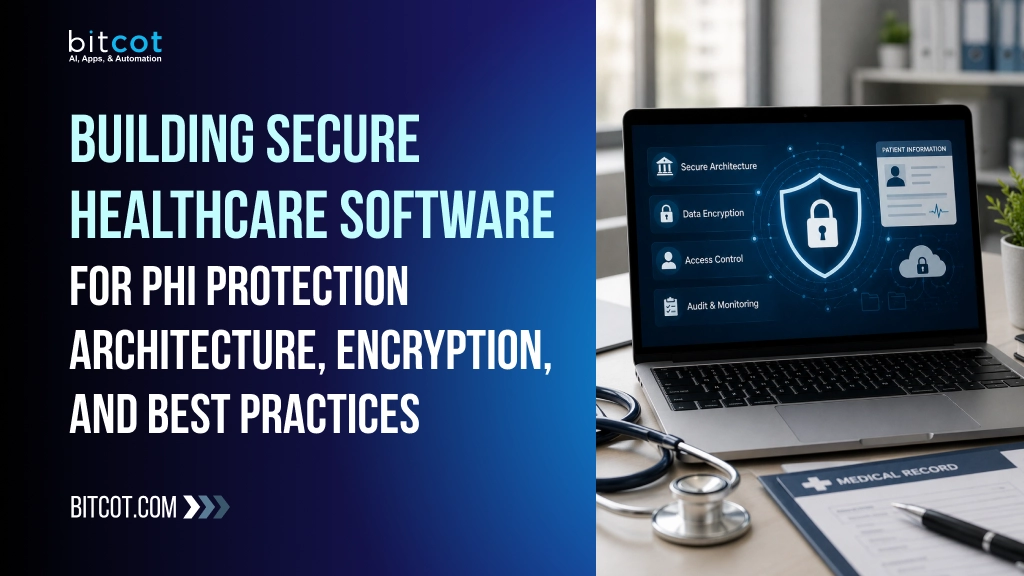
PHI protection in healthcare software is not a single control. It is a set of layered architectural decisions where field-level encryption, zero-trust service boundaries, attribute-based access control, and behavioral audit logging each address a distinct exposure surface that the others cannot cover alone.
The pattern underlying successful healthcare application security is not a more sophisticated tool. It is an earlier decision. Security architecture embedded before business logic is written requires far less remediation than security overlaid after deployment. Teams that make encryption scope, access policy design, and audit capture part of their initial architecture deliverables ship applications that are measurably harder to exploit and faster to investigate when an anomaly is detected.
If your team is designing or rebuilding a healthcare application where PHI flows across multiple services, the architectural decisions described here are worth validating against your current design before the first service boundary is committed. The cost of correcting a field-level encryption gap after deployment is orders of magnitude higher than scoping it correctly during architecture review.
Frequently Asked Questions
What is PHI protection in healthcare software?
PHI protection in healthcare software refers to the set of architectural controls that prevent unauthorized access to or exposure of Protected Health Information throughout an application’s data lifecycle. These controls include encryption at the field and transport layers, access policies tied to clinical context, and audit logging that captures behavioral patterns rather than only authentication events. The goal is to ensure that PHI is inaccessible to any component, user, or process that does not hold a documented, time-bound authorization for that specific data.
What is the difference between field-level encryption and volume encryption for PHI?
Volume encryption secures the physical storage medium so that data is unreadable if the storage is accessed outside the application, but offers no protection once a query runs inside the application layer. Field-level encryption goes further by encrypting individual PHI attributes (diagnosis codes, insurance identifiers, dates of birth) so that even a legitimate application query returns an encrypted value unless the caller holds the correct decryption key for that specific field. For healthcare applications, field-level encryption provides meaningfully stronger protection against application-layer intrusions because it limits PHI exposure even when an attacker holds a valid session.
How do you implement zero-trust architecture in a healthcare application?
Zero-trust in a healthcare application is implemented by removing implicit trust from every service boundary: each internal service authenticates the caller with a scoped token or mutual TLS certificate, access policies are defined per operation rather than per session, and no service assumes that internal network traffic is automatically authorized. The three primary implementation patterns are mutual TLS between internal services, short-lived tokens scoped to a specific API operation, and per-service authorization rules enforced at the gateway layer. Each component enforces its own access policy rather than relying on the perimeter to filter requests before they arrive.
How do healthcare software teams in San Diego approach PHI security architecture?
Healthcare software teams in San Diego increasingly treat PHI security as an architectural requirement rather than a compliance exercise, particularly in organizations building interoperable platforms that exchange data with payer networks, telehealth providers, and diagnostic systems. The California healthcare market’s concentration of health systems, digital health startups, and enterprise medical groups creates strong demand for applications where security controls are granular, auditable, and designed to survive an application-layer breach rather than just a perimeter one. Architecture-first security design has become a competitive differentiator in this market because it reduces the rework cycle that comes with retrofitting security onto a deployed system.
Is field-level encryption worth the added development complexity?
Field-level encryption adds development complexity in the form of key management infrastructure, encryption and decryption logic at the service layer, and additional testing for key rotation edge cases. That complexity is significantly lower than the cost of a PHI breach at the application layer, both in direct incident response and in the downstream impact on patient trust and operational continuity. For any healthcare application that transmits or stores diagnosis data, insurance identifiers, or biometric information, field-level encryption is not an optional enhancement; it is the architectural baseline for building a system that can withstand a realistic application-layer intrusion.