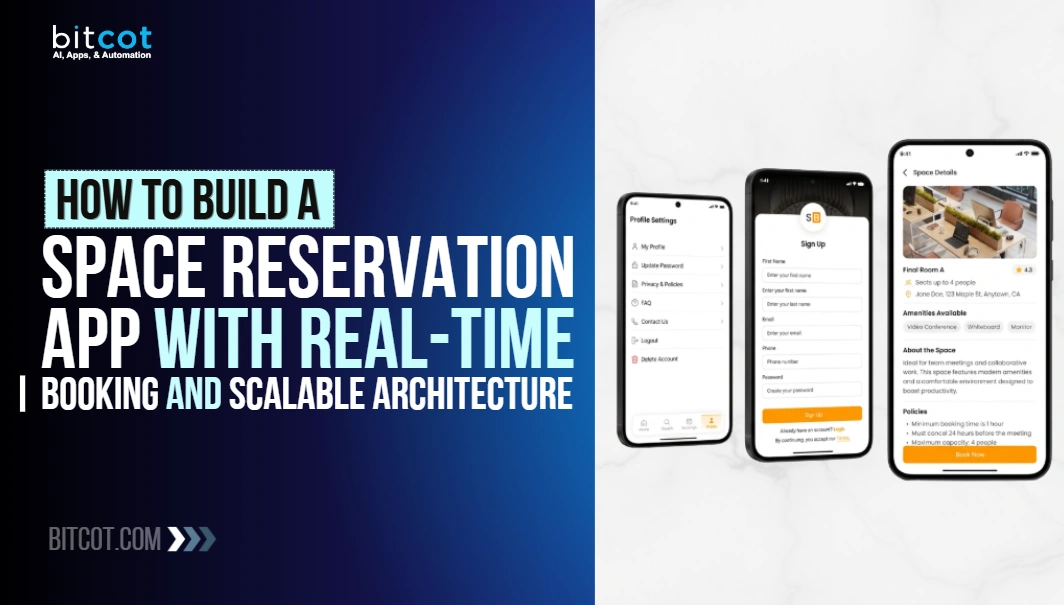
Key Takeaways
- Calendar-based tools cannot handle concurrent bookings; purpose-built architecture is required.
- Atomic GraphQL mutations resolve booking conflicts in under 200 milliseconds.
- Domain-based org mapping eliminates manual permission overhead from day one.
- A feature-based modular codebase lets teams ship new features in under one week.
- Architecture-first PoC development prevents $80K–$150K in production rebuild costs.
Introdcution
According to Gallup’s workforce panel, 53% of remote-capable U.S. employees now work in hybrid arrangements, with only 20% on-site full-time. That means the two or three peak days teams choose to come into the office create demand spikes that generic calendar tools were never designed to absorb. Two users request the same conference room at 9:02 AM on a Tuesday. Without a real-time data layer underneath the booking interface, both confirmations go through, and someone walks into a room that is already occupied.
The companies getting this right in San Diego and across California are not upgrading their calendar plugins. They are investing in purpose-built reservation platforms with a data layer, real-time sync, and organizational isolation built into the foundation from the start. This article walks through the full engineering approach behind building one: the tech stack decisions, the architecture patterns that prevent concurrent booking failures, the UX considerations that drive adoption, and the business case for doing it right the first time.
Why Hybrid Work Demands a Dedicated Space Reservation App
A space reservation app is a purpose-built platform for discovering, booking, and managing shared physical workspaces in real time. Unlike calendar integrations bolted onto facility management systems, a dedicated room booking app handles concurrent users, multi-tenant data isolation, and dynamic availability natively, as core requirements rather than afterthoughts.
The workspace management software market reflects how urgently organizations need this. According to Precedence Research, the global market was valued at $2.64 billion in 2025 and is projected to reach $10.30 billion by 2035, growing at a 14.6% CAGR, with North America holding the largest share at 38%. That growth is being driven by one core operational need: organizations managing shared spaces across flexible, non-predictable occupancy patterns.
The platforms failing at this problem were built for fixed-desk, five-day-a-week work. They assume stable occupancy patterns and treat concurrent booking as an edge case. In a hybrid model where peak days concentrate demand into 48-hour windows, concurrent booking is the default state, not the exception. Solving it requires a fundamentally different data architecture.
Key Features That Separate a Booking App from a Calendar Plugin
The feature set of a production-ready space reservation app is determined by what calendar tools cannot do, not by what they already do adequately.
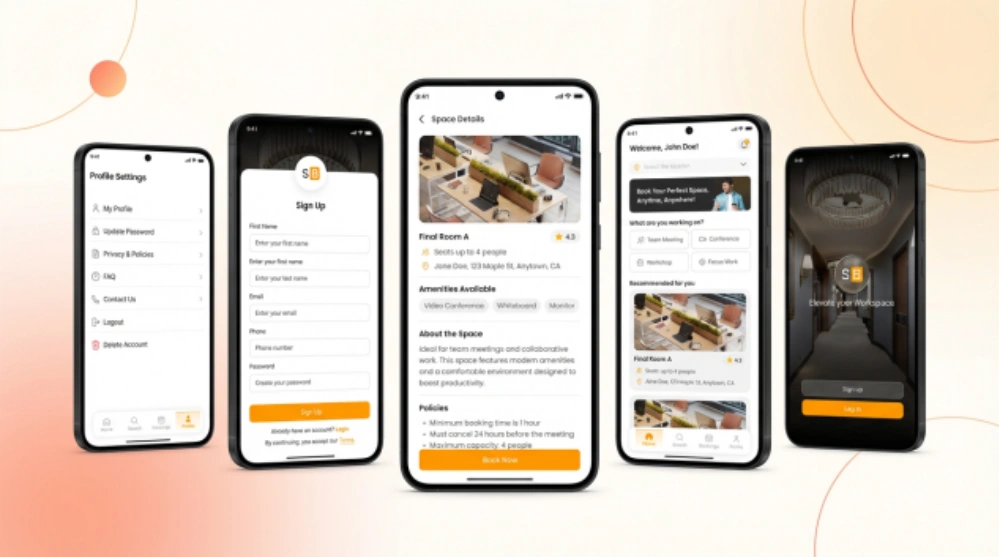
Smart space discovery goes beyond a room name and a time slot. Users search and filter spaces by keyword, preferences, and location using integrated maps. Image-rich listings give them the visual context to make an informed choice before committing to a booking. For organizations managing dozens of rooms across multiple floors, this discoverability layer alone reduces mis-bookings driven by unfamiliarity.
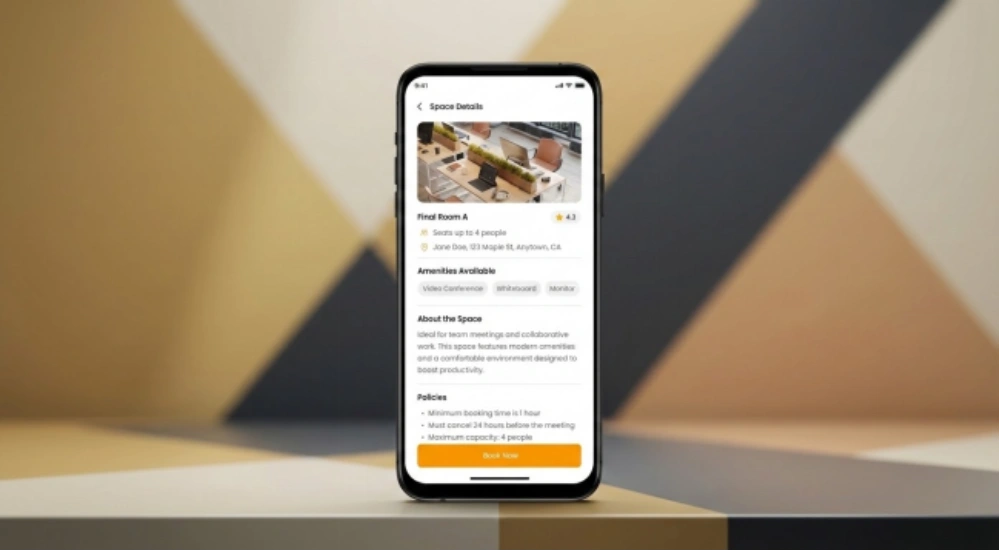
Real-time booking with instant confirmation is where calendar tools break under hybrid work pressure. Calendar-based date selection, dynamic slot availability rendering, and instant booking confirmation with no page refresh required are the baseline expectations for a credible reservation system. This feature directly eliminates double-bookings because the slot state is locked at the server level, the moment a booking is confirmed, not on the next calendar sync.
Reviews and peer feedback turn space selection from guesswork into informed decision-making. Multi-category feedback lets users rate spaces after use, giving facilities teams real utilization data and giving future users a signal on which rooms are worth booking. This is the kind of closed-loop data that room-management features inside larger platforms never generate.
Full booking lifecycle management covers history, status tracking, and cancellation flows built for users, not admins. When a user can view and cancel their own bookings without opening a support ticket, administrative overhead drops significantly.
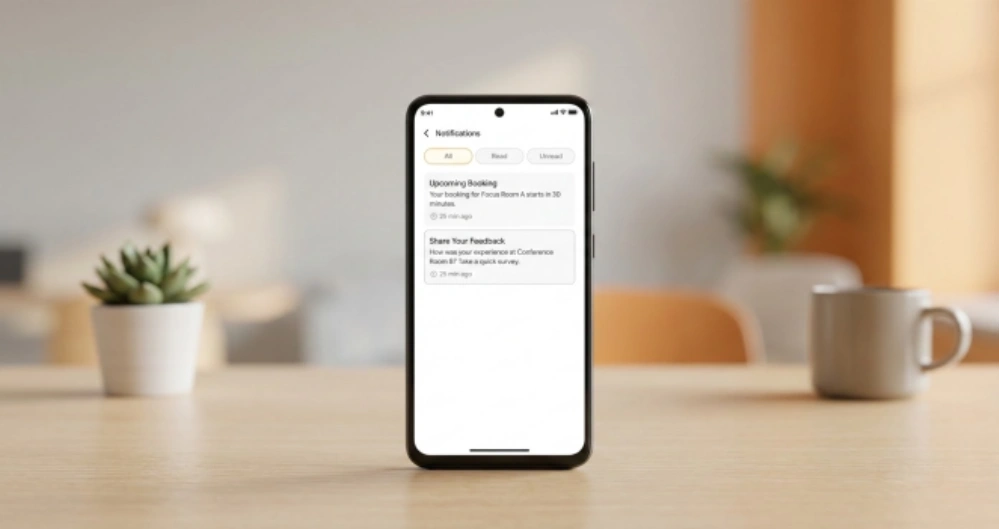
Notification system with segmented All, Read, and Unread tabs keeps users informed without requiring manual app checks. Automated alerts on booking confirmation, upcoming reservation reminders, and cancellation notices reduce no-shows and free up space for other users.
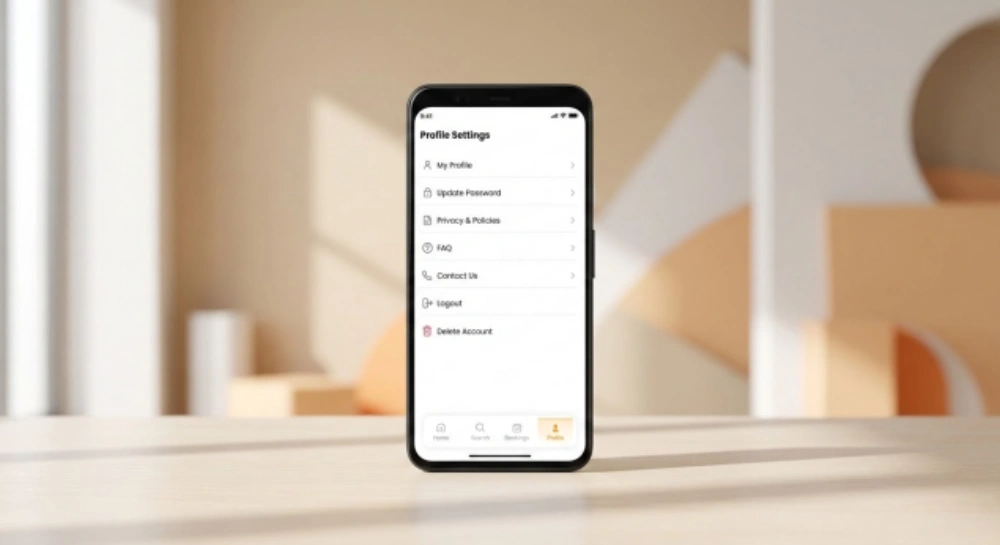
Account and profile management with domain-based organization mapping eliminates the manual permission work that typically falls on IT admins. Users register with their official domain email and are automatically placed in their organization’s context. One signup, automatic org mapping, zero admin overhead.
Choosing the Right Tech Stack for Space Reservation App Development
The technology choices behind a booking platform have direct consequences for how it performs under concurrent load and how quickly it can be extended. Each decision in the stack below was made to address a specific production constraint, not just developer preference.
| Technology | Role | Why We Chose It |
|---|---|---|
| React Native + Expo | Cross-platform mobile framework | Single codebase for iOS and Android with OTA updates |
| TypeScript | Language | Compile-time type safety and a predictable codebase at scale |
| GraphQL + Apollo Client | Data layer | Single-query nested data fetching, normalized caching, and optimistic UI updates |
| Zustand | State management | Minimal boilerplate, hook-based API, and scalability without Redux overhead |
| RxJS | Async event handling | Debounced search, notification streams, and reactive programming patterns |
| Firebase Crashlytics | Crash reporting | Real-time error tracking and performance monitoring |
| React Native Reanimated | Animations | 60 FPS native-thread animations and smooth cross-platform UX |
| React Native Maps | Location services | Location-aware space discovery and map-based search |
| Reanimated Carousel | Space image carousel | Smooth, high-performance image carousels for media-rich listings |
| Expo Image Manipulator | Image processing | Image resizing and optimization for space listing media |
React Native and Expo for Cross-Platform Delivery
The app runs on React Native v0.81.5 with Expo v54. A single codebase covers both iOS and Android, cutting development time without meaningful UX trade-offs. Expo’s over-the-air update capability means critical fixes ship without waiting for app store review cycles, a practical advantage for enterprise software where a booking bug at 9 AM cannot wait three days for review approval.
GraphQL and Apollo Client for Relational Booking Data
A space reservation system deals with deeply relational data. A space has slots. Slots have availability windows scoped to a date. Bookings reference users, spaces, and time ranges simultaneously. REST endpoints for this structure either require multiple round-trips or return bloated payloads.
GraphQL solves this by allowing the client to request exactly the data needed in a single query. Apollo Client adds normalized caching and optimistic UI updates: when a user taps to book, the UI reflects the confirmation immediately while the server processes the mutation. If the server rejects the booking (because another user beat them to it), the optimistic state rolls back cleanly. The net experience is instant feedback with an accurate eventual state, which is precisely what concurrent booking requires.
Zustand for Session and Booking State
Rather than Redux, the state layer uses Zustand. It manages user sessions, authentication state, booking flow data, notification counters, and global UI flags with minimal boilerplate and a hook-based API that integrates naturally with React Native’s component model. For teams extending the app with new features, Zustand’s module structure makes it straightforward to add new state slices without touching existing ones.

How Real-Time Slot Booking Eliminates Double Reservations
The booking flow is where the architecture either earns or loses user trust. A user selects a date from a calendar interface, sees dynamically updated slot availability, taps to book, and receives instant confirmation. Underneath that flow, the data layer is doing several things that calendar tools never do.
When a user taps to confirm a booking, an atomic GraphQL mutation fires. The server validates availability server-side before writing the booking record. If the slot is still available, the mutation completes and Apollo’s cache updates immediately, removing that slot from every other user’s active view. If two users attempt to book the same slot within milliseconds of each other, the second mutation receives a conflict response, and the UI rolls back the optimistic state. The second user sees the slot disappear rather than receiving a false confirmation.
Slot availability updates in under 200 milliseconds after a booking is confirmed. That responsiveness is not just a UX detail; it is what prevents the scenario where two users leave their desks and walk to a room they both believe they booked.
For the online booking system development work our team has done across multiple verticals, this atomic mutation pattern, combined with cache invalidation, is consistently the most reliable solution to concurrent booking conflicts. The trade-off, a brief visible rollback for the user who loses the race, is far preferable to silent double-booking that only surfaces when both parties show up at the room.
Scalable Architecture: Why Modular Design Matters from Day One
The codebase is organized by feature, not by file type. This is the most consequential structural decision in the entire build.
When a codebase is organized by file type (components/, screens/, styles/, utils/), adding a new feature requires touching multiple directories. A developer adding the review system has to navigate across the entire codebase, creating the risk of accidentally breaking unrelated features. When the codebase is organized by feature (Home/, Booking/, Login/, Notifications/, Search/, Reviews/), each module bundles its own UI, styles, and business logic. A developer working on Reviews never needs to open a Booking file.
Common UI elements like buttons, inputs, cards, and loaders live in a shared component library, keeping the visual language consistent across features. The network layer, state management, custom hooks, and utilities each have their own dedicated directories.
This structure delivered a measurable outcome during validation: the review and feedback system was added in under one week without modifying any existing booking logic. For a SaaS platform development team planning a roadmap with quarterly feature releases, that extensibility has direct revenue implications. Features ship faster because the architecture makes addition safe.
The modular design also addresses the most common PoC-to-production failure mode. When a proof-of-concept is built with throwaway architecture, the production team inherits every structural shortcut as a constraint. Refactoring a monolithic codebase under production pressure, while adding new features, is how schedules collapse, and budgets overrun. Starting modular means the PoC transitions directly into the production foundation without a rebuild cycle.
What Does It Take to Build a UX That Drives Booking Adoption?
The right answer to this question is measurable: a user should be able to book a room in under 10 seconds without reading instructions. Everything in the UX layer is oriented toward that benchmark.
Navigation uses @react-navigation with native navigation patterns, so transitions feel familiar on both iOS and Android without custom engineering. React Native Reanimated runs animations on the native thread at 60fps relevant because jank on lower-end Android devices is the most common reason users abandon productivity apps after the first week. Animations that stutter signal an app that does not respect the user’s hardware.
For space discovery, react-native-maps delivers location-aware search, react-native-reanimated-carousel renders image-rich space listings with smooth swipe behavior, and @gorhom/bottom-sheet handles contextual panels for filters and booking details without navigating away from the discovery screen.
Onboarding validates users against their organization’s domain email at registration. There is no admin approval step, no manual permission grant the domain match places the user in the right organizational context automatically. Forgot-password flows, profile management, preference customization, and a built-in FAQ all reduce the number of touchpoints where a user would otherwise contact support.
The UI scales to any device screen using horizontal, vertical, and balanced scaling functions. Centralized color and font constants mean a design update is a single-file change rather than a codebase search-and-replace.
Security, Multi-Tenant Isolation, and Performance Engineering
A booking platform handling organizational data has specific security requirements that generic SaaS platforms often handle as optional configurations. The approach used here treats them as architectural requirements.
Organization-level data isolation is pushed into the GraphQL schema itself, not handled as application-layer filtering. This means queries are structurally incapable of returning data outside the user’s organizational context. It is the difference between a security rule that can be accidentally bypassed by a developer and a schema constraint that is enforced at the data model level. This added complexity to schema design but removed an entire class of data-leak risk.
Authentication tokens and user preferences are persisted using @react-native-async-storage with secure storage patterns. Every GraphQL request is authenticated. Domain-based access control ensures only users with a verified organizational email can register.
Centralized logging unifies API calls, errors, and user actions into one structured system, integration-ready with external monitoring tools. Firebase Crashlytics captures real-time crash reports. RxJS handles complex async patterns, including debounced search queries critical for a discovery interface where every keystroke should not fire a network request and notification event streams.
Performance optimizations compound across layers. Apollo’s normalized cache reduces API calls by avoiding re-fetches for data already in memory. Reanimated offloads animation work to the native thread. Screens load lazily. Memoized components prevent unnecessary re-renders when booking state updates. The cumulative effect is an app that feels fast under the conditions that matter most: peak booking demand on a busy Tuesday morning.
For enterprise application development teams evaluating this stack, the observable performance benchmark is slot availability updating in under 200ms after a confirmed booking. That latency is achievable because the entire stack, from the atomic mutation to the cache invalidation to the UI re-render, is designed to minimize the round-trip path.
Real Engineering Challenges and How They Were Solved
No production-quality build reaches validation without encountering problems that require genuine trade-off decisions. Four challenges surfaced during this build that are worth documenting because they recur in most concurrent-booking systems.
Concurrent booking conflicts were solved with atomic GraphQL mutations that validate availability server-side before confirming, combined with Apollo cache invalidation that refreshes the losing user’s view immediately. The accepted trade-off is a brief optimistic state rollback for the second user. Delayed confirmation for all users, the alternative degraded the experience further.
Cross-platform UI consistency for calendar components, bottom sheets, and map views was solved by using React Native Reanimated instead of the default Animated API. Reanimated offloads work to the native thread and eliminates jank on lower-end Android devices, where the default API produces visible frame drops during complex transitions.
Organization-level data isolation at query depth required moving isolation logic into the GraphQL schema rather than handling it in resolvers. The added schema design complexity was the correct trade-off: resolver-level filtering is prone to missing cases as the schema grows, while schema-level isolation is structurally enforced.
Scope discipline versus production readiness was the hardest constraint to maintain. Every feature that shipped had to work reliably in production. Limiting the feature count to what was needed to validate the core concept, depth over breadth, was the principle that kept the PoC from becoming a half-finished feature catalog.
The Business Case: Architecture-First Development Versus Throwaway PoC
The total cost of a proof-of-concept is not determined by the build phase alone. It is determined by whether the production team inherits a foundation or a liability.
A PoC built on throwaway architecture costs the same upfront, roughly in the $30K to $75K range for a scoped real-time booking system, but then requires a rebuild before it can carry production load. Teams frequently underestimate what that rebuild involves: not just rewriting the code, but re-designing the data model, migrating existing data, and managing the disruption to a product that stakeholders have already seen and approved. That rebuild cycle typically costs more than the original build.
An architecture-first PoC built on the same budget transitions directly into the next development phase. The modular codebase can absorb new features. The GraphQL schema supports additional query complexity. The multi-tenant isolation model scales to additional organizations without re-architecting.
The business impact of a well-functioning space reservation system compounds beyond development costs. Facilities teams spend measurably less time resolving booking conflicts. Employees complete space reservations in under 10 seconds. Utilization data from the review and feedback system gives real estate teams actionable signals on which spaces are underused and which are consistently overbooked, supporting smarter decisions about floor configuration and lease renewal.
For companies managing multiple locations, even marginal improvements in space utilization translate to meaningful reductions in real estate overhead. The reservation platform pays for itself not through the direct cost of development, but through the operational costs it eliminates.
How to Scale a Space Reservation App from PoC to Full Product
The validated PoC covers the core use case: users can register, discover spaces, book slots in real time, track their booking history, and receive notifications. The modular architecture makes the path to a full product straightforward.
Phase two adds organizational admin dashboards with utilization analytics, Google and Outlook calendar integration for users who need their space bookings reflected in their existing scheduling tools, and role-based permissions beyond the current domain-level model. Each of these can be built as independent modules without touching the existing booking or notification logic.
Phase three addresses infrastructure hardening: CI/CD pipelines, automated test coverage, staging environments, load testing under simulated concurrent-user peaks, and monitoring dashboards that surface performance degradation before it reaches users. For cloud-native application development teams taking this to production, the layered architecture makes each of these concerns independently addressable.
The workspace booking technology roadmap beyond phase three is already taking shape across the industry. AI-driven space optimization, IoT-based occupancy sensing, and predictive booking based on historical patterns are moving from experimental features to baseline expectations. Platforms built on flexible, modular architectures today will integrate these capabilities without requiring a foundation rebuild.
What We’ve Observed Across Multi-Tenant Booking Builds
The pattern we see most consistently across booking platform builds is that multi-tenancy gets added as an afterthought. A team builds a single-organization booking system, validates it, and then tries to add organization isolation before launching to a second customer. At that point, the data model is not designed for it, the query logic does not account for it, and the notification routing has no concept of organizational scope. The retrofit work takes longer than building it correctly the first time would have.
Our engineering team made the decision early to push multi-tenant isolation into the GraphQL schema itself rather than handling it at the application layer. That decision added complexity during schema design, but the outcome was a system where every query is structurally scoped to an organizational context, and the notification routing required zero additional filtering logic because the user context was already scoped.
For software development in San Diego and across the organizations we work with in California, this pattern of getting the data model right before the feature layer is what separates products that scale from products that plateau. The booking system that works for one organization and breaks for ten is a common outcome of scope-first, architecture-later development. It is avoidable with the right decisions made in the right order.

Conclusion
The central finding from this build is not about any specific technology. It is about sequencing. Architecture decisions made before the first line of feature code is written determine whether a space reservation platform can carry production load, handle concurrent users without double-booking, and absorb new features without rework.
Atomic GraphQL mutations, organization-level schema isolation, and a modular feature-based codebase are not advanced engineering; they are the correct baseline for a booking system that needs to work reliably under hybrid work demand patterns. The validation results are specific: slot availability updates in under 200 milliseconds, concurrent booking conflicts resolve without double reservations, and new feature modules can be added in under a week without modifying existing logic.
Organizations evaluating space reservation app development for the first time should treat the architecture phase as the highest-leverage investment in the entire project. It is the difference between a platform that ships once and works, and one that requires a rebuild before it can scale.
Frequently Asked Questions
What is a space reservation app and how does it differ from a calendar booking tool?
A space reservation app is a purpose-built platform for discovering, booking, and managing shared physical workspaces in real time, with native support for concurrent users, multi-tenant data isolation, and dynamic slot availability. Calendar booking tools handle individual scheduling but lack the data architecture to resolve concurrent booking conflicts or isolate organizational data at the schema level, which makes them unsuitable as the foundation for enterprise workspace management.
What is the difference between a REST-based and GraphQL-based booking system?
A REST-based booking system typically requires multiple API round-trips to fetch relational data like spaces, slots, availability windows, and user context. A GraphQL-based system fetches all of that in a single query, which reduces latency and enables normalized client-side caching. For a space reservation app where slot availability must update in under 200 milliseconds after a booking, GraphQL with Apollo Client’s optimistic UI pattern delivers measurably better performance than comparable REST implementations.
How does a space reservation app prevent double bookings in real time?
Double bookings are prevented through atomic GraphQL mutations that validate slot availability server-side before writing a booking record. When a booking is confirmed, the server locks that slot, and Apollo Client’s cache invalidation immediately removes it from other users’ views. If two users request the same slot simultaneously, the second mutation receives a conflict response, and the optimistic UI state rolls back, so that the second user sees the slot disappear rather than receiving a false confirmation.
How is space reservation app development used by organizations in San Diego?
Organizations in San Diego managing hybrid workforces use purpose-built space reservation platforms to manage conference rooms, shared desks, and event spaces across peak-demand days. The domain-based organization mapping model is particularly relevant for San Diego’s technology and biotech employers, where multiple teams operate out of shared facilities and manual permission management creates administrative overhead at scale. The review and utilization data generated by the platform also support real estate decisions specific to California office market conditions.
Is building a custom space reservation app worth it compared to using an off-the-shelf solution?
A custom space reservation app is worth building when an organization requires multi-tenant data isolation, atomic concurrent booking resolution, or workflow integrations that generic platforms do not support. Off-the-shelf tools work for predictable, single-location, low-concurrency environments. For organizations managing hybrid work across multiple teams or locations, the operational cost of double bookings, manual admin overhead, and workarounds to calendar limitations consistently exceeds the investment in a purpose-built platform over a two-to-three-year horizon.