The AI ecosystem continues its explosive growth. According to recent industry reports, AI adoption has reached unprecedented levels, with 88% of organizations now using AI in at least one business function (a significant jump from 78% in early 2025).
The report discusses something big: “AI bottlenecks.” These are the sticking points where businesses get tripped up, slowing progress and leaving employees frustrated.
Sound familiar? You’re not alone.
If you’re a CTO, business owner, or innovation leader, you’re likely feeling the pressure. Competitors are moving faster, customers expect more intelligent experiences, and your board wants to see ROI from AI investments. The fear of making the wrong technology bet or wasting months on a failed implementation keeps many leaders up at night.
AI adoption is accelerating dramatically, with 88% of workers now using it regularly in their work. But here’s the kicker: only one-third of organizations report having scaled their AI programs enterprise-wide.
This gap between enthusiasm and execution remains significant. Companies are rushing to adopt AI, but many lack a solid strategy to integrate it effectively. As we explored in our analysis of why companies are adopting AI-based automation, the opportunities are massive, but so are the challenges.
The result? Inefficiencies, missed opportunities, and a lot of confusion. Not to mention the emotional toll of watching competitors gain ground while your team struggles with implementation.
The key takeaway is the importance of having a structured AI implementation strategy. That’s why finding the right AI partner is more important than ever.

So, we’ve rounded up the top 10 AI software development firms leading the charge in 2026. These are the trailblazers providing expertise and guidance in intelligent automation and AI transformation.
Why Businesses Rely on Artificial Intelligence Development Companies
AI is transforming business operations, but building and deploying AI solutions on your own is no small feat.
The reality many technical leaders face: You need to deliver AI solutions fast, but hiring is slow, expertise is scarce, and building in-house means pulling resources from critical projects. Meanwhile, the business is demanding results.
While many organizations think they can handle AI development internally, there are several compelling reasons why partnering with firms developing enterprise AI solutions is often the better choice.
Access to Specialized Expertise
AI development is a highly specialized field requiring a combination of skills in data science, machine learning, natural language processing, computer vision, and deep learning. Robust AI systems also require understanding algorithms, mathematical models, and working with large, complex datasets.
Let’s face it: it’s hard to find this expertise in-house unless you’re a big tech company.
The hidden cost: Even if you hire data scientists, they need 3-6 months to understand your business context, data quality issues, and specific use cases. That’s half a year before they write their first production model.
Professional AI developers typically employ top data scientists and researchers with years of experience creating applications for various industries. These experts understand cognitive computing and can design systems that truly understand and respond to complex business needs.
Cost Efficiency
Building a dedicated AI team in-house can be expensive. Hiring data scientists, machine learning engineers, and AI researchers requires significant investment in salaries, training programs, software tools, and infrastructure for data collection, storage, and processing.
The real numbers: A senior ML engineer costs $150K-250K annually, plus benefits. Multiply that by the 3-5 specialists you need, add infrastructure costs, and you’re looking at $750K-$1.5M before you deploy a single model.
Outsourcing to an AI firm allows access to these resources without the hefty upfront investment.
Organizations now report a 3.7x ROI for every dollar invested in generative AI and related technologies, making the business case increasingly clear.
Speed to Market
Established AI firms already have proven workflows, tools, and methodologies for building and deploying solutions quickly. They’re accustomed to working on tight deadlines and can deliver AI products faster than an in-house team just starting to build its capabilities.
The competitive edge: While your competitors take 12-18 months to build internal capabilities, an experienced AI partner can have your MVP running in 8-12 weeks, giving you a critical head start. Modern approaches like AI-powered development with tools like v0 and Cursor are accelerating this timeline even further.
Scalability and Flexibility
AI development isn’t a one-time thing. As your business grows, your AI solutions need to evolve. Specialized firms excel at building scalable machine learning platforms that grow with your organization.
They ensure your AI systems are flexible enough to adapt as new needs and opportunities arise. Whether you’re building SaaS platforms or custom software solutions, scalability should be built in from day one.
Access to Cutting-Edge Technology and Innovation
AI is constantly evolving, with new breakthroughs in algorithms, techniques, and technologies emerging daily. What works today may not be the best solution tomorrow.
The global AI market reached $243.7 billion in 2025 and is projected to hit $826.7 billion by 2030, representing a compound annual growth rate (CAGR) of 27.67%.
Leading AI firms stay on top of the latest trends and technologies. By partnering with them, you ensure your business always has access to cutting-edge solutions.
The tools that matter in 2026: Top firms work with platforms like LangChain, LlamaIndex, AWS Bedrock, Azure OpenAI, Anthropic Claude, and modern frameworks like LangGraph and CrewAI for building AI agents, giving you production-ready solutions built on proven technology stacks.
Risk Mitigation
AI development comes with risks, including data privacy concerns, algorithmic bias, and the possibility of failed projects. Experienced providers manage these risks through proper AI governance frameworks.
They follow best practices for data security, ethical AI design, and model testing to ensure your AI systems are ethical, secure, and reliable.
Avoiding costly mistakes: A poorly designed AI system can cost more than money. It can damage customer trust, violate regulations (GDPR fines up to €20M), or create PR nightmares. Experienced partners have navigated these challenges, particularly in sensitive areas like AI in medical diagnosis where accuracy is life-critical.
Compliance and Ethical Standards
AI development must comply with various legal and ethical standards, such as data protection regulations (e.g., GDPR) and fairness in algorithmic decision-making.
Professional AI firms are familiar with these regulatory requirements and ensure the systems they develop are compliant and ethical, protecting your business from legal risks.
How Did We Curate the List of Top AI Development Firms?
Putting this list together wasn’t about digging through endless data or running every possible technical evaluation. We focused on finding firms that actually get results and have a reputation for doing good work in the AI space.
Our selection criteria focused on what matters to you:
- Proven track record: Real client results, not just marketing claims
- Technical depth: Teams that build with modern AI stacks, not just integrate APIs
- Business understanding: Partners who speak your language, not just tech jargon
- Delivery speed: Providers that ship working solutions, not endless POCs
We wanted this list to be genuinely helpful. So, we focused on the basics: Who’s actually doing impactful work in AI? Who’s delivering real value? And most importantly, who’s making AI easier to use, not more complicated?
We looked for firms that don’t just talk about AI but actually make it work in the real world. We also wanted a good mix, from specialists helping smaller businesses to those handling big, complex enterprise projects.
10 Best AI Development Companies with Top Developers in 2026
With 92% of organizations planning to invest in generative AI over the next three years, selecting the right AI partner has never been more critical.
Some top firms are solving these challenges head-on, bridging the gap between adoption and impact.
1. Bitcot
Bitcot is an award-winning AI software development firm focused on delivering custom AI and intelligent automation solutions for small and medium-sized businesses across multiple industries.
With a reputation for agile development and affordable solutions, Bitcot optimizes processes, boosts efficiency, improves decision-making, and enhances customer experiences through AI-powered systems.
Our Development Approach: We use a proven 5-phase process that gets you from concept to production in 8-12 weeks:
- Discovery & Strategy (1-2 weeks): Deep-dive into your business goals, data environment, and success metrics
- Proof of Concept (2-3 weeks): Rapid prototype to validate approach and demonstrate ROI potential
- Development (4-6 weeks): Agile sprints with weekly demos and continuous feedback
- Integration & Testing (1-2 weeks): Seamless deployment into your existing systems
- Optimization & Scale (Ongoing): Continuous monitoring, improvements, and feature expansion
Technology Stack We Use:
- AI Frameworks: LangChain, LlamaIndex, LangGraph, CrewAI, Phidata
- Cloud Platforms: AWS Bedrock, Azure OpenAI, Google Vertex AI
- Development Tools: Flowise, n8n, Botpress, Copilot Studio, Power Automate
- ML Operations: MLflow, Weights & Biases, Docker, Kubernetes
Over the past six years, Bitcot has expanded into GenAI integration services and is a leading innovator in low-code software solutions. We’re pioneering the use of advanced technologies such as agentic workflows, RAG, and knowledge graphs.
Real-World Applications: Our expertise spans multiple domains, from AI-powered data pipelines that process millions of records to healthcare automation solutions that improve patient outcomes. We’ve also implemented legal workflow automation and AI chatbots for eCommerce that drive conversions.
Key Services:
- AI Development Services
- AI Agent Development
- AI Consulting Services
- Chatbot Development
- Workflow Automation
- Healthcare AI Agents
With proven expertise across these domains and a strong track record of delivering measurable business results, we’ve become a trusted partner for organizations seeking practical AI transformation.
2. IBM Watson
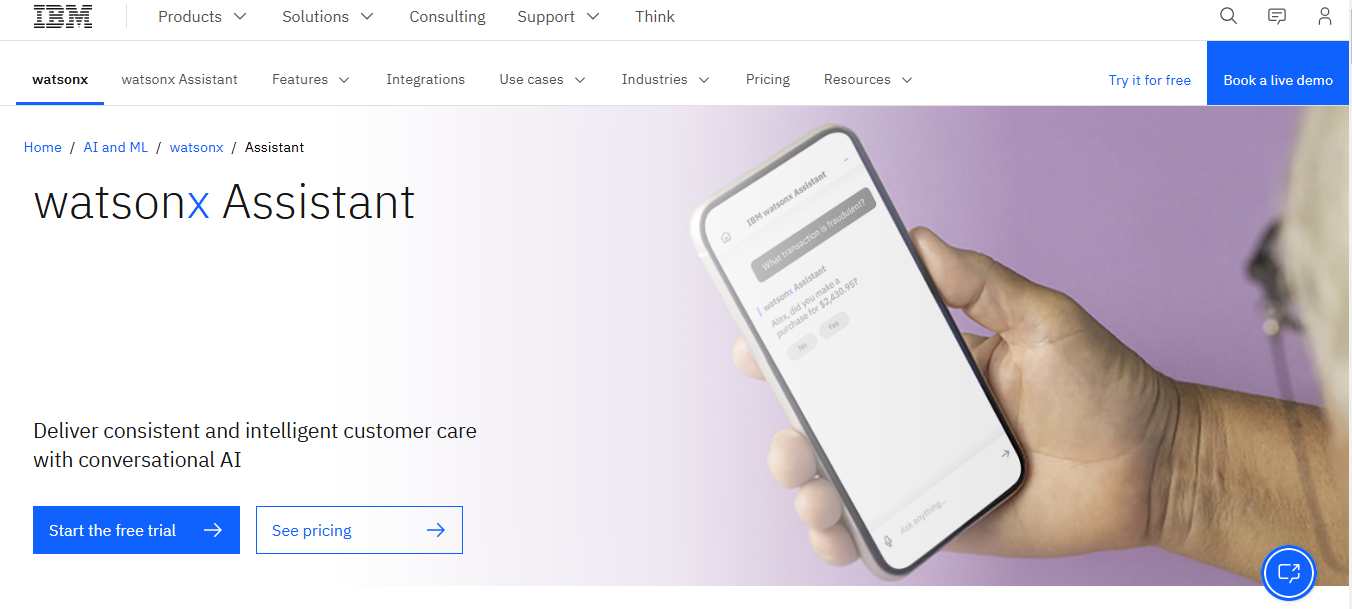
IBM Watson is one of the most recognizable names in the AI space. Known for its AI-powered solutions in data analysis, automation, and customer service, Watson boosts efficiency with ML and NLP.
IBM Watson’s enterprise-level solutions are a top choice for organizations looking to scale AI across their operations. With capabilities such as cognitive computing, Watson enables data-driven decisions, optimized workflows, and enhanced customer experiences.
3. C3.ai
C3.ai is known for its enterprise AI applications that deliver predictive insights and optimize operations across various industries. Their platform uses advanced ML algorithms to provide data-driven solutions.
C3.ai’s solutions are particularly effective in supply chain optimization, predictive maintenance, fraud detection, and energy management. By integrating with existing enterprise systems, C3.ai reduces costs and accelerates time to market.
4. DataRobot
DataRobot empowers organizations by automating the machine learning lifecycle. With their AI platform, users can build and deploy ML models in record time, without needing a PhD in data science.
By streamlining the model-building process with automated data prep, feature engineering, and model selection, DataRobot allows organizations to quickly implement AI at scale and turn data into actionable insights.
5. Accenture
Accenture has been a major player in the AI space for years, heavily investing in AI and emerging technologies through partnerships, acquisitions, and innovations.
Accenture specializes in AI strategy and consulting, defining and implementing tailored solutions for clients. Their AI capabilities span ML, automation, and AI-powered analytics, enabling organizations to scale operations and deliver superior customer experiences.

6. Cognizant
Cognizant offers AI-driven digital engineering services, focusing on creating intelligent, scalable solutions for predictive analytics, natural language processing, machine learning, and cognitive automation.
One of their unique offerings is Cognizant AI & Automation Factory, which accelerates AI capability scaling through pre-built solutions, frameworks, and accelerators.
7. Deloitte
Deloitte‘s AI services focus on enhancing business performance through the integration of AI and analytics. With an emphasis on data-driven insights, their solutions improve operations, supply chains, customer relationships, and market analysis.
They provide industry-specific AI solutions for sectors like healthcare, finance, and retail, optimizing processes like fraud detection, customer engagement, and predictive analytics.
8. H2O.ai
H2O.ai is a leader in open-source AI and ML, providing powerful tools for data analytics and predictive modeling. Their platform empowers organizations to build and deploy AI models that solve complex challenges.
H2O Driverless AI simplifies the model-building process with automated ML capabilities, enabling data scientists and business users alike to create robust AI models without deep technical expertise.
9. Affectiva

Affectiva, now part of Smart Eye, is a leading firm focused on emotion AI and human-centered ML solutions. Their products use computer vision and deep learning to analyze human emotions and behaviors.
Their technology is especially useful for incorporating emotion recognition and human-centric AI into customer service, marketing, and consumer products.
10. PathAI
PathAI specializes in AI-driven pathology solutions, offering custom-built AI products designed to assist healthcare organizations in diagnostic processes.
Their platform leverages deep learning to analyze medical data, providing tools that enable pathologists to make more accurate diagnoses and treatment recommendations, improving patient outcomes and operational efficiency.
11. Charter Global
Charter Global is a leading IT solutions provider specializing in digital transformation, custom software development, and enterprise IT consulting.
With expertise in agile development and cutting-edge technologies, Charter Global optimizes software development lifecycles, leveraging AI, cloud computing, and automation to improve efficiency.
How to Choose the Best AI Development Company for Your Business
Selecting a partner to build AI solutions requires understanding how well they can align with your unique needs and integrate AI into your business processes for long-term success.
The stakes are high: Choose the wrong partner, and you’ll waste 6-12 months and potentially hundreds of thousands of dollars. Choose the right one, and you’ll have a competitive advantage that compounds over time.
1. Understand Your AI Needs
Before looking for an AI development partner, understand exactly what you’re hoping to achieve. AI is not a one-size-fits-all solution, so pinpoint the problem you’re solving.
Do you need AI for process automation, predictive analytics, or customer service?
Framework for clarity:
- What’s the business problem? (e.g., “Customer support response time is 24 hours, we need it under 2 hours”)
- What’s the current cost? (e.g., “$500K annually in support staff costs”)
- What’s the target outcome? (e.g., “Reduce support costs by 40% while improving CSAT by 20%”)
- What’s the timeline? (e.g., “Need solution live by Q3 2026”)
A good AI partner will help you refine your needs and goals, then design a solution tailored to your situation.
2. Look at Their Expertise and Specializations
Different providers specialize in different AI areas. When evaluating, look for expertise in:
- Machine Learning and Deep Learning for predictive analytics and automation
- Natural Language Processing (NLP) for conversational AI, virtual assistants, or sentiment analysis
- Computer Vision for image, video, or visual data analysis
- Data Engineering for building composable data meshes and modern data infrastructure
Make sure the firm has experience in your specific domain. For example, if you’re in healthcare, your AI partner should have experience with HIPAA guidelines and understand how AI is transforming healthcare.
Red flags to watch for:
- Generic portfolios with no industry-specific work
- Case studies that are vague about actual results
- Teams that can’t explain tech choices in business terms
- No production deployments, only prototypes or POCs
Ask for case studies or examples of previous projects, especially those similar to yours.
3. Evaluate Their Approach to Problem-Solving
AI isn’t just about coding; it’s about solving real business problems. Look for providers that employ a structured, iterative approach:
- Problem Framing: Understanding your business challenge to ensure AI is the right approach
- Data Strategy: Robust data collection, cleaning, and preparation processes, including expertise in prompt engineering for data pipelines
- Model Selection and Validation: Rigorous processes for testing bias, accuracy, and performance
The right questions to ask:
- “How will you validate that AI is the right solution for our problem?”
- “What’s your process for handling poor data quality?”
- “How do you measure success beyond model accuracy?”
- “What’s your approach to explaining AI decisions to non-technical stakeholders?”
4. Assess Their Ability to Scale AI Solutions
Look for a provider that designs scalable solutions that can handle your current needs and adapt as your business changes.
Key considerations:
- Modular Architecture: Can it integrate with new data sources and extend to handle additional processes?
- Cloud Compatibility: Proficiency in deploying AI solutions in the cloud and managing cloud infrastructure
Scalability checklist:
- Can handle 10x increase in data volume without major rework
- API-first design for easy integration with future tools
- Containerized deployment (Docker/Kubernetes) for scaling
- Monitoring and observability built-in from day one
5. Communication and Collaboration
You need an AI partner who’s easy to communicate with. The best providers will be transparent about timelines, costs, and technical aspects.
Communication standards to expect:
- Weekly progress updates with demos of working features
- Transparent roadmap with clear milestones and deliverables
- Real-time collaboration tools (Slack, Teams, shared boards)
- Executive summaries that translate tech progress to business impact
6. Post-Deployment Support
AI doesn’t stop once it’s deployed. Choose a provider that offers robust post-deployment support.
What ongoing support should include:
- Model performance monitoring and drift detection
- Monthly optimization reviews and recommendations
- Priority bug fixes and technical support (SLA-backed)
- Quarterly strategy sessions to identify new AI opportunities
- Access to latest model updates and framework improvements
7. Price vs. Value
Focus on value, not just price. Don’t fall into the trap of going with the cheapest option if it means compromising on quality.
The real cost calculation:
- Cheap option: $50K upfront, but takes 9 months, requires rework, delivers minimal ROI = Total cost: $200K+ (including opportunity cost)
- Premium option: $150K upfront, delivers in 3 months, generates 3.5x ROI in year one = Net value: $375K+ in year one
Make sure you understand the pricing model and what’s included. Sometimes the lowest price costs more in the long run if quality isn’t there.

Final Thoughts
Every business should be able to make AI work for them. By making AI accessible and relevant to everyone, we can address some of the world’s most pressing challenges.
Whether it’s automating supply chain management, improving customer support with AI chatbots, or streamlining data analysis, we focus on practical AI solutions that generate measurable results. From building AI-native data stacks to developing software products using AI and vibe coding, we’re here to help you succeed.
Our Promise to You:
- No AI for AI’s sake: We only recommend AI where it delivers clear ROI
- Transparent pricing: Fixed-scope projects with no surprise costs
- Rapid validation: Working prototype in 2-3 weeks, not months
- Your success is our success: We measure ourselves by your business outcomes
What You Can Expect When Working With Us:
- Discovery Call (30 min): We understand your challenges and goals
- Solution Design (1 week): Custom proposal with clear ROI projections
- Rapid POC (2-3 weeks): Prove the concept with your real data
- Full Development (6-10 weeks): Agile delivery with weekly progress
- Launch & Optimize (Ongoing): Continuous improvement and scaling
Get in touch, and let’s start a conversation about how AI can transform every facet of your business.
FAQs
1. What trends in AI are driving innovation among these top companies in 2026?
In 2026, trends like AI agents, agentic workflows, generative AI, and RAG (Retrieval-Augmented Generation) are driving innovation. With AI agent adoption reaching 23% at scale and 39% in experimentation phases, firms are also focusing on creating more transparent, explainable AI systems and leveraging AI for sustainability and social good.
2. Are these AI companies focused on product development or custom solutions?
Many of the providers on the list excel in both areas. While some specialize in creating proprietary AI products, others focus on delivering tailored solutions for clients’ unique needs. At Bitcot, we specialize in custom software solutions built specifically for your business processes and data.
3. Are the companies on the list focused on specific industries or sectors?
The firms featured in this article serve diverse industries, ranging from healthcare and finance to retail and manufacturing. Some specialize in specific sectors, while others offer versatile solutions adaptable across multiple domains.
4. Do these companies also provide AI integration and support services?
Yes, most of the providers listed offer end-to-end services, including AI integration into existing systems, training for employees, and ongoing support and maintenance. The key is ensuring your provider offers SLA-backed support, not just “best effort” maintenance.
5. What industries are most likely to benefit from the services of AI companies in 2026?
Industries such as healthcare, finance, eCommerce, manufacturing, logistics, and entertainment are experiencing significant benefits from AI. According to current data, 88% of organizations are using AI in at least one business function, with information technology capturing 74% of total venture capital funding in AI. Healthcare AI investments have grown 15% quarter over quarter.
However, any industry with repetitive processes, large datasets, or customer interaction challenges can benefit. We’ve successfully deployed AI solutions across legal services, education, real estate, and non-profits as well.