Nine out of ten app startups fail – not because the technology broke, but because the founder picked the wrong idea at the wrong time.
The mobile app development market is projected to hit $305 billion in 2026, growing at a 15.18% CAGR through 2031. The US app market alone generated $52.3 billion in 2024 – a 16.4% jump from the previous year. Behind every billion-dollar stat is a founder asking, “What app should I build next?”
That question has never been more urgent. Over 300 million Americans now carry smartphones. The average US user spends more than four hours daily on their phone. And with AI, 5G, and low-code platforms slashing development timelines by 40-60%, the barrier to launching a successful app has never been lower.
But the real challenge is not building the app. It is choosing the right idea.
This is not another generic app ideas listicle. This guide breaks down 50+ proven web and mobile app ideas for 2026 – organized by industry, validated by market data, and built specifically for US-based entrepreneurs ready to move fast.
Each idea includes the revenue model, key features, and why the timing is right. Whether the goal is a lean MVP or a full-scale SaaS platform, these ideas represent where real demand meets real opportunity.
Why 2026 Is a Defining Year for US App Startups
The convergence of multiple forces is creating a rare window for American entrepreneurs. This is not a gradual shift – it is a full-scale digital transformation of how businesses operate and consumers engage.
The latest software development trends confirm this acceleration. AI integration is no longer optional – 63% of mobile app developers now embed AI features into their products. Low-code and no-code platforms are growing at a 26.7% CAGR, letting non-technical founders move from rapid prototyping to market-ready products in weeks instead of months.
Meanwhile, user behavior has shifted permanently. Over 55% of all US web browsing happens on mobile. App-based subscriptions and in-app purchases continue to climb, especially for non-gaming verticals like health, finance, and productivity.
For founders wondering “Is it too late to launch a mobile app in 2026?” – the data says no. The US remains the second-largest app market globally by revenue, and categories like AI tools, fintech, and health tech are still in early growth stages.
The opportunity is wide open. The question is which vertical to target – and some of the strongest opportunities might surprise even experienced founders.
How to Evaluate an App Idea Before Building
Not every idea deserves six months of development. Smart founders validate fast. Here is a simple framework to separate strong concepts from distractions.
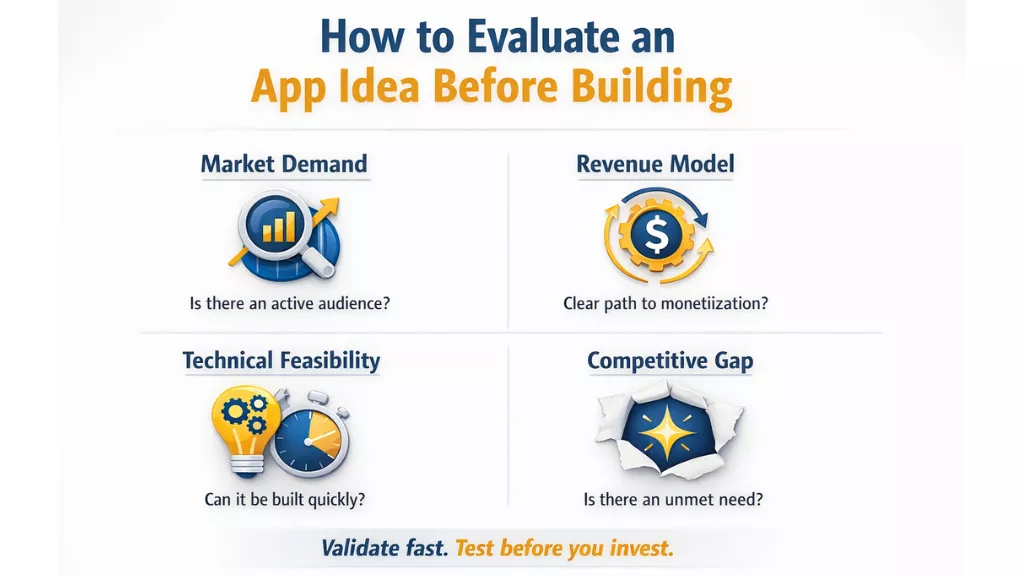
Market demand: Is there a clear, growing audience searching for this solution? Tools like Google Trends, SEMrush, and even ChatGPT search patterns can reveal real-time demand signals before committing to a full product roadmap.
Revenue model clarity: Can this app monetize through subscriptions, transactions, ads, or premium tiers? The strongest ideas have obvious paths to recurring revenue.
Technical feasibility: Can a lean team build a minimum viable product (MVP) within 8-12 weeks? Or does this idea require years of infrastructure before launch?
Competitive gap: Are existing solutions clunky, overpriced, or underserving a specific niche? The best app ideas in 2026 do not reinvent the wheel – they serve the wheel to a neglected audience.
Regulatory fit: Especially in healthcare, fintech, and education, US regulations like HIPAA, SOC 2, and state-level compliance shape what can be built and how fast.
Founders often ask, “How do I know if my app idea is good enough?” The answer: validate with real users before writing a single line of code. Discovery sprints, landing page tests, and user interviews cost a fraction of full development – and they reveal whether demand is genuine.
50+ Web and Mobile App Ideas for American Entrepreneurs in 2026
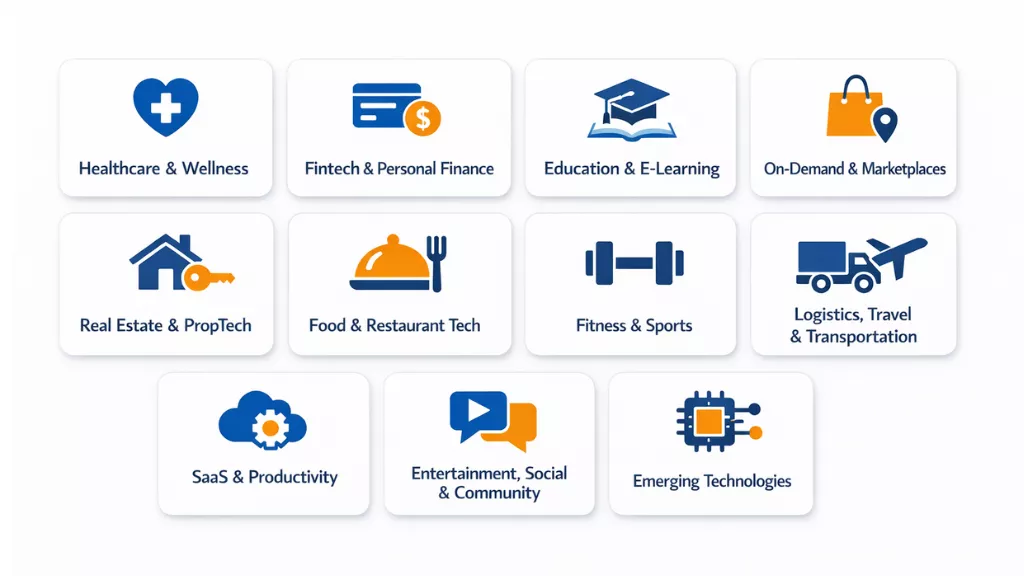
The ideas below are grouped by industry vertical. Each includes the core concept, why it works in 2026, key features, and the primary revenue model. Some of these categories are obvious. Others are hiding in plain sight.
Healthcare and Wellness Apps
The US digital health market continues to surge. Telehealth usage has stabilized at levels far above pre-2020, and patients now expect mobile-first experiences for everything from booking appointments to managing chronic conditions.
- AI-Powered Symptom Checker and Triage App: Patients want fast answers before deciding whether to visit a doctor. An AI symptom checker that integrates with local provider directories and insurance verification can capture massive demand. Core features include natural language symptom input, urgency scoring, nearby clinic recommendations, and telehealth escalation. Revenue comes through provider referral partnerships and premium health assessments.
- Remote Patient Monitoring (RPM) Platform: RPM tools that track vitals – blood pressure, glucose, heart rate – and send real-time alerts to care teams are in high demand. CMS reimbursement codes for RPM make this particularly viable in the US market. The platform should support Bluetooth-connected wearable devices, automated care plan triggers, and HIPAA-compliant dashboards for physicians. Think subscription-based SaaS for clinics and health systems.
- Mental Health Matching App: Connecting patients with therapists based on specialization, insurance coverage, communication style, and availability. The mental health provider shortage creates a strong market for better matching algorithms. For founders exploring this space, our guide on building an AI-powered mental health app covers the full tech stack and compliance roadmap. Key differentiators include verified credential checks, real-time availability calendars, video session integration, and post-session progress tracking. Monetize through provider subscriptions and booking commissions.
- Women’s Health Tracking App: A comprehensive platform covering fertility, pregnancy, menopause, and hormonal health with AI-driven insights. Features should include cycle prediction, symptom logging, lab result interpretation, and provider-approved educational content. The femtech market is projected to approach $97 billion globally by 2030, with the US leading adoption across every age group.
- On-Demand Home Healthcare App: Similar to what we built with SaludNow – a telehealth platform connecting users with doctors remotely. This model extends to in-home nursing, physical therapy, and post-surgical care coordination. An MVP should include provider profiles, real-time booking, secure video consultations, and e-prescriptions. Revenue flows through service fees and insurance integrations.
- Medication Management and Adherence App: Helping patients manage complex medication schedules with reminders, drug interaction checks, and pharmacy integration. The app should feature barcode scanning for pill identification, refill automation, caregiver notification alerts, and compatibility with electronic health records. Particularly valuable for the aging US population managing multiple prescriptions simultaneously.
Fintech and Personal Finance Apps
If healthcare apps address how Americans feel, fintech apps address how they spend. Americans downloaded more fintech apps in 2025 than any previous year, and the global e-trading mobile app market is projected to reach $13.3 billion by 2026. Personal finance tools remain one of the highest-engagement verticals in the US.
- AI Financial Advisor for Millennials and Gen Z: A robo-advisory app that goes beyond basic investing to cover student loan optimization, side-hustle tax planning, and first-home savings strategies. The app should provide personalized portfolio recommendations, spending pattern analysis, and goal-based savings automation. Monetize through premium tiers, affiliate financial products, and AUM-based advisory fees.
- Expense Splitting and Group Finance App: Upgraded group expense management for households, roommates, and small friend groups with automatic bank reconciliation, recurring split schedules, and real-time budget tracking. Unlike existing tools, this version should support shared financial goals, joint savings targets, and automated payment reminders tied directly to bank accounts.
- Freelancer Invoice and Tax Management App: Over 76 million Americans freelance. An app combining invoicing, real-time tax estimates, quarterly payment reminders, and 1099 preparation fills a gap that generic accounting tools miss. Must-have features include multi-client dashboards, estimated tax withholding calculations, receipt capture via OCR, and direct integration with accounting platforms like QuickBooks and FreshBooks.
- Subscription Tracker and Optimizer: The average American holds 6-8 active subscriptions. An app that aggregates, monitors, cancels, and negotiates subscription costs using AI addresses a real consumer pain point. Smart features include duplicate service detection, price increase alerts, and automated cancellation workflows. Revenue model: savings-based commission or premium features.
- Micro-Investment Platform for Niche Assets: Fractional investing in alternative assets – art, wine, collectibles, renewable energy projects – with low minimums starting at $10. SEC-compliant micro-investment platforms have room to grow well beyond stocks and crypto. The app should offer portfolio diversification scoring, asset performance tracking, and educational content around alternative investments.
- Small Business Cash Flow Forecasting Tool: A web app that integrates with QuickBooks, Stripe, and bank feeds to provide 90-day cash flow projections with AI-driven scenario planning. Core features include invoice aging analysis, expense categorization, runway calculators, and automated alerts when cash reserves dip below set thresholds. SaaS subscription model targeting small businesses with under 50 employees.
Education and E-Learning Apps
Money matters, but so does knowledge. The US edtech market remains one of the largest globally, and “What are the best education app ideas for 2026?” is one of the most common queries founders bring to development partners. Here are six that stand out.
- AI Tutoring App with Adaptive Learning: Personalized tutoring powered by AI that adapts difficulty in real time based on student performance. Covers K-12, test prep (SAT, ACT, GRE), and professional certifications. The platform should include progress dashboards for parents, performance analytics for teachers, and gamification elements to maintain engagement across extended study sessions.
- Skill-Based Micro-Learning Platform: Short, 5-10 minute lessons for working professionals covering data analytics, AI literacy, leadership, and other high-demand skills. Each lesson should end with a practical exercise or quiz. Subscription or employer-sponsored model works best here, with enterprise tier pricing for companies investing in upskilling their workforce at scale.
- Language Learning App for Immigrants and ESL Learners: Focused specifically on US immigrant communities with culturally relevant content, civics integration, and workplace English modules. Should include speech recognition for pronunciation practice, community forums for peer support, and progress certificates that employers recognize. Revenue from freemium subscriptions and government or NGO partnerships.
- Virtual Lab and STEM Simulation App: AR/VR-powered lab simulations for high school and college students in chemistry, biology, and physics. Students can conduct virtual experiments, observe molecular reactions, and practice lab safety protocols without physical equipment. Reduces institutional costs while improving student outcomes. License to school districts on annual subscriptions.
- Parent-Teacher Communication Platform: A streamlined app replacing scattered emails, paper notes, and group chats. Features include real-time scheduling, academic progress tracking, behavior logs, multilingual support, and secure document sharing for report cards and permission slips. SaaS pricing for school districts with per-student or per-school licensing.
- Trade Skills Training App: Video-based training for electricians, plumbers, HVAC technicians, and other trades facing severe worker shortages. Combine certification tracking with job board integration, apprenticeship matching, and hands-on assessment modules. The US trades gap represents a multi-billion dollar opportunity for the right platform.
On-Demand Services and Marketplace Apps
Education trains the workforce. On-demand apps put it to work. The gig economy keeps expanding, and on-demand marketplace apps matching service providers with consumers remain one of the most proven categories for US startups seeking fast product-market fit.
- On-Demand Staffing App: Temporary staffing for events, hospitality, and retail – similar to the Poured staffing app we developed, which streamlined talent discovery and roster management for businesses needing flexible workforce solutions. Key features include instant job posting, worker rating systems, shift management, and automated payroll processing.
- Home Services Marketplace: A curated platform for vetted home repair professionals – plumbers, electricians, handymen – with transparent pricing, real-time scheduling, and guaranteed service windows. Differentiate from existing platforms with background-verified providers, upfront flat-rate quotes, and a satisfaction guarantee. Commission-based revenue on each completed service.
- Pet Services On-Demand App: Combining dog walking, pet sitting, grooming, and veterinary telehealth into one unified platform. The US pet industry exceeds $157 billion annually, and pet owners increasingly expect app-driven convenience. Add GPS tracking during walks, pet health record storage, and automated vaccination reminders to increase retention and lifetime value.
- Personal Chef and Meal Prep Marketplace: Connecting home cooks and professional chefs with busy professionals who want personalized, fresh meals delivered or prepped at home. The app should feature dietary preference matching, allergen filtering, chef certification verification, and recurring meal plan subscriptions. Both subscription and per-order models work in this space.
- Local Experiences and Activities Marketplace: A curated platform for booking local experiences – cooking classes, guided hikes, art workshops, sports coaching. Targeted at both residents discovering their own city and tourists seeking authentic local activities. Revenue through booking commissions and featured listing placements for experience hosts.
- Senior Care Services App: On-demand companion care, errand assistance, transportation, and medication pickup for elderly Americans. The US population over 65 is growing faster than any other age group, creating sustained long-term demand. Features should include caregiver background checks, real-time GPS tracking, family notification dashboards, and integration with Medicare-approved services.
Real Estate and Property Tech Apps
If on-demand services cover how people work and eat, the next category covers where they live. Real estate technology continues attracting significant venture investment, with over 50% of home buyers starting their search online and property managers rapidly adopting digital tools.
- AI-Powered Property Valuation Tool: A web app using machine learning to estimate property values based on comparable sales, neighborhood trends, school ratings, crime data, and economic indicators. Should provide instant Zestimate-style valuations with detailed confidence scores and market timing recommendations. Monetize through realtor subscriptions and lead generation partnerships.
- Tenant-Landlord Communication App: A platform for maintenance requests, rent payments, lease management, and community announcements. Key differentiators include photo and video attachments for maintenance tickets, automated work order routing to contractors, and digital lease signing. SaaS model for property management companies managing 50+ units.
- Co-Living and Roommate Matching App: Matching compatible roommates based on lifestyle preferences, schedules, cleanliness standards, work habits, and budget ranges. Especially relevant in high-cost cities like NYC, SF, LA, and Austin where average rents continue climbing. Revenue through listing fees and premium matching features.
- Commercial Real Estate Analytics Dashboard: A data-driven web app for CRE investors providing occupancy rates, market comparisons, rent projections, cap rate analysis, and demographic trend visualization. Pull data from public records, census data, and commercial listing services. Enterprise SaaS pricing for investment firms and brokerages.
- Smart Home Integration Platform: An app that unifies smart home devices (thermostats, locks, cameras, lighting) into a single dashboard with AI-driven automation and energy savings recommendations. Should support all major IoT protocols and provide monthly energy savings reports. Monetize through hardware partnerships and premium automation features.
Food and Restaurant Technology Apps
Food is personal. It is also big business. The US food delivery market alone exceeds $100 billion, and beyond delivery, a growing ecosystem of restaurant tech, food safety, and dining experience apps is creating fresh opportunities.
- Restaurant Inventory and Waste Reduction App: AI-driven inventory forecasting that helps restaurants reduce food waste by 20-30%. Integrates with POS systems and supplier ordering platforms. Features should include expiration tracking, automatic reorder triggers, waste audit logging, and cost-per-plate analytics. SaaS subscription model with tiered pricing based on restaurant size.
- Allergen-Safe Dining Finder: An app for users with food allergies to find restaurants with verified allergen-safe menus, read community reviews, and communicate dietary needs directly to kitchens. Should include barcode scanning for packaged foods, restaurant certification badges, and emergency allergy card generation for travel.
- Ghost Kitchen Management Platform: Tools for managing multiple virtual restaurant brands from a single kitchen – menu management, order routing from multiple delivery platforms, consolidated analytics, and kitchen display system integration. This niche is growing rapidly as delivery-first dining becomes permanent in major US metros.
- Farm-to-Table Marketplace App: Connecting local farmers directly with consumers and restaurants. Features include subscription produce boxes, seasonal availability alerts, farmer profiles with growing practices, and flexible delivery or pickup coordination. Revenue through transaction commissions and premium farmer storefront listings.
Fitness and Sports Apps
What people eat matters. So does how they move. The digital fitness market shows no signs of slowing down. Consumers want personalized, on-demand workout experiences beyond what generic gym apps offer. Wearable device integration makes this category even more powerful in 2026.
- AI Personal Trainer App: Computer vision and AI to analyze workout form in real time via smartphone camera. Provides corrections, builds progressive overload programs, tracks body composition changes, and adjusts routines based on recovery data from wearables. Subscription pricing with free trial conversion.
- Sports Coaching Marketplace: A platform connecting athletes with local coaches for skill development – similar to the Stomp Sessions app we built to match individuals with sports experts for personalized learning experiences. Features include coach credentials verification, session booking and payment, video analysis tools, and progress tracking dashboards.
- Recovery and Mobility App: Guided stretching, foam rolling, and recovery routines based on workout history and muscle fatigue tracking. Integrates with Apple Health, Google Fit, and Garmin for data-driven recovery recommendations. Should include video-guided sessions, soreness logging, and sleep quality correlation analysis.
- Youth Sports League Management App: Registration, scheduling, team communication, score tracking, and payment processing for recreational youth sports leagues. Parents get schedule notifications and game results. Coaches get roster management and play-tracking tools. SaaS model for league administrators with per-team pricing.
Logistics, Travel, and Transportation Apps
Fitness apps move bodies. These next ideas move everything else. Supply chain complexity and shifting travel behaviors keep creating openings for app-based solutions targeting both consumers and businesses.
- Last-Mile Delivery Optimization Platform: AI-powered route optimization for local delivery fleets. Integrates with e-commerce platforms like Shopify and WooCommerce and provides real-time tracking for customers. Should include proof-of-delivery photo capture, automated customer notifications, and fleet performance analytics. SaaS pricing per vehicle or per delivery.
- Electric Vehicle Charging Station Finder: A comprehensive EV charging app with real-time availability, pricing comparison, route planning with charge stop suggestions, and reservation capabilities. With EV adoption accelerating across the US, this category has room for better user experiences. Revenue through advertising, premium navigation features, and charging network partnerships.
- Corporate Travel Management App: Streamlined booking, expense tracking, policy compliance checking, and itinerary management for business travelers. Targets mid-market companies with 50-500 employees that are underserved by expensive enterprise tools like SAP Concur. Integrate with major airlines, hotel chains, and expense management platforms.
- Freight Matching Marketplace: Connecting shippers with carriers for LTL and FTL freight. AI-driven price matching, load optimization, carrier rating systems, and real-time shipment tracking. The US trucking industry moves over $900 billion in goods annually, and digital freight matching still represents a small share of total volume.
SaaS and Productivity Apps
Every industry above runs on software. That makes SaaS one of the most reliable bets in 2026. “What are profitable SaaS app ideas for startups?” keeps circulating in founder communities – and for good reason. Recurring revenue attracts investors and creates predictable growth. These five ideas answer that question directly.
- AI Meeting Notes and Action Item Tracker: Automatic transcription, summary generation, action item extraction, and CRM integration for sales and product teams. Should support Zoom, Google Meet, and Microsoft Teams. Differentiate with smart follow-up reminders, meeting sentiment analysis, and searchable conversation archives. Subscription pricing per seat.
- Employee Onboarding Automation Platform: A web app that uses workflow automation to handle document collection, training scheduling, IT provisioning requests, and compliance checklists for new hires. Reduces onboarding time by up to 50% and eliminates manual HR busywork. Integrate with HRIS platforms like BambooHR, Gusto, and Rippling. Per-employee pricing scales with company size.
- Client Portal for Service Businesses: A white-label portal where agencies, consultants, and professional services firms share deliverables, track project milestones, manage approvals, and handle billing with clients. Features include branded dashboards, file versioning, comment threads, and invoice generation. Monthly SaaS subscription per business.
- AI-Powered Content Calendar and Scheduler: Beyond basic scheduling – this tool uses AI to suggest optimal posting times, content themes, trending topic alerts, and performance predictions across social platforms. Should include team collaboration workflows, content approval chains, and competitor benchmarking. Targets marketing teams and agencies.
- Compliance and Audit Management Tool: A web app for tracking regulatory compliance (SOC 2, HIPAA, GDPR) with automated evidence collection, audit trails, remediation workflows, and real-time compliance scoring. The growing regulatory burden on US businesses, especially in healthcare and finance, makes this a high-demand category with strong enterprise pricing potential.
Entertainment, Social, and Community Apps
Productivity tools help people work. The next category helps them connect. Social and entertainment apps still generate the highest download volumes, but in 2026, the real opportunity lies in niche communities – not mass-market networks competing with Meta and TikTok.
- Niche Community and Forum App: Vertical-specific social platforms for communities like remote workers, new parents, hobbyist collectors, or chronic illness support networks. Features include moderated discussion threads, resource libraries, event calendars, and expert AMAs. Revenue through premium memberships and targeted sponsorships from relevant brands.
- Local Event Discovery App: AI-curated local event recommendations based on user interests, friend activity, location, and past attendance patterns. Should include ticket purchasing, group planning tools, and post-event photo sharing. Monetize through ticket sales commissions, promoted event placements, and premium personalization features.
- Interactive Storytelling and Choose-Your-Own-Adventure App: Combining AI-generated narratives with user choices to create personalized fiction experiences. Appeals to younger demographics looking for interactive entertainment beyond traditional streaming. Features include branching storylines, character customization, community-created stories, and episodic content drops.
- Creator Economy Management Tool: All-in-one platform for content creators to manage sponsorships, track revenue across YouTube, TikTok, Instagram, and podcasts, handle contracts, and file taxes. Should include media kit generation, brand deal tracking, and audience analytics aggregation. Subscription model with tiered pricing based on creator revenue levels.
Emerging Technology App Ideas
The ideas above build on proven markets. These final five push into what comes next – leveraging cutting-edge technologies reaching mainstream viability in 2026 and offering first-mover advantages for founders willing to build at the frontier.
- AR Interior Design Visualizer: An app that lets users visualize furniture, paint colors, and decor in their actual rooms using augmented reality through their smartphone camera. Should include product catalogs from partnered retailers, room measurement tools, and shareable design boards. Revenue through e-commerce affiliate partnerships and premium design consultations.
- AI-Powered Legal Document Generator: Automated generation of contracts, NDAs, terms of service, and other legal documents with clause customization and compliance checking. Features include document comparison, version tracking, e-signature integration, and jurisdiction-specific templates. SaaS model targeting small businesses, freelancers, and early-stage startups.
- Blockchain-Based Credential Verification App: Verifiable digital credentials for education, professional certifications, and employment history stored on blockchain for tamper-proof verification. Targets HR departments, educational institutions, and professional licensing boards. Revenue through verification API fees and enterprise licensing.
- Voice-First Accessibility App: A voice-controlled assistant app designed specifically for users with visual impairments or mobility limitations. Provides navigation assistance, document reading, task management, and smart home control through conversational AI. Monetize through premium features and partnerships with accessibility organizations.
- Carbon Footprint Tracker for Businesses: A web app that calculates, tracks, and reports corporate carbon emissions with automated ESG reporting, supply chain analysis, and sustainability recommendations. Targets companies facing increasing ESG disclosure requirements from investors and regulators. Enterprise SaaS pricing with integration into existing ERP systems.
Choosing the Right App Type: Native, Web, or PWA
Every idea above needs a platform. And the wrong platform choice can double the budget before a single feature ships.
| App Type | Best For | Avg. Cost Range | Time to MVP |
| Native iOS/Android | Performance-critical apps, apps needing hardware access (camera, GPS, sensors) | $50K – $250K+ | 12-20 weeks |
| Web App (SaaS) | B2B tools, dashboards, content platforms, admin-heavy apps | $30K – $150K | 8-16 weeks |
| Progressive Web App (PWA) | Content-first apps, marketplaces, e-commerce, apps needing cross-platform reach fast | $25K – $100K | 6-12 weeks |
| Cross-Platform (Flutter/React Native) | Apps needing both iOS and Android with shared codebase | $40K – $200K | 10-18 weeks |
When do founders ask, “Should I build a native app or a web app?” Almost always at the start. If the app requires heavy device integration (camera, Bluetooth, GPS, push notifications), native or cross-platform is the right path. If it is a dashboard, marketplace, or content platform, a web app or PWA often delivers faster ROI.
Key Technology Stack Trends for 2026
The stack behind an app determines its scalability, maintenance cost, and developer availability. Here is what US startups are adopting in 2026. For a deeper breakdown, see our guide on choosing the best tech stack for web and app development.
Frontend: React, Next.js, Vue.js for web. Flutter and React Native for cross-platform mobile.
Backend: Node.js, Python (Django/FastAPI), and Go for high-performance services. Serverless architectures using AWS Lambda and Firebase continue gaining adoption.
AI/ML: OpenAI APIs, LangChain, and custom fine-tuned models for personalization, content generation, and decision automation. 63% of mobile developers now integrate AI features.
Database: PostgreSQL remains dominant for relational data. MongoDB and Firebase for real-time applications. Vector databases like Pinecone for AI-powered search and retrieval.
Cloud: AWS leads, followed by Google Cloud and Azure. Cloud-native applications and multi-cloud strategies are becoming standard for enterprise apps requiring scalable architecture from day one.
DevOps: CI/CD pipelines with GitHub Actions, containerization with Docker, and infrastructure-as-code using Terraform.
Monetization Models That Work in 2026
A strong tech stack powers the product. But the revenue model powers the business. Here are the models driving the most app revenue in the US market.
Subscription (SaaS): Recurring monthly or annual fees. Dominates B2B and productivity apps. In-app subscriptions are the fastest-growing revenue source for non-gaming apps.
Freemium: Free base tier with premium features. Works well for consumer apps with large addressable markets. Conversion rates of 2-5% are typical.
Transaction fees: Take a percentage of each transaction. Common in marketplaces, fintech, and on-demand service apps.
Advertising: Display and native ads. Works at scale (100K+ MAU). Accounts for roughly 65% of total mobile app revenue globally.
Per-seat licensing: Enterprise pricing based on number of users. Standard for B2B SaaS and collaboration tools.
Data monetization: Anonymized, aggregated data insights sold to industry partners. Must comply with US privacy regulations.
Common Mistakes That Kill App Startups
A great idea is necessary. It is not sufficient.
Even with a strong concept, execution failures derail most app ventures. Here are the patterns that consistently kill momentum – and how to sidestep every one of them.
Building before validating. Many founders spend six figures on development without confirming that real users want the product. Discovery sprints, landing page tests, and pre-launch waitlists cost a fraction of a full build and provide clarity that saves months.
Choosing the wrong development partner. Founders asking “How do I find a reliable app development company?” should prioritize partners with relevant case studies, clear communication, and experience in their industry vertical.
Ignoring user feedback post-launch. The first version of the app is never the best version. User experience design is an ongoing process, not a one-time deliverable. Startups that iterate based on real user behavior outperform those that rely on internal assumptions.
Underestimating ongoing costs. App maintenance, server costs, bug fixes, and feature updates typically run 15-20% of the initial development cost annually. Budgeting only for the build is a common and costly mistake.
Skipping compliance. In healthcare (HIPAA), fintech (PCI DSS, state money transmitter licenses), and education (FERPA, COPPA), regulatory non-compliance can shut down an app or prevent it from launching.
How We Build Web and Mobile App Solutions for Startups
So how do founders avoid these traps? The short answer: work with a team that has seen them before. Turning any of these 50+ ideas into a real product requires a development partner that understands both the technology and the business.
Bitcot is an AI-powered web and mobile app development company headquartered in San Diego, with over 11 years of experience and 3000+ projects delivered. From lean startup MVPs to full-scale enterprise platforms, our team of product engineers – not just coders – works with founders to validate ideas, design user experiences, and ship production-grade software using agile development methodology.
We have built solutions across healthcare (SaludNow telehealth app), on-demand staffing (Poured), fitness marketplaces (Stomp Sessions, Studio SWEAT onDemand), and enterprise SaaS platforms. Our startup software development services are designed for speed and iteration, with discovery sprints that help founders avoid costly development mistakes before writing a single line of code.
Whether the need is a native iOS app, a cross-platform Flutter build, a full-stack web platform, or a progressive web app, we provide end-to-end mobile app development, design, QA, and post-launch support. Key capabilities include AI/ML integration, cloud infrastructure and DevOps, React and Node.js web development, iOS and Android native and cross-platform apps, low-code solutions using Bubble, Make, and Power Platform, and ongoing product optimization.
For founders evaluating development partners, our portfolio of case studies offers a transparent look at real projects, real timelines, and real results.
Conclusion
The ideas, tools, and strategies above point to one conclusion: the window is open.
The app ideas listed here are not theoretical. They are grounded in real market data, proven business models, and the technology trends shaping 2026. Founders who move with the right idea, the right team, and the right execution framework will capture that growth.
The biggest risk is not picking the wrong idea. It is waiting too long to start.
Every successful app started as a conversation – a founder describing a problem to a team that knew how to solve it. Whether the goal is a healthcare platform, a fintech tool, or an AI-powered SaaS product, the path forward begins with validating the idea and building the first version.
Ready to turn your app idea into a real product? Start a discovery project with us and get expert guidance on building your MVP – before committing to a full development contract.
Frequently Asked Questions (FAQs)
What are the most profitable app ideas for startups in 2026?
Healthcare apps (telehealth, RPM), fintech tools (personal finance, freelancer tax management), and AI-powered SaaS products consistently show the strongest revenue potential. Subscription-based models with recurring revenue tend to attract the most investor interest.
How much does it cost to build a mobile app in the US in 2026?
Costs vary based on complexity. A simple MVP can range from $25,000 to $75,000, while a feature-rich app with AI integration and multi-platform support can range from $100,000 to $300,000+. Our detailed guide on software development cost estimation breaks this down further. Working with a discovery-first development partner helps avoid overbuilding and unnecessary spending.
Should I build a native app or a cross-platform app?
If performance and deep device integration (camera, Bluetooth, AR) are critical, native development is the stronger choice. For most business apps, marketplaces, and content platforms, cross-platform frameworks like Flutter or React Native deliver 80-90% of the experience at significantly lower cost and faster timelines. Our analysis of build vs buy decisions can help founders evaluate this tradeoff.
How long does it take to launch an MVP in 2026?
With a focused scope and an experienced team, most MVPs launch within 8-16 weeks. Low-code tools can compress this to 4-6 weeks for simpler applications. The key variable is having clear requirements and validated user demand before development begins.
What industries have the highest demand for new apps in the US?
Healthcare and wellness, fintech, education, on-demand services, and real estate tech are leading growth categories. AI-powered tools across every industry are also seeing explosive demand, with 63% of developers now integrating AI features into their apps.
Do I need a technical co-founder to launch an app startup?
Not necessarily. Many successful app startups launch with a non-technical founder who partners with an experienced development agency for the initial build. What matters more is deep understanding of the target customer and the problem being solved.
How do I protect my app idea before sharing it with a development company?
We sign NDAs as standard practice before any engagement. However, execution matters far more than the idea itself. The founders who succeed are those who validate, build, and iterate faster than everyone else.