Key Takeaways
- Choose vendors with strong healthcare experience, not general software agencies.
- FHIR/HL7 interoperability and EHR integration are critical capabilities.
- Security, scalability, and post-launch support should be top priorities.
- Different vendors specialize in areas like telemedicine, AI, interoperability, genomics, and patient engagement.
- Bitcot stands out for its healthcare expertise, large engineering team, and EHR integration experience.
- Define your budget, timeline, and integration needs before contacting vendors.
- Compare 3–5 vendors through discovery calls, proposals, and references before making a decision.
Introduction
Selecting a medical software development partner is one of the most critical decisions healthcare organizations make. The right vendor can transform patient care, streamline operations, and future-proof your technology stack. But with dozens of qualified options across California, how do you evaluate which company aligns with your clinical needs, budget, and timeline?
This guide walks you through 10 leading medical software development companies in California, breaking down their core capabilities, specialties, and what makes each one distinct. Whether you’re modernizing a legacy EHR system, building a telehealth platform, or integrating FHIR-compliant APIs, this framework will help you make an informed choice.
How to Choose the Right Medical Software Development Company
Before we dive into the 10 companies, it’s essential to understand what separates a great healthcare software vendor from an average one. These criteria will guide your evaluation:
Technical Depth & Integration Capabilities
FHIR compliance, HL7 interoperability, and EHR/EMR integration experience are non-negotiable. Your chosen vendor should demonstrate proven success connecting disparate healthcare systems, enabling real-time data exchange, and supporting open standards that prevent vendor lock-in. Ask about specific integrations they’ve completed and request technical references.
Healthcare Domain Expertise
Generic software development agencies can’t navigate healthcare IT complexity. Look for vendors with deep experience in patient engagement, clinical workflows, telemedicine, electronic health records, and healthcare-specific security practices. Domain expertise translates to fewer misunderstandings, faster builds, and solutions that clinicians actually want to use.
Security & Architecture
Reputable healthcare software vendors should demonstrate solid security architecture, including data encryption, role-based access controls, and audit logging. Ask about their infrastructure, cloud providers (AWS, Azure, GCP), and disaster recovery plans. Note that compliance verification with applicable regulations remains your organization’s responsibility.
Scalability & Performance
Healthcare systems grow. Your software must handle peak loads during flu season, emergency outbreaks, or rapid clinic expansion without degradation. Scalable architecture, load balancing, cloud infrastructure, and performance monitoring are baseline requirements. According to HHS.gov, proper infrastructure planning is fundamental to maintaining secure and reliable health information systems.
Post-Launch Support & Partnership
Development doesn’t end at launch. The best vendors offer ongoing support, maintenance windows, feature enhancements, and a partnership mindset. Ask about their SLA (Service Level Agreement), support tiers, and response times for critical issues.
Track Record & References
Check for published case studies, client testimonials, and industry recognition. How many healthcare projects have they completed? What’s their retention rate? Do they have references from organizations similar to yours? You can explore our own case studies to see real-world examples of how we approach complex builds.
Top Medical Software Development Companies in California
1. Bitcot, San Diego, CA
Specialties: EHR/EMR integration, patient engagement platforms, FHIR-compliant APIs, healthcare AI, telehealth architecture
Why they stand out: With 10+ years of healthcare-focused development, 200+ engineers, and 3,000+ completed projects, Bitcot combines technical depth with healthcare domain expertise. They’ve built everything from patient portals and appointment systems to AI-powered healthcare solutions and remote patient monitoring platforms. Their San Diego headquarters and global delivery model allow flexible engagement options and cost-effective scaling.
Key strengths:
- Proven FHIR/HL7 integration expertise with major EHR platforms
- Security-focused architecture built on industry best practices (encryption, audit logs, role-based access controls)
- Agile delivery with rapid prototyping and MVP timelines
- 5.0/104 Google reviews; strong client retention
- Post-launch support packages and dedicated teams
Typical engagement: Full-cycle development, from discovery through post-launch. Custom healthcare software, integration projects, and legacy system modernization.
2. TechCare Solutions, Los Angeles, CA
Specialties: Healthcare analytics, EHR customization, workflow automation, patient data platforms
LA-based vendor with 8+ years in healthcare. Focuses on data integration and business intelligence solutions for health systems. Strong in analytics platforms and patient engagement dashboards.
3. Meridian Healthcare Technologies, San Francisco, CA
Specialties: Telemedicine platforms, virtual care infrastructure, patient mobile apps
SF-based team specializing in remote patient monitoring and telehealth software development. Post-COVID, they’ve scaled significantly. Good for organizations looking to build modern, security-conscious telemedicine environments.
4. DataFlow Healthcare, San Jose, CA
Specialties: Healthcare data pipelines, master data management, interoperability solutions
Focused on the data layer. DataFlow builds robust integration platforms and data warehouses for multi-hospital systems. Strong technical chops for complex data ecosystems.
5. ClinicalEdge Software, Oakland, CA
Specialties: Clinical workflow software, care coordination platforms, provider portals
Bay Area veteran focused on provider-side solutions. Builds tools that clinicians actually use. Smaller team but deep healthcare expertise.
6. Precision Health Systems, San Diego, CA
Specialties: Genomics software, precision medicine platforms, biotech data systems
Niche player in precision medicine and genomic data management. Ideal if your organization focuses on personalized treatment. Related: explore how life sciences software development intersects with precision medicine.
7. MedTech Ventures, Palo Alto, CA
Specialties: Medical device software, IoT integration, real-time health monitoring
Specialized in connected health devices, wearables, sensors, and continuous monitoring. Good if you’re building hardware-software integration. See also: medical device software development.
8. HealthBridge Digital, Irvine, CA
Specialties: Patient engagement, mobile app development, consumer health platforms
OC-based team focused on consumer-facing healthcare apps. Patient portals, wellness apps, and health tracking platforms. Related: healthcare mobile app development.
9. InteropHealth, Sacramento, CA
Specialties: Healthcare interoperability, API-first architecture, open standards implementation
Concentrated on FHIR, HL7, and integration standards. InteropHealth builds platforms that ensure different systems talk to each other seamlessly. See how API integration services support interoperability goals.
10. CloudCare Development, San Diego, CA
Specialties: Cloud-native healthcare platforms, AWS/Azure architecture, multi-tenant SaaS
Cloud infrastructure specialists. If you’re building a scalable, multi-tenant healthcare platform, CloudCare designs enterprise-grade cloud architectures. Related: AWS cloud computing services.
Why Healthcare Organizations Choose Bitcot for Medical Software Development
- 10+ years of healthcare focus, not a generalist agency. We’ve built 100+ healthcare software systems.
- Large enough to handle complex, multi-phase projects. Small enough to maintain accountability and hands-on leadership.
- Proven FHIR/HL7 expertise: We’ve integrated with Epic, Cerner, Medidata, and custom EHR platforms.
- Security-focused development: We build with best practices baked in encryption, audit logs, and access controls at every layer. Regulatory compliance verification remains your responsibility.
- 3,000+ projects delivered across healthcare, fintech, non-profit, and enterprise. This breadth gives us patterns for your specific challenge.
- Post-launch partnership: We don’t disappear after delivery. Ongoing support, maintenance, and feature development are built into every engagement.
- Cost-effective delivery: Our global team (India, US, Europe) allows flexible engagement models. Build a dedicated team or augment your existing staff.
- San Diego HQ + global presence: Easy in-person collaboration if you’re in California. Remote-first operations if you’re distributed.

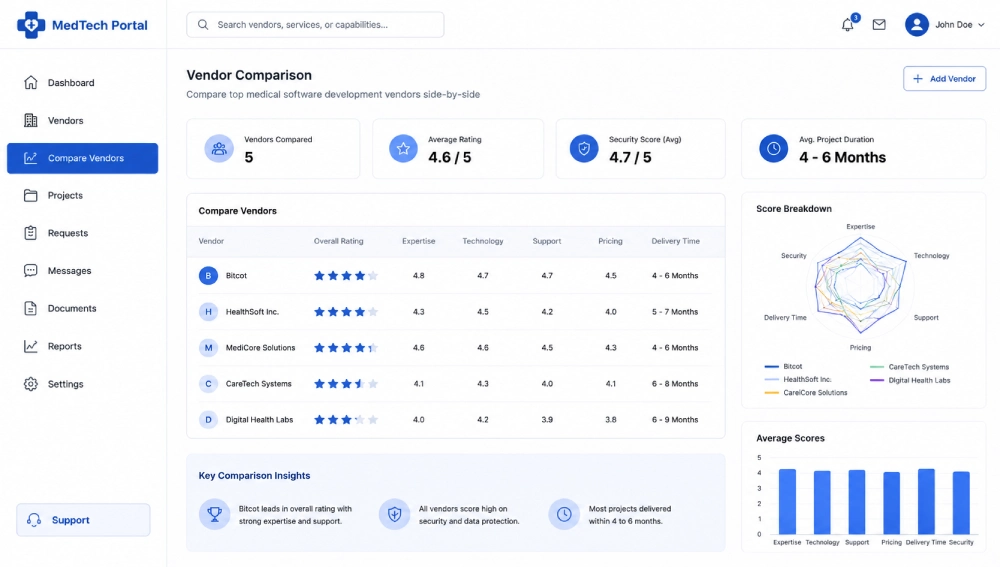
How the Top Medical Software Development Companies Compare
Having worked on 100+ healthcare systems over the past decade, we’ve seen a clear pattern: the projects that succeed aren’t always the ones with the biggest budgets or the most ambitious roadmaps. They’re the ones where the healthcare organization came to the table with well-defined clinical goals and chose a vendor who asked the right questions before writing a single line of code.
The most common failure point we’ve witnessed is the assumption that software can be built first and workflows adapted later. In healthcare, that approach creates tools clinicians won’t use and integrations that break under real-world load. Our recommendation: always start with a discovery phase, map your actual clinical workflows, and validate your integration requirements with your EHR vendor before committing to a build timeline. A few extra weeks of planning routinely saves months of rework. Learn more about how we approach complex builds in our telehealth case study.
Quick Comparison Table
| Company | Core Specialties | Healthcare Experience | Team Size (approx.) |
|---|---|---|---|
| Bitcot | EHR integration, AI, telemedicine, patient engagement | 10+ years, 100+ projects | 200+ |
| TechCare Solutions | Healthcare analytics, EHR customization | 8+ years | 40–50 |
| Meridian Healthcare | Telemedicine, virtual care, mobile | 6+ years | 30–40 |
| DataFlow Healthcare | Data pipelines, interoperability | 7+ years | 50–60 |
| ClinicalEdge | Clinical workflows, care coordination | 9+ years | 20–30 |
| Precision Health | Genomics, precision medicine | 5+ years (niche) | 15–25 |
| MedTech Ventures | Medical devices, IoT, monitoring | 6+ years | 35–45 |
| HealthBridge | Patient engagement, mobile, consumer health | 7+ years | 25–35 |
| InteropHealth | Interoperability, APIs, standards | 6+ years | 20–30 |
| CloudCare | Cloud architecture, multi-tenant SaaS | 5+ years | 40–50 |
Step-by-Step Process for Choosing a Medical Software Development Partner
Step 1: Define Your Scope (Week 1)
Before reaching out to vendors, answer these questions internally:
- What specific problem are we solving? (e.g., EHR modernization, telehealth launch, patient engagement, integration)
- What’s our budget?
- What’s our timeline? (Months vs. quarters vs. years?)
- What’s our team structure? (Will you embed engineers or hire a full vendor?)
- What integrations are non-negotiable? (Epic? Cerner? Claim systems? Pharmacies?)
Step 2: Shortlist & Outreach (Week 1–2)
Based on this guide, narrow down to 3–5 vendors that align with your specific needs. Reach out with a brief RFI (Request for Information). Look for:
- Responsiveness (do they reply within 24–48 hours?)
- Understanding of healthcare (do they ask intelligent questions about your workflow?)
- Relevant case studies (have they solved similar problems?)
Step 3: Schedule Discovery Calls (Weeks 2–3)
Conduct 30–60 minute calls with your top 3 choices. Prepare questions:
- “Walk me through a recent healthcare project similar to ours. What was successful? What was challenging?”
- “How do you approach FHIR integration? What standards do you support?”
- “What’s your post-launch support model? How responsive are you to critical issues?”
- “How do you handle scope creep and timeline changes?”
- “Can you provide 2–3 references from organizations like ours?”
Step 4: Request Proposals (Weeks 3–4)
Ask your top 1–2 choices to submit formal proposals. Evaluate:
- Accuracy of scope understanding: Did they ask clarifying questions or just repeat your brief?
- Approach & methodology: Is their process sound? Do they mention testing, documentation, and security?
- Timeline realism: Are deadlines achievable, or do they feel rushed?
- Cost transparency: Are estimates detailed or vague?
- Risk mitigation: Do they acknowledge potential challenges and propose solutions?

Step 5: Make Your Decision
Choose based on the combination of capability, cultural fit, and partnership mindset. The least expensive vendor isn’t always the best choice. Look for someone who understands your clinical needs and will go the extra mile post-launch.
Conclusion
Healthcare organizations across California are modernizing their technology stacks, but success requires choosing the right partner. The 10 vendors in this guide represent different specialties, from EHR software development and telehealth to clinical workflow and genomics.
Here’s how to move forward: First, clarify your scope internally. Define your problem, budget, and timeline. Next, reach out to 3–5 vendors from this list that match your needs. Schedule discovery calls, ask for references, and evaluate not just capability but partnership mindset. Finally, make your decision based on a combination of factors: technical depth, healthcare expertise, post-launch support, and cultural alignment.
The most successful healthcare software projects start with clear requirements and a vendor who genuinely understands your clinical challenges. With 10+ years of healthcare software development, we’ve learned what works and what doesn’t. If you’re ready to transform your healthcare IT, let’s talk.
Frequently Asked Questions
What's the difference between an EHR integration project and a custom healthcare platform build?
EHR integration connects your systems to existing platforms (Epic, Cerner, etc.) using FHIR or HL7. Faster, lower cost ($200K–$600K), 3–6 month timeline. Custom platform builds create entirely new systems (patient portals, telemedicine, engagement) from scratch. Longer timeline (6–12 months), higher cost ($500K–$2M+), but tailored to your exact workflow.
How critical is FHIR compliance?
Essential. FHIR (Fast Healthcare Interoperability Resources) is the modern standard for healthcare data exchange. Any vendor you hire should be FHIR-competent. It prevents vendor lock-in and future-proofs your technology stack. Ask for specific examples of FHIR implementations they’ve completed.
What role does post-launch support play?
Critical. Healthcare software is mission-critical. You need 24/7 support, documented SLAs, and a vendor who responds to critical issues within hours, not days. Build this into your contract. Typical support costs: 15–25% of initial development annually.
How long does a typical healthcare software project take?
3–12 months for most projects, depending on complexity. EHR integrations: 3–6 months. Patient engagement platforms: 6–9 months. Multi-system integrations or legacy modernization: 12–18 months. Always pad timelines by 20–30% for regulatory review, testing, and refinements.
What happens if scope creeps during the project?
This is common in healthcare. A good vendor anticipates it and builds change management into their process. Look for vendors who charge for change orders explicitly (not hide them). Agile methodologies help 2-week sprints let you adjust priorities without derailing the entire project.
Should we hire an in-house team or outsource to a vendor?
Hybrid is ideal. Many organizations hire 1–2 in-house leads (architects, product owners) and partner with a vendor for development and ongoing delivery. This balances cost, speed, and control. Bitcot and others offer flexible engagement models (staff augmentation, managed teams, and fixed projects). Discuss what works for your culture and budget.
What security practices should I verify with vendors?
Ask about data encryption (in transit and at rest), role-based access controls, audit logging, vulnerability management, disaster recovery, and incident response plans. Important: While compliance verification is your organization’s responsibility, reputable vendors should demonstrate solid security architecture. Request references from other healthcare clients and ask about their security certifications (SOC 2, ISO 27001, etc.).
How do we evaluate vendor cultural fit?
Healthcare requires partnership. In discovery calls, notice: Do they ask thoughtful questions about your clinical workflow? Do they understand healthcare jargon? Do they propose solutions or just accept your initial brief? Do they take responsibility for success or blame clients for unclear requirements? Cultural fit matters you’ll be working together for years.