Key Takeaways
- California is home to some of the world’s most capable healthcare AI development firms, spanning clinical AI, operational automation, medical device software, and data analytics.
- The right partner depends on your specific use case. EHR integration, clinical documentation, device AI, and population health analytics all require different expertise.
- Data security should be an architectural decision made at the start of a project, not a feature added at the end.
- Always verify vendor claims with direct references from comparable healthcare organizations and look for case studies with specific, measurable outcomes.
- Post-launch model monitoring matters as much as the initial build. AI performance changes over time as clinical data and workflows evolve.
Introduction
Picking the wrong AI development partner in healthcare is an expensive mistake, and not just financially. A system that mishandles patient data, breaks an EHR integration, or makes unreliable predictions in a clinical workflow carries real consequences for care teams and patients alike.
That is the core reason why evaluating a healthcare AI development company is a different process from hiring a general software team. Technical skill matters, of course. But healthcare also demands clinical knowledge, familiarity with interoperability standards, a disciplined approach to data privacy, and the ability to build systems that fit into the way hospitals and clinics actually operate.
California is home to some of the world’s most capable healthcare AI firms, ranging from enterprise cloud platforms to boutique development shops with deep clinical domain experience. This guide profiles the top 10 and gives you the practical criteria to evaluate which type of partner fits your project.
Top 10 Healthcare AI Development Companies in California
1. Bitcot
Bitcot is a San Diego-based healthcare AI development company with over 10 years of experience building intelligent healthcare software. The firm specializes in AI agent development, RAG (Retrieval-Augmented Generation) assistants, and clinical decision support systems that integrate with existing EHR and EMR platforms. With 200+ engineers and 3,000+ delivered projects, Bitcot holds a 5.0/5 rating across 104 verified reviews on Clutch.
Key Strengths:
- EHR/EMR Integration: Deep working knowledge of HL7 and FHIR standards, with proven integrations across Epic, Cerner, Athena, and NextGen. Explore our EHR integration services.
- AI Specialization: Generative AI, machine learning, NLP, and predictive analytics for patient outcomes, operational efficiency, and clinical workflows. See our AI and ML development capabilities.
- Healthcare Focus: Dedicated healthcare software development team with domain knowledge across patient engagement, telehealth, diagnostic support, and provider workflows.
- Agile Delivery: Global delivery model enabling rapid scaling, continuous development cycles, and cost-effective team expansion.
- Technology Stack: Full-stack capabilities including Node.js, Python, React, AWS, Azure, Docker, and Kubernetes.
Best For: Organizations building custom AI agents, RAG-based clinical assistants, patient intake automation, or projects requiring deep EHR integration work.
2. Google Health AI
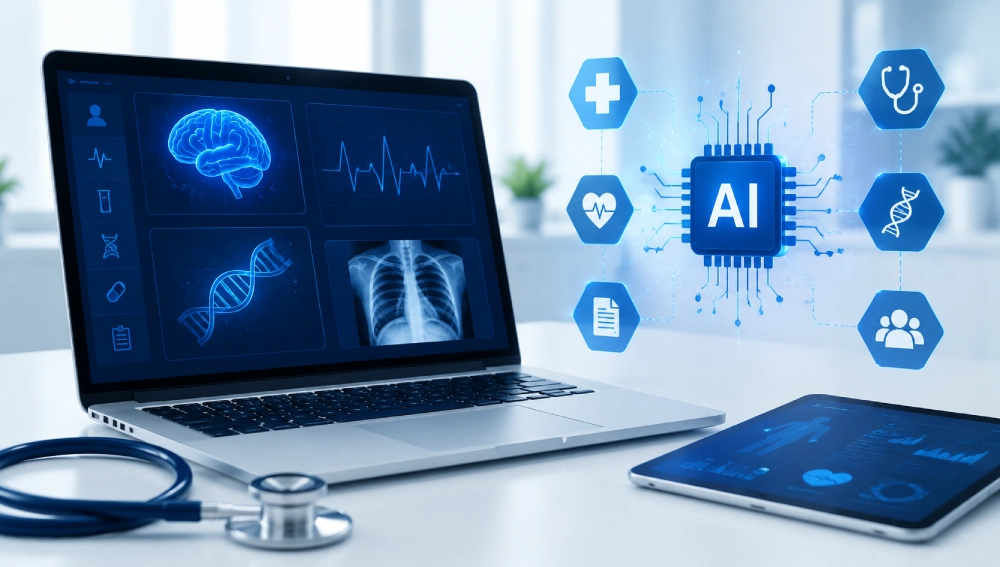
Google Health operates an innovation division focused on deploying machine learning for medical imaging analysis, patient risk prediction, and large-scale health data analytics. The division combines Google’s AI research infrastructure with cloud-native deployment through Google Cloud Healthcare API.
Key Strengths:
- Advanced computer vision for medical imaging, including X-ray, CT, and pathology analysis
- Large-scale data processing and analytics infrastructure
- Partnership opportunities with health systems for collaborative AI research
- Integration with Google Cloud’s HIPAA-eligible services and BigQuery for population analytics
Best For: Health systems with large imaging data volumes or organizations already embedded in the Google Cloud ecosystem.
3. Amazon HealthLake
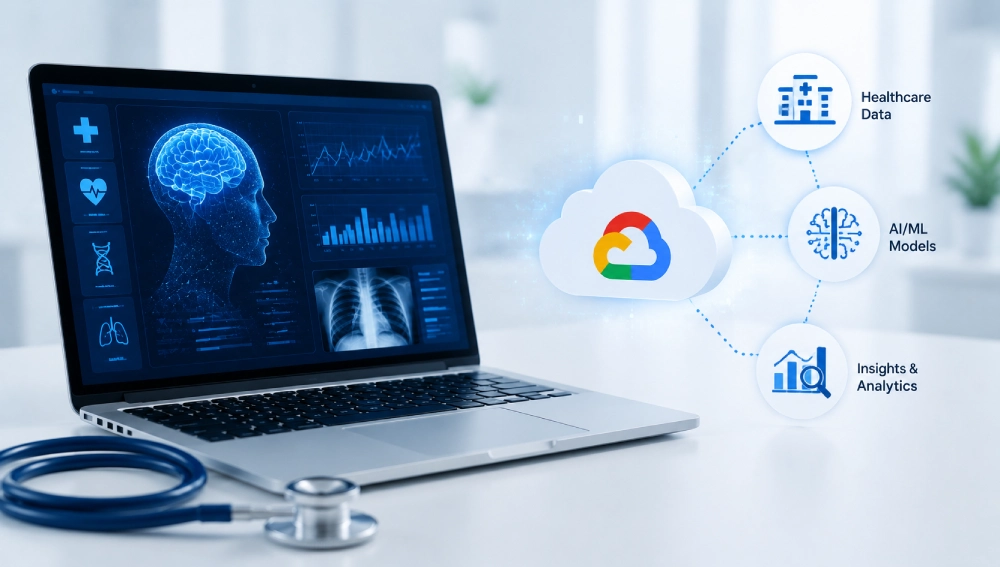
Amazon HealthLake provides a managed, cloud-native service for storing, analyzing, and visualizing health data at scale. The platform uses machine learning to extract clinical insights from unstructured data, including clinical notes, lab results, and medication records. Full documentation is available at AWS HealthLake.
Key Strengths:
- Turnkey platform for health data analytics without custom infrastructure build
- FHIR-normalized data model enabling interoperability across systems
- Pre-built connectors to major EHR systems and medical devices
- AI-powered insights for population health, quality reporting, and operational metrics
Best For: Organizations seeking a managed analytics platform rather than a custom build, particularly those already on AWS infrastructure.
4. Nuance AI (Microsoft)
Nuance Communications, acquired by Microsoft in 2022, specializes in clinical voice AI and ambient clinical intelligence. Its Dragon Ambient eXperience (DAX) solution transcribes and documents patient-provider conversations in real time and is deployed across a significant number of U.S. health systems. Learn more at Nuance Healthcare.
Key Strengths:
- Market-leading clinical voice recognition and documentation automation
- Reduces provider documentation burden through real-time ambient intelligence
- Deep EHR integrations with Epic, Cerner, and Athena
- Broad deployment across major health systems in North America
Best For: Health systems prioritizing provider burnout reduction through automated clinical documentation.

5. IBM Watson Health
IBM Watson Health offers enterprise AI solutions for medical imaging analysis, oncology decision support, and large-scale health data analytics. Watson for Oncology assists clinicians with evidence-based treatment recommendations. Full product details are available at IBM Watson Health.
Key Strengths:
- AI-powered diagnostic and treatment decision support tools
- Enterprise-scale deployment infrastructure
- Integration with major health IT vendors and data systems
- Data analytics and research collaboration capabilities
Best For: Large enterprise health systems evaluating AI for oncology, imaging analysis, or population-level clinical decision support.
6. Tempus
Tempus, headquartered in Chicago with active California operations, is a leading healthcare AI platform focused on oncology, cardiology, and rare disease diagnosis. The company uses machine learning to analyze clinical and molecular data for precision medicine recommendations. More information is available at Tempus.
Key Strengths:
- Specialized AI models for oncology treatment guidance
- Access to large-scale clinical and genomic datasets for model training
- Direct integration with pathology workflows and EHR systems
- Evidence-based recommendations supporting improved treatment outcomes
Best For: Academic medical centers, oncology practices, and research organizations working in precision medicine.
7. Velentium
Velentium is a software development firm specializing in medical device software, embedded systems, and AI integration for healthcare. The firm combines deep device engineering expertise with AI algorithm deployment and regulatory navigation. Learn more at Velentium.
Key Strengths:
- Medical device software development with regulatory awareness
- AI integration for diagnostic devices and clinical tools
- Firmware and embedded systems engineering
- FDA submission support and post-market surveillance capabilities
Best For: Medical device manufacturers and MedTech companies integrating AI into regulated hardware products.
8. Qventus
Qventus delivers AI-powered operational efficiency software for hospitals and health systems. The platform analyzes real-time clinical and operational data to optimize patient flow, reduce wait times, and improve bed management. Learn more at Qventus.
Key Strengths:
- Machine learning applied to hospital operations optimization
- Real-time patient flow analytics and actionable recommendations
- Integration with hospital information systems and EHR platforms
- Measurable ROI impact on operational efficiency and patient throughput
Best For: Hospital operations teams focused on capacity management, bed utilization, and patient flow improvement.
9. Optum AI Labs
Optum (UnitedHealth Group) operates an innovation lab focused on AI applications spanning health insurance, care delivery, and pharmacy. Optum’s AI models address care optimization, fraud detection, and member health prediction at scale. More at Optum AI.
Key Strengths:
- Large-scale claims and health data for training robust AI models
- End-to-end healthcare ecosystem perspective across payer and provider
- Deployment across health plans, care networks, and pharmacy systems
- Predictive modeling for population health management and cost reduction
Best For: Health plans and integrated delivery networks seeking AI for population health, fraud detection, or care management programs.
10. CitiusTech
CitiusTech is a healthcare software services company with California offices, specializing in health data exchange, interoperability, and AI-powered analytics. The firm supports healthcare organizations across data integration and clinical analytics projects. Learn more at CitiusTech.
Key Strengths:
- Health data exchange and interoperability solutions across HL7 and FHIR
- Clinical data analytics and reporting platform development
- AI integration for operational and clinical insights
- Managed services for ongoing data pipeline support and maintenance
Best For: Healthcare organizations prioritizing data interoperability, analytics infrastructure, and FHIR-based integration projects.
Why Leading Healthcare Organizations Choose Our Team for AI Development
Healthcare organizations do not have the luxury of learning from a failed AI implementation. That is why the organizations that take AI seriously choose their development partner with the same rigor they apply to clinical decisions.
We start with a POC, not a pitch. Every healthcare AI engagement begins with a structured proof of concept before a full build is scoped or a contract is signed. We build something real inside your actual environment using your EHR data, your clinical workflows, and your infrastructure to answer the questions no proposal can answer: Does the AI output fit your clinical team’s workflow? Is your data ready? Where are the integration gaps that will slow the full build if we do not address them now?
We build for the clinical team, not just the IT team. A system the IT team loves, but the clinical team ignores, is a failed project regardless of what the technical specs say. We involve care team stakeholders from the POC phase, not just at testing, because clinical adoption is an engineering requirement, not an afterthought.
We stay accountable after go-live. The first 90 days after launch are when the most important learning happens. Model behavior in a real clinical environment is always different from a controlled test environment. Our post-launch process includes ongoing performance monitoring, retraining cycles, and a direct escalation path when something behaves unexpectedly.
If you are evaluating healthcare AI development partners and a vendor is not willing to start with a POC, that hesitation is itself an answer.
How to Evaluate Healthcare AI Development Companies
When selecting an AI development partner, these are the criteria that separate credible vendors from generalists.
Healthcare Domain Experience
Push past marketing materials and ask to see detailed case studies from healthcare clients that explain the actual problem, what was built, how it connected to existing systems, and what the measurable result was. Signs of genuine domain depth include working knowledge of HL7 and FHIR, experience with Epic, Cerner, and Athenahealth, and involving clinical advisors during the build. For a broader view of the landscape, see how current healthcare technology trends are shaping what good AI partners need to know.
Technical AI and ML Depth
Healthcare AI spans computer vision for imaging, NLP for clinical documentation, machine learning for patient risk prediction, and agentic AI for multi-step workflows. Map your use case to the capabilities it actually requires, then verify whether the vendor has done real work in that specific area.
EHR Integration Experience
One of the most common ways healthcare AI projects fail is that the AI works in isolation but cannot connect to the clinical environment it is supposed to serve. Ask any candidate vendor to describe a real EHR integration challenge they have solved, a specific instance with a named EHR, a real obstacle, and how they resolved it. Vague answers here are informative. For healthcare organizations looking at the broader picture, the current healthcare technology landscape makes interoperability a non-negotiable priority.
Data Security Approach
Any AI development for healthcare that does not treat security as a core architectural concern is a risk before the first line of code ships. A practical signal: if a vendor only raises security topics after you ask, that is a red flag. A partner with genuine healthcare experience will address data handling in the first scoping conversation.
Post-Launch Support and Model Monitoring
Clinical workflows evolve, and AI models can quietly degrade in accuracy over time if nobody is watching. Ask every candidate: how do you monitor model performance after launch, what triggers a retraining cycle, and how are AI decisions logged for auditability and traceability?
Documented, Verifiable Outcomes
Almost every vendor will claim their AI improves patient outcomes. What separates credible partners is whether they can show specific numbers from actual deployments, not estimates. Request a reference contact who can confirm the results. Review independent ratings on platforms like Clutch and G2. You can also browse our healthcare AI case studies for project-level detail.
Portfolio Alignment With Your Use Case
A team with strong expertise in diagnostic imaging AI is not automatically well-suited to build a patient scheduling agent. Look for work that is close to your actual project at a granular level. Organizations building conversational or agentic systems should look specifically at whether the vendor has experience with multi-step AI agents for healthcare, not just single-function chatbots.
Regulatory Awareness
An administrative automation tool has different requirements than an AI system that influences a clinical decision. A credible development partner will raise regulatory classification as a scoping question early, including FDA guidance for Software as a Medical Device (SaMD), applicable data privacy laws, and AI governance practices covering how decisions are logged, explained, and reviewed over time.
| Evaluation Criteria | What to Assess | Red Flags |
|---|---|---|
| AI/ML Expertise | Proven models, real-world deployments, case studies with measurable outcomes | No demonstrable AI projects, vague technical details, projections instead of results |
| Healthcare Domain Depth | Dedicated healthcare team, HL7/FHIR knowledge, clinical advisor involvement | Generic software firm with healthcare listed as one of many verticals |
| EHR Integration | Named EHR platforms integrated, specific integration challenges solved | No documented EHR integrations, unfamiliar with interoperability standards |
| Scalability | Enterprise deployments, handles clinical data volumes, cloud-native architecture | Limited to pilot-stage projects, no production-scale deployments |
| Post-Launch Support | Clear model monitoring plan, defined retraining triggers, and SLA documentation | Vague support commitments, relationship ends at delivery, no monitoring process |

Conclusion
Choosing a healthcare AI development company is not the same as choosing a software vendor. The stakes are different, the constraints are more specific, and the cost of a wrong decision goes beyond budget overruns.
California’s healthcare AI ecosystem spans enterprise cloud platforms, specialized clinical AI firms, medical device software companies, and full-service development partners. Each serves a different type of project, and the right choice depends on your specific use case, your existing technology environment, and how much customization and integration depth your project actually requires.
The companies that deliver the best healthcare AI systems treat clinical context as a design input rather than an afterthought. They build systems that fit the way healthcare actually operates, and they stay engaged long enough to make sure those systems continue to perform after go-live.
Use the criteria and company profiles in this guide as your starting framework. If a vendor cannot clearly answer questions about their EHR integration experience, data handling approach, post-launch monitoring process, and relevant portfolio work, treat that as a meaningful signal before a contract is signed.
Frequently Asked Questions
What qualifies as a "top" healthcare AI development company?
Market leadership in healthcare AI is determined by: (1) Proven project delivery across diverse use cases (clinical, operational, diagnostic); (2) Demonstrated expertise in AI/ML technologies deployed at scale in real health systems; (3) Proven ability to integrate with major EHR platforms; (4) Customer references and measurable outcomes; (5) Team depth and specialized healthcare knowledge; (6) Sustained innovation in emerging AI areas (generative AI, RAG, clinical agents).
How long does a typical healthcare AI project take?
Timeline depends on scope: AI-powered chatbots or initial analytics dashboards: 2–4 months. Custom EHR integrations with machine learning models: 4–8 months. Full-scale clinical decision support systems with data architecture: 6–12 months. Discovery and scoping (recommended): 2–4 weeks. Post-launch optimization: ongoing. Early engagement with your development partner during planning phases accelerates timelines significantly.
Which healthcare AI use case delivers the highest ROI?
High-impact areas depend on your organization’s pain points. Clinical documentation automation (reducing provider burden) delivers rapid adoption. Patient intake automation (AI-powered pre-visit questionnaires) improves efficiency and data quality. Operational optimization (bed management, scheduling) reduces wait times and overhead. Predictive analytics (patient risk stratification) enables proactive care. Start with an assessment of which workflows consume the most time or create the most errors.
Can healthcare AI solutions integrate with our existing EHR system?
Yes, modern healthcare AI solutions are designed for integration. Leading development partners (including Bitcot) have deep expertise with Epic, Cerner, Athena, NextGen, and other major platforms. Integration typically uses official EHR APIs, HL7/FHIR standards, and secure data exchange protocols. Discuss API availability, data access requirements, and integration timeline during partner evaluation.
What's the difference between custom AI development and pre-built healthcare AI platforms?
Pre-built platforms (Amazon HealthLake, Google Health, Nuance DAX) offer faster deployment, lower upfront investment, and reduced technical risk but may require workflow adaptation. Custom AI development (firms like Bitcot) tailors solutions to your exact workflows, EHR integrations, and competitive advantage takes longer and costs more, but delivers proprietary capabilities and integration depth. Many organizations combine both: pre-built platforms for analytics + custom AI agents for unique workflows.
How do you measure success in healthcare AI projects?
Success metrics vary by use case: Clinical documentation: Provider time saved per note, user adoption rate, error reduction. Patient engagement: Response rates, data quality improvements, patient satisfaction. Operational optimization: Bed utilization, wait time reduction, staff overtime reduction. Diagnostic support: Accuracy/sensitivity/specificity improvements, clinical acceptance. Define metrics and success thresholds before project launch to align expectations and track ROI clearly.
Is ongoing support included after AI solution deployment?
Best-in-class development partners offer tiered support: (1) Post-launch optimization: Fine-tuning models, addressing user feedback, integration refinements (typically 3–6 months). (2) Ongoing maintenance: Updates, monitoring, troubleshooting, performance optimization. (3) Model enhancement: Retraining with new data, expanding capabilities as use cases evolve. Discuss support structure, SLAs, and cost model during partnership negotiations. Bitcot provides dedicated post-launch engineering and ongoing optimization support.
How do you ensure data security and privacy in healthcare AI solutions?
Healthcare AI development requires multi-layered security: (1) Secure data transmission (encryption in transit and at rest); (2) Access controls (role-based permissions, audit logging); (3) Data minimization (use only required data for AI models); (4) Regular security assessments and penetration testing; (5) Secure infrastructure design (cloud-native, containerized deployments); (6) Team security awareness and training. Evaluate development partners on security practices, infrastructure certifications, and incident response procedures. Ask for security whitepapers and third-party audit results.
What emerging AI technologies should healthcare organizations prioritize in 2026?
Generative AI agents: Conversational AI for clinical documentation, patient engagement, and operational workflows rapidly becoming mainstream. Retrieval-Augmented Generation (RAG): AI systems that combine large language models with your organization’s data (EHR records, clinical guidelines, research papers) for accurate, contextualized recommendations. Multimodal AI: Models processing text, images, and structured data together valuable for radiology, pathology, and clinical decision support. Real-time analytics: AI-powered streaming data processing for live patient monitoring and operational insights. Organizations should evaluate pilots in these areas as part of strategic planning.