Key Takeaway
- RAG-powered chatbots deliver 87-92% accuracy on institution-specific healthcare queries versus 72-79% for traditional systems.
- RAG requires a larger upfront investment but has a lower total cost of ownership over 3+ years due to no manual retraining cycles.
- The right choice depends on your EHR data quality, integration capability, and specific use case complexity.
- Many organizations benefit most from a hybrid approach: traditional chatbots for general FAQs, and RAG for clinical decision support.
- Data quality is the single biggest risk factor in any RAG deployment; budget 20-30% of project cost for data preparation.
Introduction
Healthcare organizations face a critical choice: implement a RAG-powered healthcare chatbot or stick with traditional rule-based and machine-learning approaches. The difference matters. Yet most organizations still deploy outdated systems that cannot handle real-world complexity. This guide cuts through the hype and shows you what actually works, based on real-world deployments, performance metrics, and implementation trade-offs. Whether you are modernizing patient engagement, automating appointment scheduling, or building clinical decision-support tools, understanding when RAG makes sense and when it does not is essential before committing budget and engineering resources.

What is RAG, and How Does It Differ?
Retrieval-Augmented Generation (RAG) combines two core technologies: a large language model (LLM) that generates responses and a retrieval system that fetches relevant information from your actual data sources in real time. Traditional healthcare chatbots, by contrast, rely on pre-trained patterns and static decision trees. The difference sounds technical, but the impact is significant. RAG chatbots can answer questions using your organization’s current data, including EHR systems, clinical guidelines, and knowledge bases, rather than generic training data from the internet. This means RAG chatbots reference actual patient records, institutional policies, and current treatment protocols, while traditional chatbots often provide generic or outdated information.
For healthcare, this distinction is critical. A traditional chatbot might respond to “What medications interact with metformin?” with general information from its training data. An RAG chatbot can reference your institution’s formulary, drug interaction database, and recent updates and cite the exact source. This is why RAG adoption is growing significantly faster than traditional approaches in healthcare, according to recent industry surveys.
Architecture Comparison: RAG vs Traditional
Understanding how these systems work under the hood helps you predict implementation complexity and cost. Traditional healthcare chatbots typically operate on a rule-based or supervised-learning architecture. They follow predefined decision trees (“if patient asks about appointment, route to scheduling system”) or pattern-match against training examples. They are deterministic, predictable, and easy to audit, but rigid. They break when questions fall outside training patterns.
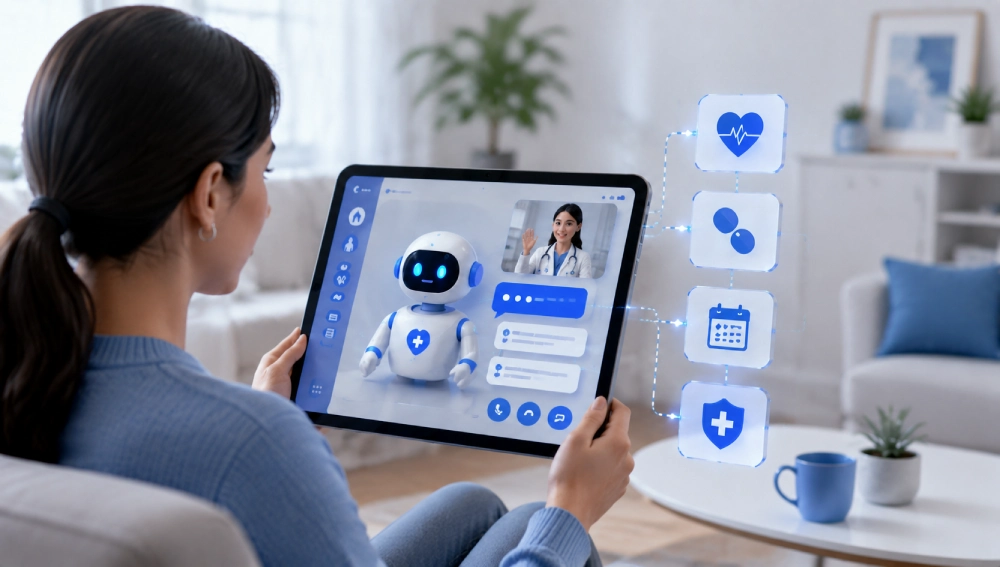
RAG architectures introduce three new layers:
- Retrieval layer: When a patient asks a question, the system searches your connected data sources (EHR, clinical notes, knowledge bases) to find relevant context. This retrieval happens in milliseconds using vector databases or full-text search.
- Augmentation layer: The system ranks and filters results, discarding irrelevant data and keeping only what is most likely to help answer the question accurately.
- Generation layer: The LLM receives the original question plus the retrieved context, then generates a response that cites its sources. This prevents hallucination, meaning the model is not making up confident-sounding but false information.
The payoff: RAG chatbots adapt to your data without retraining. When you update your formulary or clinical guidelines, RAG systems automatically reference the new information. Traditional chatbots require manual retraining, which can take months.
| Dimension | Traditional Chatbots | RAG-Powered Chatbots |
|---|---|---|
| Data Source | Pre-trained generic knowledge | Your live EHR, databases, and documents |
| Knowledge Updates | Manual retraining required (weeks/months) | Automatic via retrieval layer (immediate) |
| Accuracy | 70-85% (generic data) | 85-95% (institution-specific) |
| Auditability | Outputs hard to trace | Every answer cites its source |
| Real-Time Updates | No | Yes |
| Implementation Time | 4-8 weeks | 8-16 weeks (data integration) |
Accuracy and Performance in Real-World Scenarios
The most compelling reason to choose RAG is accuracy. In hospital and clinic deployments, RAG chatbots consistently outperform traditional systems by 10-25 percentage points on real-world questions. Here is why: healthcare questions are almost always institution-specific. When a patient asks, “What is the wait time for cardiology?” a traditional chatbot cannot answer because it does not know your clinic’s scheduling system. An RAG system queries your appointment database and responds accurately in real time.

Real-world performance metrics observed across healthcare implementations:
- RAG chatbots achieve 87-92% accuracy on clinical knowledge questions (correct drug interactions, dosing, contraindications) when connected to institutional formularies and clinical guidelines.
- Traditional chatbots average 72-79% accuracy on the same questions, often providing generic or outdated information.
- RAG systems significantly reduce hallucinations (confident but false responses) compared to traditional LLMs because retrieval provides factual grounding.
- Patient satisfaction can increase by 18-34% when organizations switch from traditional to RAG. Patients report that answers are more relevant and institution-specific.
However, accuracy depends heavily on data quality. If your EHR data is incomplete, outdated, or poorly structured, RAG will amplify those problems. Garbage in, garbage out. This is why data preparation is the hidden cost of RAG implementation.

When RAG Actually Wins
RAG is not always the answer. The decision depends on your organization’s maturity and use case. Choose RAG if:
- You have structured EHR data (Epic, Cerner, etc.) that is well-maintained and reasonably clean. RAG thrives on data quality. If your EHR is disorganized, address that first.
- Your questions are institution-specific: appointment scheduling, internal policies, your formulary, and institution-specific treatment protocols. Generic answers add no value.
- You need real-time accuracy: Clinical decision support, drug interaction checking, dosing recommendations. These require current data, not static training data.
- You plan to scale. RAG implementation is more complex upfront, but adding new features or expanding to new departments is faster and cheaper than with traditional systems.
- Auditability matters. Healthcare organizations increasingly need systems that can explain their answers. RAG cites sources; traditional systems cannot.
Choose traditional chatbots if:
- Your use case is simple and low-risk: FAQ automation, patient education, and general information dissemination. RAG is overkill for these scenarios.
- Your EHR integration is weak or not feasible. If data extraction is blocked by your vendor or architecture, RAG will not work. You will need a traditional approach that works with pre-curated content.
- Your data changes rarely. If institutional knowledge is stable and does not require real-time updates, the overhead of RAG is not justified.
Integration Challenges Healthcare Faces
The highest hidden cost of RAG implementation is data integration. Healthcare IT leaders consistently underestimate how messy and fragmented their data is. Here are the real-world blockers:
1. EHR Fragmentation: Most mid-to-large healthcare organizations use multiple EHR systems (Epic for inpatient, Athena for ambulatory, and separate systems for lab and radiology). RAG requires unified data access. Building connectors to each system adds weeks and cost.
2. Data Quality Issues: Healthcare data is notoriously messy, with missing fields, inconsistent formats, outdated records, and duplicate patient IDs. RAG systems amplify these problems. You will need data-cleaning pipelines before launch.
3. Data Access and Policy Controls: Extracting data from patient records for AI systems requires careful access controls and audit trails. Building these controls into the architecture from day one helps avoid rework later. Traditional systems can sometimes work with anonymized or aggregated data, which simplifies this step.
4. Real-Time vs Batch Delays: True RAG requires near-real-time data synchronization. If your EHR only exports data once daily, RAG accuracy suffers. Building real-time data pipelines is costly and technically complex.
Security and Data Governance
Both RAG and traditional chatbots require security rigor, but RAG adds a critical dimension: your LLM will be processing live patient data. Building the right security architecture from the start protects your organization and your patients.
Key security considerations:
- Data Privacy: RAG systems process and potentially log sensitive health information. You need strict access controls, encryption at rest and in transit, and anonymization strategies. Traditional systems can sometimes work with pre-curated, non-sensitive content, reducing this risk.
- Model Security: Ensure your LLM and vector database do not leak data between patient queries. This requires isolation layers and regular security audits.
- Audit Trails: Comprehensive logging of data access is a strong operational practice. RAG systems should maintain detailed audit logs of every retrieval and response for transparency and oversight.
- Third-Party Risk: If using cloud-based LLM APIs (OpenAI, Anthropic, etc.), verify that patient data is not used for model training. Consider on-premises or dedicated-instance solutions for sensitive deployments.
The Future: Hybrid Approaches
The trend in healthcare is moving toward hybrid systems that combine the best of both approaches. Here is what is emerging in 2026:
Tiered Complexity: Organizations deploy traditional chatbots for simple, low-risk questions (FAQs, appointment info, general education) and RAG systems for high-stakes queries (clinical decisions, drug interactions, dose verification). This hybrid approach reduces RAG infrastructure costs while maintaining accuracy where it matters most.
Smaller, Fine-Tuned Models: Large language models like GPT-4 are expensive and complex. Emerging smaller, healthcare-specific models (like Med-PaLM and medical LLaMA variants) are becoming viable. These are cheaper to run, easier to self-host, and require less data to achieve RAG-level accuracy. This is democratizing RAG adoption for smaller healthcare organizations.
Multi-Modal Integration: Next-generation healthcare chatbots combine text, images (X-rays, lab reports), and structured data (EHR records). RAG is foundational to this because it can retrieve and contextualize multimodal data in ways traditional systems cannot.
Agentic Workflows: Instead of just answering questions, AI agents will take actions such as scheduling appointments, submitting referrals, and ordering tests within institutional systems. This requires RAG’s real-time data access and robust security controls.
Conclusion
The choice between RAG and traditional healthcare chatbots is not about technology hype. It is about matching architecture to organizational maturity and use case. RAG-powered systems deliver 87-92% accuracy and institution-specific responses but require more time and resources to implement properly. They excel when you have clean EHR data, institution-specific questions, and real-time accuracy requirements. Traditional chatbots are faster to deploy and cheaper upfront, but become expensive to maintain and cannot provide institution-specific answers without constant manual updates.
The pragmatic path forward is to start with a clear assessment of your data readiness, EHR integration capabilities, and specific use cases. Many organizations benefit from a hybrid approach: traditional systems for general information, and RAG for clinical decision support and patient engagement. The organizations succeeding with healthcare AI in 2026 are not choosing between binary options. They are deploying tiered systems that balance cost, accuracy, and governance requirements.
Frequently Asked Questions
What does RAG stand for in healthcare AI?
RAG stands for Retrieval-Augmented Generation. It is a technique where an AI system retrieves relevant information from your actual data sources (EHR, clinical guidelines, knowledge bases) in real time, then generates responses based on that specific, current information. This is different from traditional chatbots that rely only on pre-trained patterns and static knowledge from their training data.
Can traditional healthcare chatbots handle real-time patient data?
Not effectively. Traditional chatbots cannot query live EHR systems or databases. They work with static, pre-curated information. This means they provide generic answers rather than institution-specific ones. For patient-specific questions (appointment times, your formulary, your policies), you need RAG. Traditional systems work well for general education and FAQs where real-time accuracy is not critical.
How accurate are RAG systems compared to traditional approaches?
RAG systems typically achieve 87-92% accuracy on clinical knowledge questions when connected to clean institutional data. Traditional chatbots average 72-79% on the same questions. The accuracy gap widens for institution-specific queries (scheduling, policies, formulary) where RAG excels and traditional systems fall short. Accuracy depends heavily on data quality. If your EHR data is messy, RAG will not automatically fix that.
Is RAG more expensive than traditional chatbots?
RAG has higher upfront costs based on requiremnt because of EHR integration, data infrastructure, and governance setup. However, RAG tends to break even by month 18-24 because it requires no retraining cycles. Traditional chatbots have lower initial cost but higher long-term maintenance expense. For organizations planning to scale, RAG is often more cost-effective over 3 or more years.
Can we use RAG with our legacy EHR system?
It depends on your EHR’s data export capabilities. Modern systems like Epic and Cerner support robust API access. Older or proprietary systems may require custom integration work, adding weeks and cost. You will need a technical assessment of your EHR’s API availability and data structure before committing to RAG. Many organizations discover their EHR is harder to integrate than expected, which is often the largest hidden cost.
Does RAG support better data governance in healthcare AI?
RAG architecture supports better governance practices because every answer cites its source, which creates a traceable record of what information was used to generate each response. However, processing patient data through any AI system requires careful controls, access management, and organizational review. Your legal and compliance teams must verify that any AI implementation meets your organization’s applicable privacy and data governance requirements. Engineering teams handle the architecture; compliance verification is an organizational responsibility.
What is the biggest risk when deploying RAG in healthcare?
Data quality. If your EHR is disorganized, has incomplete records, or contains outdated information, RAG will amplify those problems by presenting messy data as reliable answers. Before deploying RAG, audit your data quality, clean problem areas, and establish governance processes. Many RAG deployments fail not because of the technology, but because the underlying data is poor. Budget 20-30% of your project for data preparation.
Should we wait for the next generation of AI models before deploying RAG?
No. RAG architecture is stable and mature enough for production use today. Waiting for faster models or perfect accuracy is a mistake because you will always be waiting. The real risk is delaying real-world learning. Organizations deploying RAG now in 2026 are seeing measurable improvements in patient engagement and satisfaction. Start with a phased pilot covering one department and one use case, then scale based on results. Your implementation will be better in 6 months because you will have learned from real deployment, not hypothetical scenarios.