Key Takeaways:
- The global AI agent market will exceed $52B by 2030 at a 46.3% CAGR.
- Not all AI companies are equal – type and delivery model determine results.
- Custom agents outperform off-the-shelf when your workflows or data are unique.
- Top partners cover the full cycle: strategy, build, integration, and support.
- Wrong partner choice costs more than money – it costs months of momentum.
- Ten firms ranked by execution readiness, technical depth, and delivery record.
Most businesses know they need AI agents. Far fewer know who to actually trust to build them.
Picking the wrong partner means months of delays, cost overruns, and agents that never make it past a demo environment. That’s the real risk most buyers don’t talk about.
From automating workflows to delivering personalized user experiences, the demand for intelligent, autonomous AI systems is skyrocketing across industries. The global AI agent market is projected to grow from $7.84 billion in 2025 to over $52 billion by 2030, at a CAGR of 46.3%.
“Most companies don’t fail at AI because of bad technology. They fail because they chose the wrong partner for the stage they were in.”
That kind of growth doesn’t just create opportunity. It creates noise.
More companies, agencies, and platform builders are entering the space every quarter, making it harder than ever to separate genuine expertise from polished marketing. The shift toward self-directed agents capable of autonomous task execution across business systems is no longer a future trend. It’s the current standard of competition.
That’s exactly why this list exists.
In this 2026 ranking, we spotlight the top 10 AI agent development companies in the USA. These firms stand out not just for technical expertise but for delivering scalable, real-world results, helping startups to Fortune 500s deploy next-gen AI solutions with confidence.
Whether you’re looking to build a custom AI agent or seeking a long-term innovation partner, this list gives you a head start. But before the names, let’s establish what actually separates the best from the rest.

How Do You Define a Top AI Agent Development Company?
“How do I know if a company can actually build what I need, or just sell me on it?”
That question matters more than ever in 2026. The answer comes down to four things.
Before diving into the rankings, it’s important to understand the criteria that separate top-tier firms from the rest. The AI agent landscape is evolving rapidly. Whether you’re evaluating a boutique agency, a dedicated service provider, or a full-scale platform builder, a few core qualities consistently define industry leaders.
Technical Depth and Specialization
Leaders in this space go beyond generic AI development. They specialize in building intelligent agents capable of autonomous decision-making, context awareness, and real-time adaptation.
The kind that powers real agentic AI workflows, not just chatbots with a new label.
Proven Use Cases
Top companies have a track record of delivering real-world applications. Whether it’s AI agents for sales automation, customer support, process optimization, or enterprise workflow automation.
Demos are easy. Deployed production agents are not.
Scalability and Security
Building a prototype is one thing. Scaling it securely across an organization is another.
The best firms engineer for long-term performance, compliance, and enterprise AI integration into complex existing environments.
Design for Usability
The most effective AI agents are intuitive, responsive, and aligned with user needs. Great companies focus not only on intelligence, but also on interface, experience, and adoption.
These four criteria formed the basis for our 2026 rankings, ensuring that each featured company isn’t just innovative but also execution-ready. The firms below didn’t just meet the bar. They set it.
What are the Best AI Agent Development Companies in the USA?
As businesses look to adopt autonomous systems that can reason, act, and learn, the demand for experienced AI agent developers has exploded.
“Which type of AI company should I choose, a specialist agency, a platform builder, or a research-backed firm?”
The answer depends on your use case, timeline, and internal technical capacity. Each type serves a different need, and understanding that difference is what makes the list below so useful.
From established platform builders to specialized agencies, these ten companies lead the way in 2026, helping organizations turn cutting-edge models into real-world, business-ready agents.
Here’s a list of the 10 Best Companies Building AI Agent Platforms in 2026
1. Bitcot
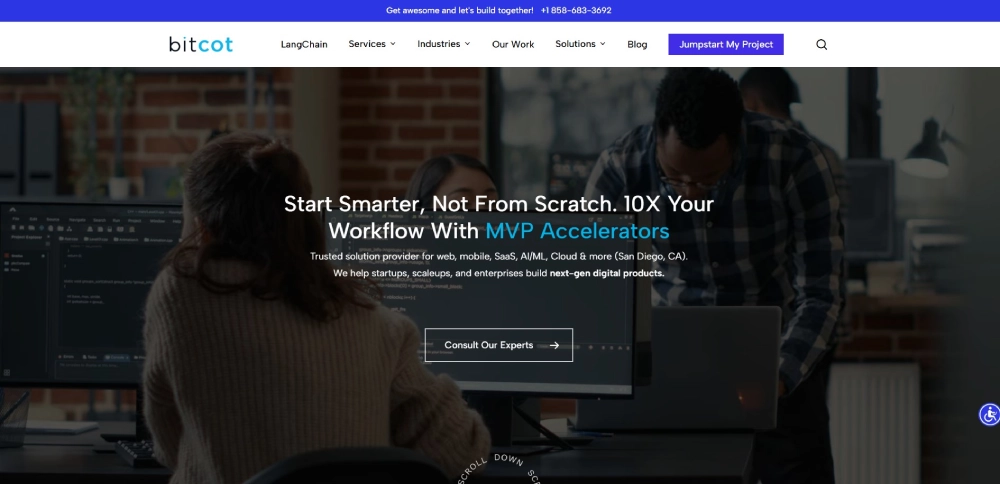
Based in San Diego, Bitcot is a custom AI agent development company specializing in end-to-end solutions tailored to startups and growth-stage businesses.
As both an agency and a service provider, our emphasis on practical deployment, cost-efficiency, and iterative prototyping makes us a trusted partner for companies that need to move fast without the overhead of larger enterprise firms.
What sets us apart isn’t just what we build. It’s how fast we get it into your hands.
Why Choose Bitcot:
- Cost-effective solutions designed specifically for startups and growth-stage companies
- Rapid deployment and iterative development approach that gets your AI agents to market faster
- Personalized service with dedicated project teams that understand your unique business challenges
Focus Areas:
- Custom AI agent development for business process automation
- Startup-friendly AI solutions with scalable architecture
- End-to-end AI integration services from concept to deployment
From intelligent sales orchestration using single-agent LangGraph architecture to multi-agent HR automation with LangGraph, here is a look at what that means in practice.
2. Scale AI
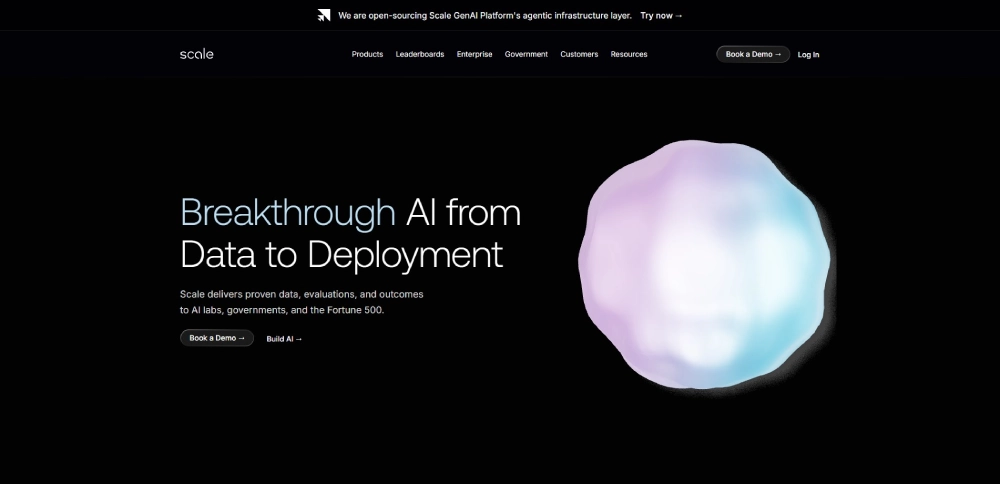
Headquartered in San Francisco, Scale AI has evolved from its origins in data infrastructure to become a powerhouse in AI agent development.
As a platform builder operating at the highest levels of complexity, their agents are deployed in mission-critical environments. From defense simulations to logistics automation, enabling autonomous task execution in scenarios where errors carry real-world consequences.
With deep investments in reinforcement learning and agent simulation, Scale AI has become one of the most strategically important firms in the country. When the stakes are too high for trial and error, this is the company most enterprises call first.
If your needs sit at the opposite end of the spectrum, closer to agility than infrastructure, the next few companies are worth your attention.
Why Choose Scale AI:
- Proven track record in mission-critical applications with enterprise-grade reliability
- Deep expertise in reinforcement learning and advanced AI simulation technologies
- Unmatched scalability for large-scale enterprise deployments across multiple industries
Focus Areas:
- Defense and security AI agent systems for government and military applications
- Logistics and supply chain automation with real-time decision-making capabilities
- High-stakes simulation environments requiring precision and advanced modeling
3. OpenAI
OpenAI is more than just a foundational model vendor.
Through its developer ecosystem and advanced APIs, it powers a vast number of AI agent platforms built on LLM-powered agents capable of reasoning, planning, and executing multi-step tasks.
Businesses are building autonomous systems on top of models like GPT-4o and o3, leveraging tools like memory, retrieval, code execution, and the Responses API to build sophisticated agents for operations, support, and creative workflows.
OpenAI’s 2026 push into agentic infrastructure, including its Operator-class agents and expanded function-calling capabilities, has made it the default platform builder that much of the agent development ecosystem is built upon.
For many teams, the question isn’t whether to use OpenAI’s infrastructure. It’s how deeply to integrate it.
Why Choose OpenAI:
- Access to cutting-edge foundational models that power the most advanced AI agents
- Comprehensive developer ecosystem with robust APIs and extensive documentation
- Continuous innovation with regular model updates and new capabilities
Focus Areas:
- Foundational AI model development powering diverse agent applications
- Developer platform services enabling rapid AI agent creation and deployment
- Advanced API solutions for operations, customer support, and creative automation
4. Adept AI
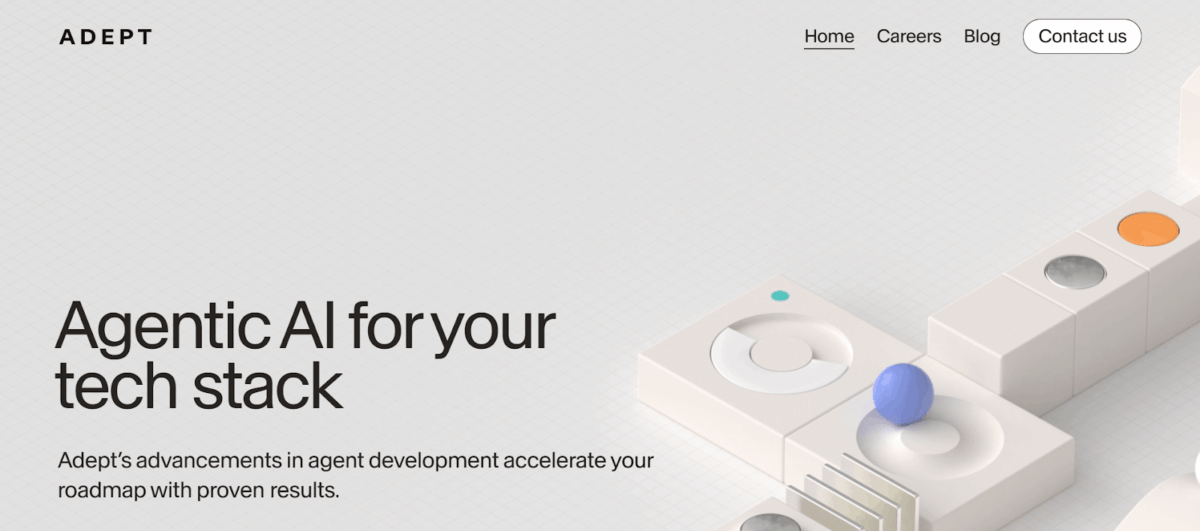
Adept AI stood out for its unique approach to agent design: building AI that interacts with software interfaces the way a human would.
Rather than replacing existing tools like Excel, CRMs, or internal dashboards, Adept’s agents work inside them. As a company focused on human-computer interaction at the enterprise level, their work influenced how the broader industry thinks about interface-native agents and intelligent process automation, the bridge between traditional RPA and the fully agentic systems emerging today.
In 2024, Adept’s co-founder and CEO David Luan, along with several other co-founders, joined Amazon’s AGI organization. Amazon simultaneously licensed Adept’s model technology and datasets. It was one of the most significant acqui-hire arrangements in recent AI history.
Adept continues to operate as an independent company under new CEO Zach Brock, formerly Head of Engineering, now narrowly focused on agentic AI solutions powered by its existing in-house models and web interaction software.
While the leadership transition was significant, Adept’s underlying technology and interface-automation approach remain influential and in active development.
Why Choose Adept AI:
- Specialized human-like interface interaction that works with existing software tools
- Continued focus on enterprise workflow automation without replacing current tooling
- Proprietary multimodal models and agentic infrastructure, now refined for partner integrations
Focus Areas:
- Software interface automation for business applications
- Enterprise workflow optimization within existing tool ecosystems
- Agentic AI solutions and platform partnerships with other technology providers

5. Relevance AI
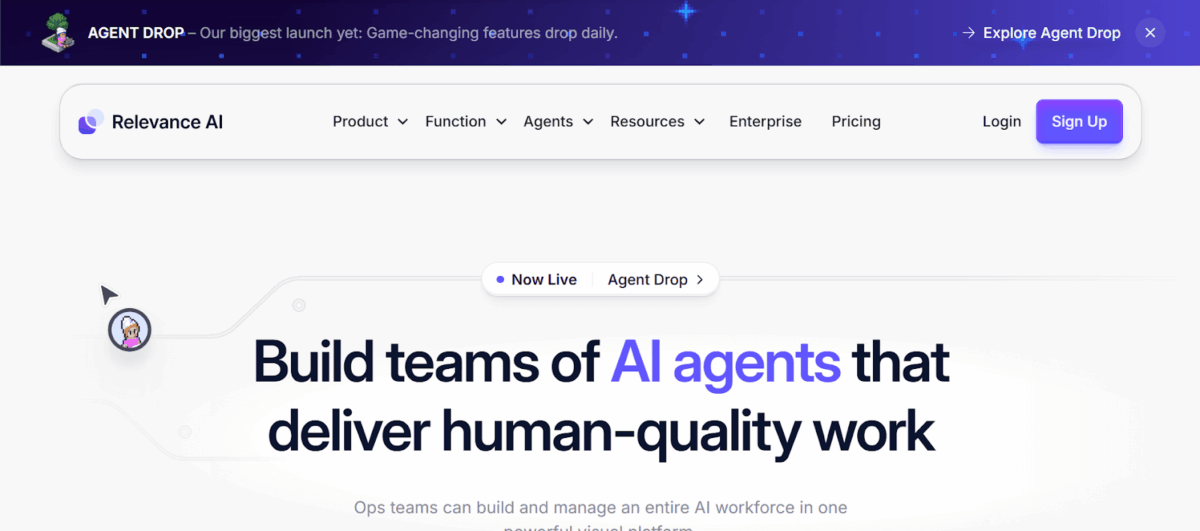
Based in Los Angeles, Relevance AI is a platform builder focused on modular, composable agent systems.
Their platform makes it easy for product and ops teams to deploy AI agents across customer journeys, internal workflows, and decision-making processes, without needing to work through a traditional agency or enterprise service provider.
Their emphasis on rapid experimentation and AI workflow orchestration sets them apart in the automation landscape. Their no-code agent builder has attracted a wide base of business users who want to move quickly without deep engineering resources.
It’s one of the rare platforms where a non-technical team can have a working agent in days, not months.
Why Choose Relevance AI:
- Modular architecture that allows flexible composition of agent capabilities
- User-friendly platform designed for non-technical product and operations teams
- Rapid experimentation capabilities that accelerate time-to-value for AI initiatives
Focus Areas:
- Customer journey automation with intelligent touchpoint optimization
- Internal workflow orchestration across departments and business functions
- Decision-making process enhancement through data-driven agent recommendations
6. Cognosys
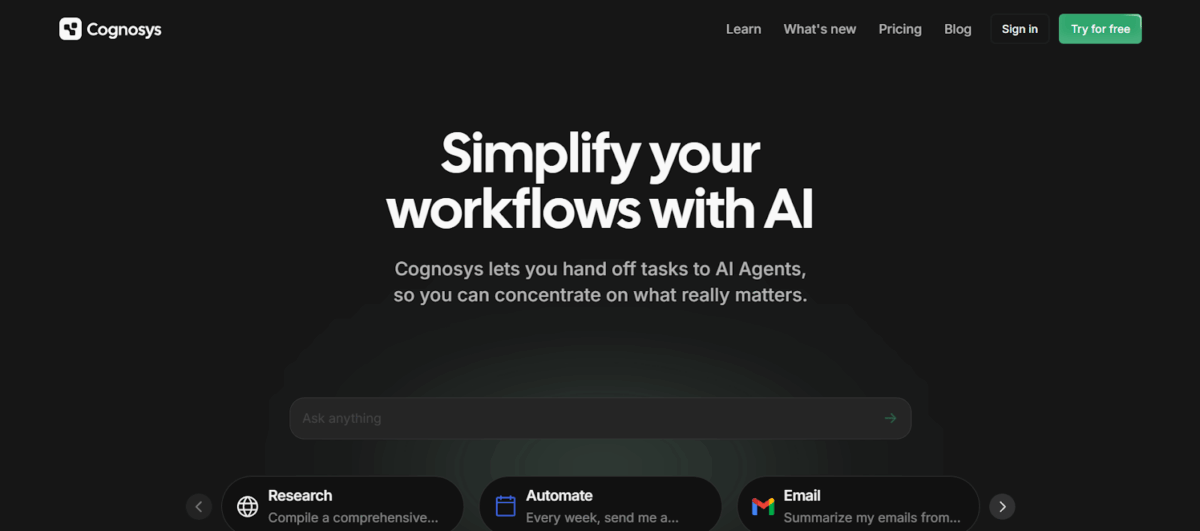
Cognosys has made waves by helping enterprises simulate internal teams with persistent AI agents.
These agents don’t just complete one-off tasks. They collaborate, remember context, and drive entire projects forward through context-aware automation that keeps the broader goal in view.
Think less chatbot, more autonomous colleague.
We’ve built something similar: our internal AI persona for enterprise teams case study shows exactly how persistent AI agents can be embedded into real enterprise workflows and team structures.
As a service provider focused on knowledge work, Cognosys is ideal for internal R&D use cases. They offer flexible no-code and low-code deployment options for business users who need intelligent, long-horizon agents without a dedicated ML team.
Why Choose Cognosys:
- Persistent AI agents that maintain context and drive long-term project continuity
- Collaborative agent systems that simulate and enhance team dynamics
- No-code and low-code options that empower business users without technical expertise
Focus Areas:
- Knowledge work automation with context-aware AI team members
- Internal R&D project acceleration through collaborative agent systems
- Enterprise team simulation for improved productivity and decision-making
7. Crew AI
Crew AI offers developers and businesses an agent orchestration framework for building structured multi-agent systems.
With role assignment, message routing, and collaboration logic built in, this platform builder is perfect for organizations wanting to coordinate multi-agent orchestration with minimal overhead.
The framework has grown significantly in the developer community. It’s now one of the more widely adopted open-source tools, sitting alongside LangChain and AutoGen as a go-to starting point for agent-based architectures.
If your team is already comfortable in code, Crew AI gives you structure without sacrificing flexibility.
Why Choose Crew AI:
- Structured framework that simplifies complex multi-agent system development
- Built-in collaboration logic and role assignment that reduces development overhead
- Open and flexible architecture that adapts to diverse organizational needs
Focus Areas:
- Multi-agent system frameworks with predefined collaboration patterns
- Developer tools for orchestrating complex agent interactions and workflows
- Open-source solutions that provide flexibility and community-driven innovation
8. Lindy
Lindy is an AI agent company that builds personalized executive assistants, handling email, scheduling, follow-ups, and task management.
Unlike generic AI copilot products offered by larger vendors, Lindy’s agents adapt to each user’s workflows and preferences through conversational AI that learns over time, creating a tailored productivity experience.
Lindy is notable for its full-stack approach as both a service provider and platform builder, not just an API. It features long-term memory and context learning across work tools, making it one of the more mature personal productivity agent products on the market heading into 2026.
It doesn’t just assist. It learns. And for teams that need voice-level intelligence on top of that, the next company takes things even further.
Why Choose Lindy:
- Highly personalized AI assistants that adapt to individual user preferences and workflows
- Full-stack development approach providing a complete solution rather than just API access
- Advanced memory and context learning capabilities that improve over time
Focus Areas:
- Executive assistant automation for email, scheduling, and task management
- Personalized productivity enhancement with adaptive learning capabilities
- Cross-platform integration that unifies work tools and communication channels
9. Moveworks
Moveworks built autonomous AI agents designed to handle IT and workplace support ticketing within Slack, Teams, ServiceNow, and more.
As a dedicated service provider in the enterprise IT space, these agents use natural language processing to parse employee requests and resolve them end-to-end with no human intervention needed. A practical demonstration of what conversational AI looks like when it’s truly production-grade.
If you want to understand what an AI-powered helpdesk can look like in practice, our breakdown on building an AI HR helpdesk copilot walks through how similar systems are architected.
In 2025, ServiceNow announced an agreement to acquire Moveworks for $2.85 billion, the largest acquisition in ServiceNow’s history. The deal closed later that year in 2025.
It was a clear signal that the market for enterprise AI agents had matured from experiment to infrastructure.
Moveworks now operates as part of the ServiceNow AI platform, combining its front-end AI assistant, enterprise search, and agentic Reasoning Engine with ServiceNow’s backend workflow automation. The combined platform serves over 5.5 million employee users worldwide, with Moveworks continuing to expand under ServiceNow’s broader AI-native platform strategy.
Why Choose Moveworks (now part of ServiceNow):
- Autonomous end-to-end resolution of IT support requests without human intervention
- Backed by ServiceNow’s enterprise scale, trust, and extensive workflow platform
- Seamless integration across Slack, Teams, ServiceNow, and 100+ enterprise tools
Focus Areas:
- IT support automation with natural language processing for ticket resolution
- Workplace service management across communication and ticketing platforms
- Enterprise help desk optimization now powered by ServiceNow’s full workflow engine
10. AssemblyAI
While known for best-in-class transcription, AssemblyAI is a company carving a new path with agents that understand and act on voice.
These agents can join meetings, summarize calls, extract action items, and manage spoken tasks in real-time.
For businesses seeking voice-native interfaces, AssemblyAI is leading the charge. Its audio intelligence APIs have become a foundational layer that other agencies and platform builders use to deliver voice-enabled agent products on top of their infrastructure.
As voice becomes a primary interface for enterprise AI, this is the company that others are quietly building on.
You’ve now seen ten very different approaches to building AI agents. The next question is how to match one of them to your specific situation.
Why Choose AssemblyAI:
- Pioneer in voice-native AI agents with industry-leading transcription accuracy
- Real-time voice processing capabilities for meetings and spoken task management
- Specialized expertise in audio intelligence that translates to superior voice agent performance
Focus Areas:
- Voice-native AI agent development with advanced speech recognition and processing
- Meeting automation including real-time transcription, summarization, and action item extraction
- Audio intelligence solutions that transform spoken communication into actionable insights
Now that you’ve seen what the best firms in the space are building, the next logical question is: how do you actually pick the right one for your situation?
How to Choose the Right AI Agent Development Company?
“The best AI agents aren’t built on the best models. They’re built by teams who understood the business problem before writing a single line of code.”
This is where most buyers make expensive mistakes.
They evaluate demos, not delivery records. They compare features, not fit. They underestimate how much the wrong partner costs, not just in money, but in time they can’t get back.
Choosing the right AI agent development partner, whether it’s a boutique agency, an enterprise service provider, or a large platform builder, is about finding a team that understands your business goals, technical realities, and risk appetite.
If you’re still unsure where to start, an AI consulting engagement can help you define scope before committing to a full build.
Here are the key factors to evaluate regardless of which path you take:
Use-case alignment: Do they have experience building agents similar to what you need, be it AI chatbots for customer service (like our Kord Fire Protection chatbot integration), workflow agents, or executive assistants?
Full-stack capabilities: Can the company handle everything from model selection and context engineering to UI, deployment, and post-launch support? A vendor who hands off at integration is a liability, not a partner.
Speed vs. scale: Are you building a quick MVP to validate, or a deeply integrated system to scale? The right firm should match your current phase and your future ambition.
Security and compliance: For regulated industries, healthcare, finance, and legal especially, your partner must understand data handling, access controls, and model auditability. For healthcare specifically, see how purpose-built AI agents for healthcare handle compliance at the application layer, and how we’ve applied this in real production systems like our intelligent healthcare orchestrator using multi-agent AI and LangGraph and our autonomous patient coordinator built on n8n AI agents.
Human-in-the-loop design: Look for teams that build fallback mechanisms and escalation paths. True autonomy doesn’t mean zero oversight, and any firm that says otherwise is glossing over real operational risk.
The right partner, regardless of whether they operate as a vendor, agency, or service provider, will help you start small, validate quickly, and scale confidently. The wrong one will cost you months you don’t have.
With that framework in hand, here is why one firm on this list consistently earns trust across all five criteria.

Why Bitcot Is a Smart Choice for AI Agent Development in the USA
Among the companies on this list, Bitcot stands out for one key reason: practical, business-focused execution.
Most businesses building AI agents don’t struggle with ambition. They struggle with delivery. They run into scope creep, unclear timelines, and vendors who disappear after launch.
That’s where we’re built differently.
“We don’t hand off after launch. The real work starts when the agent meets real users. That’s when we earn the partnership.”
– Raj Sanghvi, Founder & CEO, Bitcot
While some firms prioritize bleeding-edge research or platform tooling, and larger vendors focus on enterprise-scale contracts, we operate as an agency focused on getting real, useful agents into the hands of actual business teams.
Here’s what makes us unique:
Tailored builds, not templates: We work closely with clients to understand their workflows and design AI agents that fit directly into their business processes, something off-the-shelf platform builders simply can’t replicate. See how we applied this approach in our Biglio project management platform case study, where we built a complex workflow automation system around a founder’s specific operational needs. Our multi-agent HR automation case study is another example, showing how we built a LangGraph-based system to handle complex policy queries across an enterprise workforce.
Startup agility with enterprise discipline: Whether you’re in early-stage experimentation or scaling an existing product, we bring a blend of flexibility and rigor that’s rare in this space. Our Stanford University intervention management platform is a strong example of how we handle enterprise-grade scale, secure integrations, and real-time automated workflows when the stakes are high.
End-to-end delivery: From LLM and agent design to generative AI integration, UI, and user training, we handle the full development cycle as a complete service provider. You don’t need a full team of AI and machine learning specialists to get started.
Accessible pricing: Unlike larger vendors and platform builders, we offer transparent pricing structures that make high-impact AI copilot development and custom agent builds accessible to growing teams and SMBs.
If you’re a founder, CTO, or product leader who needs a trusted, nimble firm that delivers not just agents but results, we are one of the top names to consider in 2026 for custom AI agent development.
Final Thoughts
The companies above represent the full range of what AI agent development looks like in 2026, from foundational platform builders to specialized execution partners. The right choice depends entirely on what you’re building, and how fast you need to move.
AI agents are no longer just prototypes or experimental side projects.
They’re becoming embedded collaborators in every part of the enterprise. From automating tedious workflows to making real-time decisions using agentic AI workflows, the right AI agent company, agency, or service provider can unlock compounding value for teams across industries.
The broader shift toward AI-native development, where intelligence is built into a product’s architecture from day one and not bolted on later, is what separates the businesses winning in 2026 from those still catching up.
But success doesn’t come from the technology alone.
It comes from choosing the right partner, one who understands how to align intelligent systems with real business goals. And in a market this crowded, that choice matters more than ever.
The cost of waiting isn’t neutrality. It’s falling behind competitors who moved sooner.
Whether you’re looking to streamline operations, improve customer experience, or build entirely new digital workflows, now is the time to act.
At Bitcot, we specialize in designing, building, and deploying custom AI agents that solve real business problems. Whether you’re looking to automate customer support, optimize internal workflows, or build a personalized assistant for your team, we’ll help you bring it to life.
Book a free strategy call with Bitcot today and turn your agent idea into a working product, faster than you think.
Frequently Asked Questions
Why choose a custom AI agent company over a general AI vendor?
The short answer: fit. General AI vendors are built for the widest possible audience, which means they’re optimized for nobody in particular. Custom AI agent development companies and agencies deliver deeply integrated, task-specific agents that align with your workflow, data, and goals, resulting in higher accuracy, better automation, and faster ROI.
How do I know if I need a custom agent or just an off-the-shelf tool?
It comes down to how unique your situation is. If your workflows are standard, off-the-shelf may work. If your operations, data, or compliance requirements are unique, custom is almost always worth it.
How do top AI agent development companies approach custom AI agent development?
The approach varies by use case, but the best firms follow a consistent pattern.
They start with the business problem, not the technology. From there, they prioritize domain-specific customization and select the right LLM or hybrid architecture, such as RAG or multi-agent, to build solutions trained on proprietary data. These are then integrated with CMSs, ERPs, and APIs to serve specific business needs like sales, support, R&D, or operations.
If you want to see this process mapped out step by step, our guide on how to build an AI agent covers the full process for both startups and enterprise teams.
What technologies are commonly used by leading custom AI agent developers?
The best AI agent developers, whether operating as a firm, agency, or platform builder, leverage the latest in LLMs (like GPT-4o, o3, and Claude 3.7), Retrieval-Augmented Generation (RAG), multimodal inputs (text, voice, vision), vector databases, and orchestration frameworks like LangChain, CrewAI, or AutoGen.
Together, these form the technical backbone of most production-ready agentic systems today.
How long does it take to develop a custom AI agent?
Timeline depends on scope, but most projects fall in a predictable range.
Developing a custom AI agent typically takes 6 to 16 weeks, depending on complexity, data readiness, and integration needs. Advanced use cases involving full enterprise AI integration may require additional phases like prototyping, RAG setup, fine-tuning, and system orchestration.
What is the biggest mistake companies make when hiring an AI agent development company?
Evaluating the demo, not the delivery record.
Many vendors can show impressive prototypes in a pitch. Fewer can show agents running in production at scale, six months after launch. Always ask for post-deployment references, not just case study PDFs.
Are there open-source alternatives to hiring an AI agent development company?
Yes, and they’re worth exploring early. Tools like LangChain, CrewAI, and OpenAI’s APIs allow developers to experiment with AI agents. But open-source is a starting point, not a finish line.
Scaling and customizing these solutions for production requires expert help from a qualified service provider. For a structured look at what’s available, our breakdown of AI agent frameworks by category covers both open-source and enterprise-grade options side by side.
The challenges include managing context windows, securing data pipelines, handling edge cases, and ensuring reliability at enterprise scale. These are exactly where open-source tooling tends to fall short without experienced hands guiding the build.
How do I evaluate whether an AI agent development company is the right fit for my industry?
Ask three questions before signing anything.
First: have they built agents in your industry before? Second: can they show you a working example of the integration your stack requires? Third: what does their post-launch support model look like?
Companies that answer all three clearly, without redirecting to a generic capabilities deck, are the ones worth shortlisting.