Here’s what most digital health founders don’t realize until it’s too late: choosing the wrong development partner costs more than money – it costs market position.
The digital health market reached $172 billion in 2024 and continues accelerating – with hundreds of millions of users worldwide relying on mHealth solutions and healthcare apps to manage their well-being.
This isn’t just growth – it’s a complete transformation of how medical care is delivered.
For digital health startups, choosing the right app development partner can make or break success. One wrong decision could mean months of delays, compliance violations, or worse – building a product that fails in the market.
The healthcare sector demands more than coding skills. Apps need HIPAA compliance, EHR integration, healthcare interoperability, and interfaces that work for both doctors and patients.
The pressure is real: investors expect results, patients need reliable solutions, and competitors aren’t waiting.
So how do you navigate this complex landscape? The good news is that not all development companies are created equal. This guide profiles the leading healthcare app development companies, agencies, and consultants helping startups build compliant, scalable solutions in 2026.
What separates the winners from the rest? Keep reading.
What Makes a Great Healthcare App Development Company in 2026
Healthcare application development isn’t like building an e-commerce app or social media platform. The stakes are higher, regulations are stricter, and user needs are more complex.
Digital health startups fall into several categories, each with unique challenges:
Early-stage founders validating concepts need rapid MVP development and flexible pricing. Funded startups scaling their solutions need enterprise-grade architecture and EHR integrations. Established healthtech companies need partners who can enhance existing platforms without disrupting live users.
Despite their differences, all share common fears: choosing the wrong partner, burning through runway on rewrites, or launching applications that fail compliance audits.
So what should you look for? Leading healthcare app developers bring these core capabilities:
Regulatory Expertise: Deep understanding of HIPAA, HL7, FHIR, and FDA regulations for medical devices. Compliance isn’t an add-on – it’s built into the foundation.
Clinical Knowledge: Teams that understand healthcare workflows, patient journeys, and provider needs. This knowledge prevents costly redesigns later.
Security Infrastructure: Bank-level encryption, secure APIs, role-based access controls, and audit trails that protect patient data. Look for partners with SOC 2 Type II and ISO 27001 certifications.
Integration Experience: Proven ability to connect with EHR systems, lab networks, pharmacy databases, wearable devices, and patient engagement platforms for remote patient monitoring.
AI and ML Capabilities: Experience implementing predictive analytics, clinical decision support, and automated workflows that improve outcomes.
But here’s the critical question: Why these 10 companies?
The answer lies in our selection methodology. Each company below was selected based on specific criteria: proven healthcare project portfolios, regulatory compliance expertise, startup-friendly engagement models, and track records of delivering on time and within budget.
Some excel at AI integration. Others dominate telemedicine. A few specialize in enterprise-scale solutions. The key is matching your startup’s needs with the right partner’s strengths.
Let’s dive into the top 10.
Top 10 Healthcare App Development Companies for Digital Health Startups
Expert-vetted partners delivering proven solutions that transform healthcare delivery and accelerate startup growth.
1. Bitcot
Bitcot stands out as a comprehensive healthcare software development partner for digital health startups. Based in San Diego, we have built our reputation on delivering systems built following HIPAA guidelines that integrate emerging technologies like AI, machine learning, and automation.
What sets us apart is our end-to-end approach – from discovery and strategy through UX/UI design, agile development, rigorous testing, and post-launch support. Our expertise spans custom EMR/EHR systems, telehealth platforms, remote patient monitoring, digital therapeutics, and AI-powered diagnostic tools.
Our portfolio includes telemedicine implementations handling virtual consultations, patient scheduling, and secure messaging. Notable case studies include the DICOM Image Analysis Tool for medical imaging and radiology AI, and mdNect Healthcare platform for centralized patient management across multiple facilities.
For startups with limited resources, our rapid prototyping and MVP development approach proves particularly valuable. We maintain transparent pricing models and consistently deliver projects on time. Our technical stack includes expertise in DICOM, FHIR, ICD-10, and CPT standards, ensuring seamless interoperability across healthcare systems.
Best For: Digital health startups needing AI integration, telemedicine solutions, and custom healthcare software built following robust security protocols and HIPAA guidelines.
2. Epic Systems Corporation
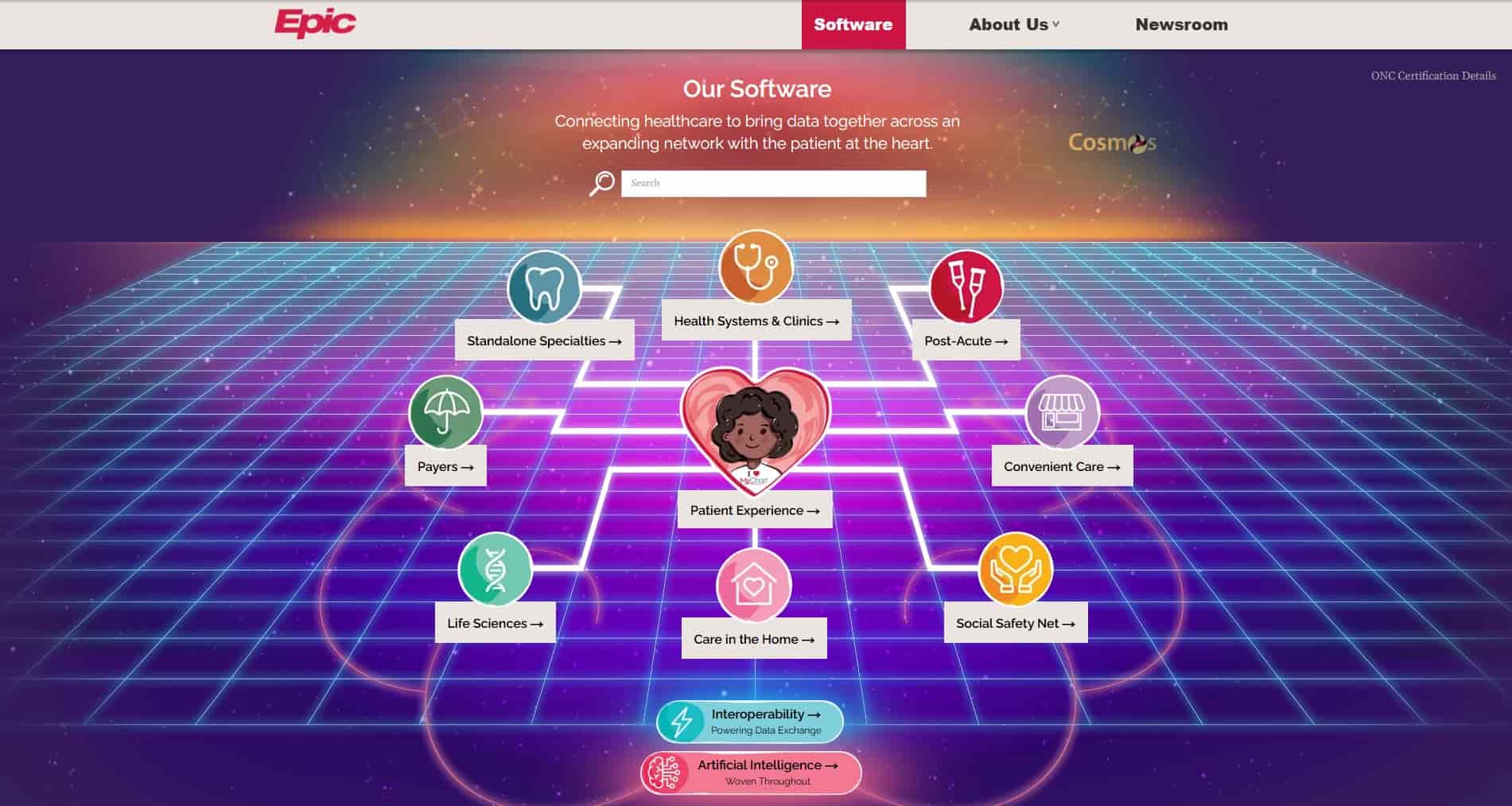
Epic Systems dominates the enterprise healthcare software market with installations in major health systems across North America.
While primarily known for their comprehensive EHR platform, Epic also partners with digital health startups through their App Orchard marketplace.
The company’s strength lies in deep integration capabilities and massive scale. Epic’s Interconnect framework allows third-party developers to build apps that seamlessly exchange data with Epic’s EHR system.
For startups targeting enterprise healthcare organizations, Epic integration often becomes a competitive requirement.
Epic’s development tools, APIs, and technical documentation provide startups with pathways to reach hundreds of health systems. The company’s focus on interoperability through FHIR standards makes data exchange more straightforward than legacy systems.
However, working with Epic requires significant technical resources. Their implementation timelines are longer, and customization can be complex. Startups need to demonstrate clear value propositions before health systems will consider Epic-integrated solutions.
Best For: Startups with enterprise sales strategies targeting large health systems already using Epic’s EHR platform.
3. Oracle Health (formerly Cerner)
Oracle Health brings enterprise-grade cloud infrastructure to healthcare software development. Since acquiring Cerner in 2022, the platform leverages Oracle Cloud Infrastructure to deliver scalable healthcare solutions.
For digital health startups, Oracle Health offers robust APIs and development frameworks that enable integration with their widespread EHR installations. The platform’s strength in data analytics and cloud computing creates opportunities for startups building AI-powered clinical tools or population health solutions.
Oracle Health’s Developer Program provides access to sandbox environments, technical documentation, and support resources. Startups can build and test integrations before deploying to production environments.
The company’s focus on cloud-native architecture and microservices aligns well with modern development practices. However, Oracle Health’s enterprise focus means longer sales cycles and more complex procurement processes.
Best For: Startups developing analytics platforms, clinical intelligence tools, or solutions requiring massive data processing capabilities.
4. Accenture (Healthcare Practice)
Accenture’s Healthcare Practice combines management consulting with software development expertise. The global consulting firm brings strategic perspective alongside technical implementation capabilities.
For well-funded digital health startups, Accenture offers comprehensive services spanning strategy, design, development, and change management.
Their team of healthcare consultants and technology experts understands payer and provider workflows, regulatory landscapes, and market dynamics.
Accenture’s strength lies in handling complex, multi-stakeholder healthcare projects. The firm has experience implementing large-scale digital transformations for major health systems, insurers, and pharmaceutical companies.
Their digital health capabilities include AI-powered diagnostics, telehealth platforms, patient engagement apps, and blockchain solutions for health information exchange. Accenture’s Applied Intelligence group brings machine learning and data science expertise to healthcare applications.
The trade-off for working with Accenture is cost. Their consulting-driven model comes with premium pricing that may stretch early-stage startup budgets.
Best For: Series B+ startups needing strategic guidance alongside technical development, or those targeting enterprise healthcare clients.
5. Cognizant Technology Solutions (Healthcare)
Cognizant’s Healthcare Practice delivers IT services and software development to hospitals, payers, pharmaceutical companies, and medical device manufacturers. The company’s healthcare vertical combines technical expertise with industry knowledge.
Cognizant’s TriZetto platform provides core administrative and financial solutions for health plans, creating integration opportunities for digital health startups focused on payer markets.
The company’s experience with claims processing, care management, and member engagement platforms makes them valuable partners for insurance-focused healthtech ventures.
Their software development offerings span mobile app development, cloud migration, data analytics, and AI implementation. Cognizant’s offshore development model can provide cost advantages while maintaining quality standards.
The company has invested heavily in digital health capabilities including remote patient monitoring, virtual care platforms, and precision medicine tools. Their life sciences practice also supports clinical trial management and regulatory submission software.
Best For: Startups targeting payer markets or those needing cost-effective development resources with healthcare domain expertise.
6. GE Healthcare
GE Healthcare brings decades of medical device and imaging expertise to software development.
The company’s Edison platform provides AI algorithms and applications that enhance medical imaging interpretation and clinical decision-making.
For digital health startups working with medical imaging, diagnostics, or clinical workflows, GE Healthcare offers partnership opportunities through their Edison Developer Program. Startups can access imaging data, AI tools, and clinical algorithms to build innovative applications.
GE Healthcare’s strength lies in deep clinical knowledge and relationships with healthcare providers worldwide.
Their medical device expertise creates opportunities for startups developing software that connects with imaging equipment, patient monitors, or other medical devices.
The company’s focus on enterprise imaging and radiology workflow optimization makes them particularly relevant for startups in diagnostic imaging, pathology, or cardiology specialties.
Best For: Startups building solutions around medical imaging, diagnostics, or clinical workflow optimization in hospital settings.
7. McKesson Corporation
McKesson operates as one of the largest healthcare services companies in North America. While primarily known for pharmaceutical distribution, McKesson’s technology division develops software for pharmacy management, revenue cycle, and healthcare supply chain.
Their Relay Health platform connects patients, providers, and payers through secure health information exchange. For digital health startups, McKesson’s pharmacy network and healthcare supply chain reach creates unique partnership possibilities.
McKesson’s strength lies in healthcare operations and logistics. Startups focused on medication management, pharmacy automation, or supply chain optimization can benefit from McKesson’s market position and technical capabilities.
The company’s technology stack includes pharmacy management systems, electronic prescribing platforms, and patient engagement tools.
Their understanding of healthcare economics and reimbursement makes them valuable partners for startups navigating payer relationships.
Best For: Startups developing pharmacy-focused solutions, medication adherence tools, or healthcare supply chain applications.
8. Allscripts Healthcare Solutions (Veradigm)
Allscripts (now part of Veradigm) provides EHR systems and practice management solutions primarily to ambulatory care practices and community hospitals. Their Developer Program allows third-party developers to build apps that integrate with Allscripts EHR platforms.
For startups targeting smaller healthcare practices rather than enterprise health systems, Allscripts offers more accessible integration pathways than Epic or Oracle Health.
Their market presence in ambulatory care creates opportunities for practice management tools, patient engagement apps, and clinical decision support solutions.
Allscripts’ Open platform uses FHIR standards to enable data exchange and app integration. The company’s focus on interoperability and open standards aligns with modern healthcare IT trends.
Their analytics capabilities through the Veradigm network provide access to de-identified patient data for research and development purposes, valuable for startups building AI models or conducting clinical research.
Best For: Startups building solutions for ambulatory practices, specialty clinics, or those needing access to real-world clinical data.
9. WillowTree (TELUS Digital)
WillowTree brings consumer-grade design thinking to healthcare software development. As part of TELUS International, the company ranks among the leading digital agencies in North America, with a portfolio exceeding 400 mobile apps across industries including healthcare, retail, and media.
Their healthcare portfolio includes FDA-approved medical device apps like the Dexcom G7 companion app for continuous glucose monitoring. WillowTree’s work on Vocable, a free communication app for non-verbal patients, demonstrates their commitment to accessible healthcare technology.
The company’s strength lies in user experience design and mobile development. WillowTree’s teams understand how to create intuitive interfaces that work for diverse patient populations. Their design-driven approach helps startups move quickly from concept to validated product.
WillowTree’s healthcare experience spans patient engagement apps, digital therapeutics, clinician tools, and remote patient monitoring platforms. They understand the balance between clinical functionality and consumer-friendly design.
Their development process emphasizes rapid prototyping, user testing, and iterative refinement – essential for startups validating product-market fit.
Best For: Digital health startups prioritizing user experience and mobile-first design, particularly those building patient-facing applications.
10. Zco Corporation
Zco Corporation has operated for nearly 40 years as a custom software development company serving healthcare organizations, research institutions, and digital health startups. Their healthcare portfolio includes mental health research apps, telemedicine platforms, and medical device software.
Zco’s development of mindLAMP – a neuropsychiatric research app used at over 15 institutions worldwide – showcases their ability to build complex, research-grade healthcare applications. The app demonstrates Zco’s expertise in handling sensitive health data while providing flexible, customizable platforms.
The company’s experience spans native iOS and Android development, hybrid applications, and progressive web apps. Zco’s technical stack includes modern frameworks like React Native and Flutter, enabling cost-effective cross-platform development.
For digital health startups, Zco offers transparent pricing, clear communication, and on-time delivery – critical factors for resource-constrained ventures. Their NDA policies protect intellectual property while their staffing flexibility allows projects to scale as needed.
Zco’s clients include Fortune 500 companies and research institutions like Massachusetts General Hospital, demonstrating their ability to meet enterprise security and compliance requirements.
Best For: Startups needing custom mobile apps built following HIPAA guidelines, particularly those in mental health, research, or specialty care domains.
With these companies identified, what technologies are shaping their work in 2026?
Key Technologies Shaping Healthcare App Development in 2026
Understanding 2026 technology trends helps startups make informed decisions about development partners and technical approaches. Leading healthcare software providers are implementing these innovations:
Artificial Intelligence and Machine Learning
AI has moved from buzzword to essential healthcare technology. The shift happened fast.
By 2026, predictive analytics enables early disease detection before symptoms appear. Machine learning algorithms analyze medical imaging, lab results, and patient data to identify health risks in real-time.
Healthcare applications in 2026 use AI for symptom checkers, clinical decision support, treatment recommendations, diagnostic assistance, and value-based care delivery. The most sophisticated tools combine multiple AI models to deliver personalized medical insights.
Here’s what matters: Development firms with legitimate AI expertise – not just API integrations – create competitive advantages for digital health startups.
Telemedicine and Remote Care
Virtual care evolved beyond simple video consultations. Fast.
Modern telemedicine platforms integrate with EHRs, handle prescriptions electronically, process insurance claims, and coordinate with in-person care.
Remote patient monitoring connects wearable devices, medical sensors, and mobile apps to clinical workflows. Care teams receive real-time alerts about patient conditions without requiring hospital visits.
Industry leaders are using telemedicine platforms to bridge geographic gaps between patients and specialists, particularly in rural and underserved populations.
Wearable Device Integration
Smartwatches and fitness trackers generate continuous health data streams. Healthcare applications that connect with wearables provide early warning systems for cardiac events, blood sugar fluctuations, and other acute conditions.
The challenge for developers lies in processing massive data volumes while maintaining battery life and user privacy. Successful wearable integrations require sophisticated data filtering and analysis.
Blockchain for Health Data
While still emerging, blockchain technology addresses healthcare’s persistent interoperability challenges. Distributed ledger systems enable secure health information exchange without centralized databases vulnerable to breaches.
Some digital health startups use blockchain for patient consent management, clinical trial data integrity, and pharmaceutical supply chain tracking.
But before selecting a development partner, you need to make another critical decision.
Custom vs. Template Healthcare Apps: Which Is Right for Your Startup?
One of the first decisions digital health startups face: build custom or use templates?
The choice affects your timeline, budget, and competitive position.
Template-Based Healthcare Apps
Template solutions offer faster deployment and lower upfront costs.
Pros: Launch in weeks, lower initial cost ($10K-$50K), pre-built HIPAA compliance, proven functionality.
Cons: Limited customization, vendor lock-in, monthly fees add up, generic experience, hard to differentiate.
Best for: Validating market fit quickly, straightforward requirements, proof-of-concept for investors.
Custom Healthcare App Development
Custom development means building from scratch for your exact needs.
Pros: Complete control, unique experience, scalable architecture, proprietary technology, full data ownership, integration flexibility.
Cons: Higher upfront cost ($150K-$400K), longer timeline (3-12 months), requires clear vision, needs ongoing resources.
Best for: Unique value propositions, enterprise clients, specific compliance needs, deep EHR integration.
The Hybrid Approach
Many startups use templates for basic features (authentication, billing, messaging) and build custom solutions for differentiated capabilities (AI algorithms, diagnostic tools, clinical workflows).
This balances speed and cost with competitive advantage.
Making Your Decision
Choose templates if: You need quick validation, budget under $50K, speed matters most, lack technical team.
Choose custom if: Your innovation requires unique technology, targeting enterprise healthcare, need specialized workflows, have 6+ month runway.
Choose hybrid if: Want to balance speed and customization, have moderate funding ($75K-$200K), some features are standard while others are unique.
Many startups begin with templates to validate demand, then rebuild custom once they prove product-market fit and secure funding.
Once you’ve decided on your approach, how do you evaluate potential partners?
How to Evaluate Healthcare App Development Companies: Key Selection Criteria
Technology trends matter. But here’s the real question: How do you separate qualified partners from those just talking a good game?
Choosing the wrong development partner wastes time and money. Whether evaluating software vendors, technology consultants, or development agencies, these criteria help startups make better decisions:
Healthcare Domain Experience
Generic software developers struggle with healthcare’s unique requirements. Look for firms with proven healthcare digital transformation projects, not just general mobile app experience. Top vendors understand that healthcare products need clinical context, not just technical features.
Ask candidates:
- How many healthcare applications have they built?
- What therapeutic areas or specialties do they understand?
- Can they provide healthcare references?
- Do they understand clinical workflows?
Regulatory Compliance Knowledge
HIPAA violations carry penalties up to $2.13 million per violation category annually. Development partners must understand regulatory requirements from project inception.
Evaluate compliance capabilities:
- Do they design architecture following HIPAA guidelines?
- What security frameworks do they follow?
- How do they handle data encryption and access controls?
- Can they support FDA submissions for medical device software?
Technical Architecture Approach
Scalability matters for growing startups. Development partners should design systems that handle increasing user loads and support healthcare data analytics without expensive rebuilds.
Technical evaluation points:
- What cloud infrastructure do they recommend? (AWS, Azure, Google Cloud configured for HIPAA compliance)
- How do they approach API design and microservices?
- What testing and quality assurance processes exist? (Unit testing, integration testing, security testing with frameworks like Jest, Selenium, Cypress)
- Do they use CI/CD pipelines for faster deployments?
- Which development frameworks do they prefer? (React Native, Flutter for mobile; Node.js, Python, .NET for backend)
- How do they handle database design for healthcare data? (PostgreSQL, MongoDB with encryption at rest)
Ask for architecture diagrams and technical documentation from previous healthcare projects. This reveals whether they truly understand healthcare-specific requirements or just claim expertise.
Integration Capabilities
Healthcare apps rarely operate in isolation. Healthcare interoperability and connections to EHR systems, lab networks, pharmacies, and wearables determine practical utility.
Integration assessment:
- What EHR systems have they integrated with?
- Do they have FHIR implementation experience?
- Can they work with HL7 standards?
- Have they connected applications to medical devices?
Warning sign: If a developer can’t provide specific integration examples, they likely lack real healthcare experience.
Post-Launch Support
Digital health tools require ongoing maintenance, security updates, and regulatory compliance monitoring. Development partnerships shouldn’t end at launch.
Support considerations:
- What post-launch services do they offer?
- How do they handle bug fixes and updates?
- What are their response times for critical issues?
- Do they provide DevOps and infrastructure management?
The reality for digital health startups: app development is just the beginning. Regulations change, operating systems update, user needs evolve, and healthcare providers request new integrations.
Partners who offer comprehensive post-launch support help startups adapt without rebuilding from scratch or scrambling to find new developers who must learn the entire codebase.
Beyond these technical considerations, what’s the financial reality?
Healthcare App Development Costs: Why Quality Partners Save Money Long-Term
Cutting corners on healthcare software development creates expensive problems later. The numbers tell the story.
The cost difference between top-tier partners and budget developers shrinks when accounting for:
Compliance Violations: HIPAA penalties, data breach costs, and legal exposure dwarf initial development savings. A single data breach can cost startups $10.93 million on average – enough to shut down most early-stage companies.
Technical Debt: Poorly architected systems require expensive rewrites that delay market entry and frustrate users. Startups that choose inexperienced developers often rebuild their entire product within 18 months, losing market position to competitors.
Security Incidents: Healthcare data breaches average $10.93 million in total costs – the highest of any industry. Beyond financial damage, breaches destroy trust with healthcare providers and patients.
Integration Failures: Apps that don’t connect to EHRs, labs, or pharmacies have limited practical utility regardless of features. Many startups discover integration problems only after investing 6+ months in development.
User Experience Issues: Healthcare applications with poor usability create clinical workflow problems and reduce adoption rates. Without proper clinical workflow optimization, doctors and nurses won’t use tools that slow them down, no matter how innovative the technology.
The bottom line? Quality development partners help startups avoid these pitfalls while accelerating time to market with validated technology.
Industry leaders understand that investing in quality development from the start saves money and reduces risk long-term. Experienced partners bring regulatory knowledge, healthcare workflow understanding, and proven development processes that turn innovative ideas into market-ready products.
So where does this leave you?
How to Choose the Right Healthcare App Developer for Your Startup
Healthcare app development partnerships require careful evaluation. The right partner understands medical workflows, navigates regulatory requirements, and builds scalable technical solutions.
For digital health startups, success depends on choosing partners who combine technical excellence with healthcare domain expertise. The firms, vendors, and service providers profiled above represent proven options across different startup stages, budgets, and technical requirements.
Startups should begin with thorough discovery conversations, reference checks, and technical assessments before committing to development partnerships. Ask about their development process. Request case studies from similar projects. Speak with their past healthcare clients.
Understand their approach to compliance testing, security audits, and post-launch support. The investment in partner evaluation pays dividends throughout product development and beyond.
Whether building telemedicine platforms, patient engagement apps, clinical decision support tools, or healthcare analytics systems, the foundation of success lies in partnering with experienced healthcare software developers who understand both medicine and technology.
The right partnership delivers faster time to market, reduced technical risk, stronger compliance posture, and applications that healthcare professionals actually want to use.
The digital health revolution continues accelerating. Startups that combine innovative ideas with experienced development partners position themselves to deliver products that genuinely improve patient care, reduce costs, and transform healthcare delivery.
Success in digital health requires more than great ideas – it demands execution partners who’ve navigated healthcare’s unique challenges and emerged with market-ready products.
Your move.
Looking to build a healthcare application for your digital health startup? Explore custom healthcare software development services that combine technical expertise with regulatory compliance. Our team specializes in telemedicine app development, AI-powered healthcare solutions, and platforms built following HIPAA standards that scale with your business growth.
Schedule your free discovery consultation today to discuss your healthcare app concept, receive a technical roadmap