
Key Takeaways:
- Approximately 70% of US software projects fail or are severely challenged, burning billions in enterprise capital annually
- Most failures trace back to architecture decisions made in week one, not engineering mistakes made in production
- Technical debt, vendor misalignment, and compliance gaps are the three leading causes of project collapse in enterprise environments
- AI integration without a governed data pipeline is one of the fastest-growing failure modes in 2026
- Scalability crises are almost always predictable and preventable with cloud-native architecture designed before launch
- The cost of fixing a flawed architecture post-launch is 4 to 7 times higher than building it right the first time
Most Software Projects Don’t Die From Bad Code. They Die From Bad Decisions.
Here is a number that should stop you cold.
According to the Standish Group’s CHAOS Report, approximately 70% of software projects either fail outright or are severely challenged. Only 31% are completed on time, on budget, and with the expected scope.
In the US enterprise market, where average project budgets range from $500K to well over $5M, that is not a statistic. That is a financial catastrophe waiting to happen.
And yet, the patterns repeat.
A SaaS founder raises Series B funding. Their engineering team ships fast. Then the architecture collapses under scale. Gone: twelve months of runway.
A FinTech CTO launches a compliance-ready product. Six months later, regulators flag three gaps the team never anticipated. Gone: the enterprise deal that would have defined the year.
A marketplace VP hires a vendor who promises agile delivery. The vendor disappears after month four. Gone: the MVP, the timeline, and the investor confidence.
These are not edge cases. They are the norm.
The real question is not whether software projects fail. It is why they keep failing at the exact same points, and what enterprise leaders can do to permanently break the cycle before it burns capital, timelines, and competitive position.
Every one of these points traces back to the same root: strategic decisions made without architectural consequence. That is the thread running through every failure pattern below.
“Software doesn’t fail because engineers write bad code. It fails because organizations make strategic decisions without understanding their technical consequences. By the time the symptoms appear in production, the real damage was done months earlier in a planning room.”
The Real Cost of Software Project Failure in US Enterprise Environments
Software project failure is not just a technical inconvenience. It is a direct threat to your funding runway, revenue trajectory, and competitive standing.
According to the Consortium for Information and Software Quality (CISQ), unsuccessful IT and software development projects cost American businesses an estimated $260 billion annually.
That figure sits inside a broader crisis: CISQ’s 2022 report confirmed that poor software quality across all categories cost the United States economy at least $2.41 trillion in that year alone. For Series A through C companies operating in SaaS, FinTech, or HealthTech, a single mismanaged product build can consume 40 to 60% of an entire funding round without delivering a market-ready product.
The financial exposure goes beyond direct project costs. Failed software creates downstream liabilities: compliance gaps that surface during enterprise sales cycles, technical debt that consumes 20 to 40% of engineering capacity, and infrastructure inefficiencies that inflate cloud spend quarter over quarter.
For technical leaders accountable to boards and investors, the stakes are not abstract. A failed product build is a career event, a funding event, and sometimes an existential company event.
Understanding why projects fail with precision is the first step toward making sure yours does not. The second step is recognizing that most failures follow a predictable sequence, one that starts long before a single line of code is written.
Why US Software Projects Face a Higher Failure Threshold Than Global Averages
The United States market imposes a uniquely demanding set of conditions on software product development that amplifies software delivery risk at every stage.
Regulatory complexity is one layer. HIPAA, SOC 2 Type II, PCI-DSS, CPRA, and an expanding matrix of state-level data privacy laws create a compliance surface that most global development teams are not equipped to navigate without specific domestic market expertise.
Investor expectations add another layer. American Series A and B investors apply rigorous technical due diligence standards. Architecture fragility, unaddressed debt, and governance gaps surface quickly in due diligence and directly impact valuation.
Market velocity is the third compounding factor. Domestic product markets move faster than most global equivalents. A six-month architecture misstep does not just cost time. It costs market position that competitors are actively capturing during the delay.
Building software for enterprise audiences across the United States requires a fundamentally different level of architectural rigor, compliance awareness, and scalability planning than most project teams initially account for. The teams that understand this early build differently. The teams that learn it late rebuild expensively.
Warning Signs Your Software Project Is Already Headed Toward Failure
Most project failures do not arrive as sudden collapses. They arrive as slow-moving patterns that leadership recognizes too late to course-correct without significant cost.
The clearest early signals include declining sprint velocity without corresponding scope reduction, increasing production bug density across consecutive releases, architectural decisions being deferred repeatedly into future sprints, compliance requirements surfacing for the first time during an enterprise sales cycle, and infrastructure costs growing faster than user or revenue growth.
If two or more of these patterns are present in your current project, the structural risk is significant. The cost of addressing them now is a fraction of the cost of addressing them after a major incident, a compliance audit, or a failed funding round.
Recognizing these signals early and responding with a structured software architecture review is what separates technical leaders who scale successfully from those who find themselves managing expensive rebuilds twelve months after launch.
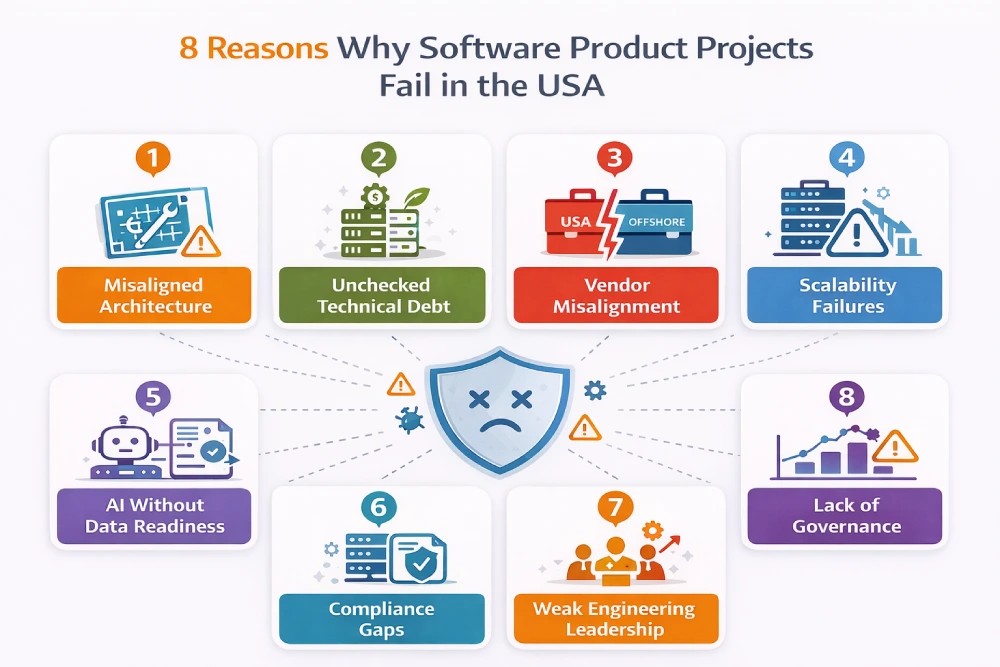
The eight failure patterns below explain exactly how most projects across the country arrive at that point. More importantly, each one has a fix that works best when applied before the damage is done.
8 Reasons Why Software Product Projects Fail in the USA (And How to Fix Them)
These eight patterns drive the majority of enterprise software failures across the United States. Each one is preventable when the right decisions are made at the right stage of your build.

Most projects begin with excitement and end with confusion.
The business team has one vision. The engineering team builds something technically sound but misaligned. The product team defines requirements in sprints without ever locking down a north-star architecture blueprint. By the time the product reaches UAT, there are three different definitions of what “success” looks like, and none of them match.
This is not a communication problem. It is an architecture governance problem.
In enterprise environments across the country, especially in SaaS development and AI-platform builds, the absence of a documented technical contract between business intent and engineering execution is the single most expensive mistake a leadership team can make. Scope expands silently. Debt accumulates invisibly. Delivery timelines stretch indefinitely.
The fix: Before writing a single line of code, leadership needs a technical architecture document that maps business outcomes to system design. This includes API-first architecture decisions, data models, third-party integration dependencies, compliance requirements, and infrastructure provisioning plans.
Discovery workshops that align product, engineering, and business stakeholders in week one eliminate 60 to 70% of mid-project disputes before they occur. The answer to misalignment is not better communication in retrospect. It is a binding technical contract agreed upon before the first sprint begins.
And if misaligned definitions are this costly at the planning stage, what happens when the debt from those misalignments compounds silently across every sprint? That is exactly where teams run into the next failure.
Reason 2: Underestimating Technical Debt as a Strategic Risk
Technical debt is not a developer complaint. It is a balance sheet liability.
Many American product teams, particularly those running post-Series A at speed, make rational short-term tradeoffs. They ship faster. They use patchwork solutions. They defer refactoring. These decisions make sense in isolation.
But debt compounds. A monolithic backend that served 5,000 users becomes a crisis at 500,000. Teams that delay a shift to microservices architecture often find that what seemed like a minor structural shortcut becomes a full re-platforming project eighteen months later.
A hardcoded third-party API integration becomes a security vector when that vendor changes their authentication model. A React frontend built without state management conventions becomes unmaintainable after three engineering team rotations.
By the time leadership recognizes the problem, the options are brutal. A full legacy system modernization can cost $400K to $1.2M and take 9 to 18 months. A patched system continues leaking engineering capacity month over month.
The hidden cost most teams ignore: According to McKinsey research, technical debt consumes an estimated 20 to 40% of the entire technology budget in companies that do not actively manage it. The CISQ 2022 report puts accumulated software technical debt in the United States at approximately $1.52 trillion, making it the single largest obstacle to making changes in existing codebases nationwide. That is capital that does not go toward new features, new markets, or new revenue streams.
The fix: Build with a technical debt register from day one. Assign ownership. Set quarterly thresholds. Treat architectural remediation as a product line item, not an engineering afterthought. For teams already in debt, a structured re-architecture roadmap with phased migration beats a full rewrite in most cases.
Also Read: Monolithic vs Microservices Architecture: Key Differences and How to Choose the Better Approach
Debt is a slow leak. The next failure pattern is faster and more visible, but equally preventable.
Reason 3: Vendor Misalignment and Offshore Team Dysfunction
The American software market is flooded with development vendors promising enterprise delivery at startup speed. Very few deliver.
The failure pattern is predictable. A CTO or VP of Engineering selects a vendor based on portfolio and price. Contracts are signed. Kickoff calls happen. Early sprints look promising. Then: timezone friction surfaces, communication becomes asynchronous and vague, code quality degrades quietly, and by month three, the internal team is spending more time reviewing and correcting vendor output than building.
The financial math breaks down fast. A $150K engagement that requires $80K in remediation and $60K in timeline extension has an effective cost of $290K, with a worse outcome than the original plan.
What enterprise leaders often miss: Vendor selection is not just a procurement decision. It is an architectural decision. The team you hire shapes the choices made at every layer of your system. A vendor optimizing for billable hours will never surface the conversation about whether your current approach is the right approach.
The fix: Evaluate vendors not just on delivery history but on their discovery process, code review culture, documentation standards, and escalation frameworks. Senior-only teams with embedded architects, not staffing agencies with rotating junior developers, are the correct model for $75K+ engagements. Define governance SLAs before the contract is signed.
The wrong vendor creates debt, delays, and a system that looks functional on the surface but cannot survive the next growth phase. And growth phases, as the next pattern shows, come faster than most teams plan for.
Reason 4: Ignoring Scalability Until the System Is Already Breaking
Scalability planning is almost always reactive in failed projects. Teams build for today’s load and redesign for tomorrow’s crisis. The question technical leaders rarely ask early enough is: what happens when this system faces 10x the traffic it sees today?
This is especially acute in three scenarios.
First, marketplace platforms that experience sudden demand spikes after funding announcements or media coverage – as Bitcot navigated in building the PartnerHere marketplace platform, where cloud-native scalability was architected from the first sprint to handle precisely this kind of unpredictable growth.
Second, healthcare SaaS platforms that acquire enterprise clients with 10x the user volume of their existing base.
Third, eCommerce platforms running headless commerce builds that underestimate CDN, caching, and database query load at peak.
The cost of reactive scalability is not just engineering time. It is revenue lost to downtime, customer trust damaged during outages, and investor confidence shaken during growth phases that should be celebratory.
For mid-market eCommerce platforms operating across the United States, a single hour of downtime can cost $50,000 to $150,000 in direct revenue loss, before accounting for customer churn or reputational impact.
Cloud cost optimization also suffers when scalability is treated reactively. Overprovisioned emergency infrastructure costs two to three times more than properly designed auto-scaling configurations.
The fix: Design for 10x current load before launch, not after. Cloud application development built on AWS or GCP with horizontal scaling policies, distributed caching layers, and read replica database configurations gives teams the infrastructure to grow without rebuilding. Conduct load testing at 5x and 10x expected traffic before any major launch or campaign.
Also Read: How Google Cloud Platform is Transforming Enterprise Success
Scalability failures are visible and painful when they hit. The next failure pattern is quieter, and in many ways more dangerous because it often goes undetected until a high-stakes sales conversation forces it into the open.
Reason 5: AI Integration Without Data Readiness
In 2026, AI is no longer a differentiator for most product categories nationwide. It is an expectation. Investors want it. Customers expect it. Competitors are shipping it.
The failure mode is almost universal: leadership mandates AI features. The engineering team integrates a third-party LLM API. The product ships with an “AI-powered” label. And then reality arrives.
The model hallucinates in edge cases. Personalization features are generic because the underlying data is siloed, unstructured, or incomplete. Compliance teams flag the data pipeline governance gaps. Customers stop using the AI features within 30 days.
The core issue: AI is an output layer. Its value is determined entirely by the quality of the data infrastructure beneath it. A team without clean, governed, properly labeled training data cannot build AI features that deliver measurable business outcomes.
The difference between AI that works in production and AI that becomes a liability is architectural. Bitcot’s case study on building an enterprise AI voice assistant illustrates what this looks like in practice: a hybrid engine balancing low-latency safety responses with LLM reasoning, built on a governed data architecture from sprint one. That is what separates genuine AI-native product development from teams simply layering AI labels on top of legacy data stacks.
According to a 2024 Gartner survey of over 1,200 data management leaders, 63% of organizations lack confidence in their data management practices for AI. Gartner predicts that through 2026, organizations will abandon 60% of AI projects not supported by AI-ready data. Separately, RAND Corporation analysis confirms that over 80% of AI projects fail, twice the failure rate of non-AI technology projects.
The fix: Before committing to AI feature development, conduct an AI readiness assessment. Map your data sources, assess quality and completeness, identify governance gaps, and define a pipeline architecture that can support model training or fine-tuning. Bitcot’s AI development services include a structured data readiness review before any model work begins. AI integration built on a clean data foundation delivers 3 to 5x better user outcomes than AI layered on top of messy, inconsistent data.
Also Read: How to Build AI-Powered Data Pipelines: 5 Patterns That Work
The data problem is invisible until it is catastrophic. Compliance failures share that same characteristic, except their consequences carry direct legal and financial exposure.
Reason 6: Compliance as an Afterthought, Not a Design Principle
For healthcare, FinTech, and enterprise SaaS products, compliance is not a checkbox. It is an architectural constraint that shapes every layer of the system.
HIPAA. SOC 2 Type II. PCI-DSS. GDPR for American companies with EU users. State-level data privacy laws including California’s CPRA and emerging equivalents in Virginia, Colorado, and Texas. The regulatory surface area for enterprise software in the United States is larger than it has ever been and continues to expand.
The failure pattern is familiar. A HealthTech startup builds fast, raises Series A, begins enterprise sales conversations, and discovers in due diligence that their data handling, access control, and audit logging architecture does not meet HIPAA requirements.
Remediating a non-compliant system post-launch costs 4 to 7 times more than building compliance into the architecture from the start. Bitcot’s work on the MdNect healthcare platform demonstrates exactly how this is avoided: architecture aligned with HIPAA guidelines is defined before the first sprint, not after the first enterprise sales conversation.
“How do we build a healthcare SaaS that supports HIPAA requirements without rebuilding every six months?” This is one of the most common questions enterprise technical leaders face. The answer is simpler than most expect. Teams that follow a structured healthcare web application development process design PHI data flows, role-based access control frameworks, and enterprise-grade security audit trails in alignment with HIPAA guidelines before writing production code, not during a compliance review triggered by a sales deal. Teams that do this from sprint one never face the rebuild. Teams that skip it almost always do.
For FinTech software development, the compliance surface is equally demanding. PCI-DSS, Dodd-Frank, GLBA, and SOC 2 Type II requirements shape every data handling, reporting, and authentication decision. Building to these standards from day one is faster and cheaper than retrofit.
“The most expensive compliance conversation a technical leader can have is the one that happens inside an enterprise sales cycle, not inside a discovery workshop. Retrofitting compliance into a live production system doesn’t just cost money. It costs deals, timelines, and trust.”
The fix: Map regulatory requirements to specific architectural decisions during the discovery phase. Compliance-by-design means your authentication model, data encryption standards, logging architecture, and third-party vendor agreements are all built to satisfy your highest-stakes regulatory requirement from the beginning.
Also Read: Integrating Security Seamlessly into Your DevOps Pipeline
Compliance gaps are costly when they surface in a sales cycle. The next failure is costlier still, because it does not surface in a meeting or an audit. It surfaces in the quality of every decision your team makes when no one senior is watching.
Reason 7: Poor Engineering Leadership and Team Structure
Software projects do not fail because developers write bad code. They fail because there is no one in the room translating business strategy into technical decisions consistently, at every stage of the build.
This problem surfaces in three common ways across the industry.
First: A founder-led startup scales from 5 to 50 engineers without a CTO, relying on a lead developer to make architectural decisions they were never trained to make. The codebase reflects this gap at every layer.
Second: An enterprise team outsources development to a vendor but retains no internal technical oversight. The vendor optimizes for scope completion, not for long-term system health.
Third: Engineering leadership is present but disconnected from product and business strategy. Quarterly roadmaps are built in isolation. Technical debt decisions are made without financial modeling. Infrastructure costs grow without visibility.
The cost of a leadership vacuum in engineering is enormous. Teams without clear technical ownership ship inconsistently, accumulate debt invisibly, and rebuild avoidably.
The fix: Define your engineering leadership model before scaling. Whether that is a fractional CTO, a senior architect embedded in the team, or a structured oversight function through your development partner, technical strategy must have an owner.
That owner must have access to business context, budget authority, and cross-functional visibility. This is also where enterprise digital transformation engagements that include organizational design, not just code delivery, tend to dramatically outperform purely technical vendor relationships.
Leadership gaps create invisible risk. And invisible risk becomes catastrophically visible when there is no governance system in place to catch it. That is exactly what the final failure pattern removes.
Reason 8: Misaligned Success Metrics and Governance Frameworks
Projects that lack clear governance frameworks do not collapse suddenly. They drift.
Timelines extend by two weeks, then four. Budgets creep by 10%, then 30%. Features that were MVP essentials become nice-to-haves, and nice-to-haves become blockers. Nobody officially escalates because the gap between expectation and reality grows slowly enough that it never triggers a clear alarm.
This is the failure mode that burns the most capital in American enterprise software development. It is also the most avoidable.
The root cause is almost always the absence of clearly defined, measurable project health indicators reviewed consistently by the right stakeholders. Agile delivery frameworks without governance accountability are theater.
Sprint reviews without business outcome validation are productivity rituals that miss the point. Low DevOps maturity compounds this further. Teams without a functioning CI/CD pipeline, automated testing, and release governance cannot generate the signal they need to catch drift before it becomes failure.
The fix: Define success metrics before kickoff that connect engineering output to business outcomes. Deployment frequency. Mean time to recovery. Feature adoption rates. Revenue impact per release. Infrastructure cost per user.
Product-led growth metrics tied directly to engineering output, not just sales activity, are increasingly what investors use to evaluate engineering health at the Series B and C stage. Time-to-market acceleration only matters when the product being shipped is architecturally sound. Review these metrics at the executive level, not just in engineering standups.
Also Read: Enterprise DevOps Transformation: Strategy, Challenges, and Solutions
All eight of these patterns share one thing in common: the longer they go unaddressed, the more they cost to reverse. The table below makes that cost impossible to ignore.
What a Failed Software Project Actually Costs US Enterprises in 2026
Before you look at the numbers below, understand that each row represents a scenario that is fully predictable and largely avoidable with the right architecture decisions made upfront.
| Risk Category | Conservative Estimate | Enterprise High End |
| Downtime per hour (mid-market) | $50,000 | $150,000+ |
| Data breach remediation (US average) | $1M+ | $10.22M+ |
| Full re-architecture post-launch | $400,000 | $1.2M+ |
| Compliance retrofit (post-sale) | $150,000 | $800,000+ |
| Lost competitive window | Unquantifiable | Existential |
| Engineering capacity leak (debt) | 20% of tech budget | 40%+ of tech budget |
Every month a flawed architecture runs in production, the cost of correction rises.
Every quarter a governance gap goes unaddressed, the risk surface expands.
Every funding cycle a product misses due to scalability failure or compliance exposure is a runway event that cannot be reversed.
The question enterprise leaders need to ask is not “Can we afford to fix this?” It is “Can we afford not to?” And the comparison below shows exactly what the right architecture choice looks like against the alternative.
Legacy vs. Architecture-First Approach: What the Data Shows
Choosing the wrong architectural approach compounds costs silently across every sprint. Here is how the two models compare across scalability, compliance, and long-term engineering ROI.
| Factor | Legacy / Patchwork Approach | Architecture-First Approach |
| Time to scale (5x load) | 6 to 12 months rebuild | 2 to 4 weeks configuration |
| Compliance readiness | Retrofit required | Built-in from sprint 1 |
| AI integration feasibility | Blocked by data quality | Enabled by governed pipeline |
| Engineering cost over 3 years | 40% higher (debt service) | 20 to 30% lower (clean baseline) |
| Investor due diligence outcome | Technical risk flags | Architecture confidence |
| Vendor dependency risk | High (tight coupling) | Low (modular design) |
| Mean time to recovery | Hours to days | Minutes to hours |
The architecture-first model is not the slower model. It is the model that eliminates the rebuilds, the compliance retrofits, and the scalability crises that slow teams down in years two and three.
Every column on the right side of that table represents a decision that gets made correctly in week one, or expensively in month eighteen.
How Bitcot Helps Engineering Leaders Break the Failure Cycle
We have worked alongside CTOs, VPs of Engineering, and product leaders across SaaS, HealthTech, FinTech, and enterprise eCommerce builds across the United States. The failure patterns described above are not theoretical for us. We have seen them destroy timelines, burn capital, and stall growth at companies that had every advantage except the right technical foundation.
We are not the vendor described in Reason 3. Our model is built around the opposite: architecture ownership, senior-only teams, and governance accountability from day one. Clients like ResMed, Stanford University, and Evolus did not bring us in because we were the cheapest option. They brought us in because the cost of getting the architecture wrong was greater than the cost of getting it right the first time.
“The biggest DevOps failures I have seen were not technical. They were teams buying tools before understanding their own architecture. Discovery is not optional. It is the foundation.”
– Raj Sanghvi, Founder and CEO, Bitcot
That philosophy shapes every engagement we take on. Here is what architecture-first looks like in practice.
Discovery and Architecture Validation. Every engagement begins with a structured discovery process that maps business goals to technical architecture. We identify software delivery risk before a single line of production code is written. This includes compliance dependency mapping, scalability stress-testing of the proposed architecture, and data readiness assessment for any AI feature roadmap.
Senior-Only Engineering Teams. We do not route enterprise projects through junior developers supervised remotely. Our teams are senior engineers with domain experience in your industry, led by architects who understand the business context of every technical decision. Learn more about how Bitcot builds AI-powered products for enterprise clients across every major vertical.
Governance Frameworks That Actually Work. We define project health metrics that connect to business outcomes and review them with your leadership team on a cadence that surfaces risk before it becomes crisis.
Cloud-Native Infrastructure Design. Whether your stack runs on AWS, GCP, or Azure, we design infrastructure that scales horizontally, manages cloud cost optimization intelligently, and does not create lock-in dependencies that limit your future options.
AI Readiness Roadmaps. For teams exploring AI integration, we conduct a structured AI readiness assessment to evaluate data quality, pipeline architecture, and governance frameworks before recommending a technical approach. This ensures that AI features deliver measurable outcomes, not marketing headlines.
We work as a senior engineering partner, not a vendor. The distinction matters enormously at the $75K to $500K+ engagement level. You can explore our full range of capabilities at Bitcot’s services page.
The Architecture You Build Today Determines the Company You Can Scale Tomorrow
Software projects do not fail at the finish line. They fail at the foundation.
The eight failure patterns outlined in this article, from misaligned architecture to ungoverned AI integration to compliance debt, are not random. They are predictable. They are also preventable, when the right decisions are made at the right moments in the product lifecycle.
For technical leaders across the United States accountable for scalability, ROI, and delivery risk, the most expensive decision is the one that delays addressing a structural problem because the system is “working well enough for now.”
It is not. The costs are accumulating. The risk surface is expanding. And the competitive window to build the right foundation is narrowing.
The leaders who win in 2026 and beyond are the ones who build architecture-first, govern with clarity, and partner with teams that have the senior expertise to execute without the typical learning curve that burns capital and timelines.
Ready to Diagnose Your Project Before It Becomes a Rebuild?
Request a Technical Roadmap Audit with Bitcot. We will review your current architecture, identify risk factors, and deliver a prioritized action plan that connects technical decisions to business outcomes. No sales theater. No junior consultants. Just senior-level clarity on where your product stands and what it takes to scale it the right way.
Schedule Your Technical Roadmap Audit
Frequently Asked Questions (FAQs)
What is the TCO of modernizing a legacy system versus maintaining it?
Over a three to five year window, legacy maintenance typically costs 30 to 50% more in engineering capacity, infrastructure inefficiency, and opportunity cost than a structured modernization. The upfront investment in re-architecture pays for itself within 18 to 24 months for most mid-market systems.
How long does a typical re-architecture engagement take?
It depends on system complexity and the degree of existing debt. Phased modernization for a mid-market SaaS product typically runs 6 to 12 months. Full cloud-native migration for a legacy enterprise system can run 12 to 24 months. The key is phasing the migration so production is never fully offline during the transition.
How do we prevent vendor lock-in during a major rebuild?
Modular architecture design, open API standards, and clear data portability requirements in vendor contracts. We design systems that can swap infrastructure providers or third-party services without a full rebuild. This is a governance decision, not just a technical one.
Can we integrate AI features without rebuilding our entire data infrastructure?
In some cases, yes. If your data is reasonably structured and governed, targeted AI features can be layered without a full data overhaul. We assess this during discovery and recommend the minimum viable data architecture needed to deliver your specific AI use case safely.
How do we handle compliance requirements across multiple state regulations?
By designing to the most stringent applicable standard first. If your product must meet HIPAA guidelines, SOC 2 Type II, and CPRA requirements, we design the architecture to support all three simultaneously rather than retrofitting compliance requirement by requirement. This is faster and cheaper than incremental compliance.
What does it look like to work alongside our internal engineering team?
It looks like elevation, not replacement. In most engagements we work directly alongside your internal engineers, providing architecture guidance, code review, and governance oversight. The goal is to raise the output quality and decision-making confidence of your existing team, not to create a dependency on outside resources.
How do we know if our current project is at risk before it fully fails?
The signals are almost always there before the crisis. Sprint velocity declining without scope reduction, bug density rising across consecutive releases, architectural decisions deferred repeatedly, compliance gaps surfacing in sales cycles, and infrastructure costs outpacing user growth. If two or more of these are present, the structural risk is significant and the time to act is now, not after the next incident.