Key Takeaways
- Safety is enforced by the system, not left to the agent’s judgment.
- Consequential actions are blocked by default and need explicit human or pipeline approval.
- Secrets never pass through the AI, and every change is scanned for them.
- Results use an honest vocabulary, so a “pass” always means a real pass.
- The tooling tests itself on every change, with checks that need no secrets.
AI agents can author, run and report tests at remarkable speed. In a regulated environment, speed only matters if every action is safe, traceable and honest. This is how we design for that, layer by layer.
The question every leader asks
When we introduce AI-assisted testing to engineering leaders, the first question is rarely “how fast is it?” It is “what stops it from doing something it should not?” That is exactly the right question, especially in industries where a stray change, a leaked credential or an overstated test result has real consequences.
Handing test tooling to an AI agent is a little like giving a talented new colleague the keys on their first day. They are fast and eager, and they have not yet learned which doors should stay closed. Our answer is not to slow the agent down. It is to build the closed doors into the system itself.
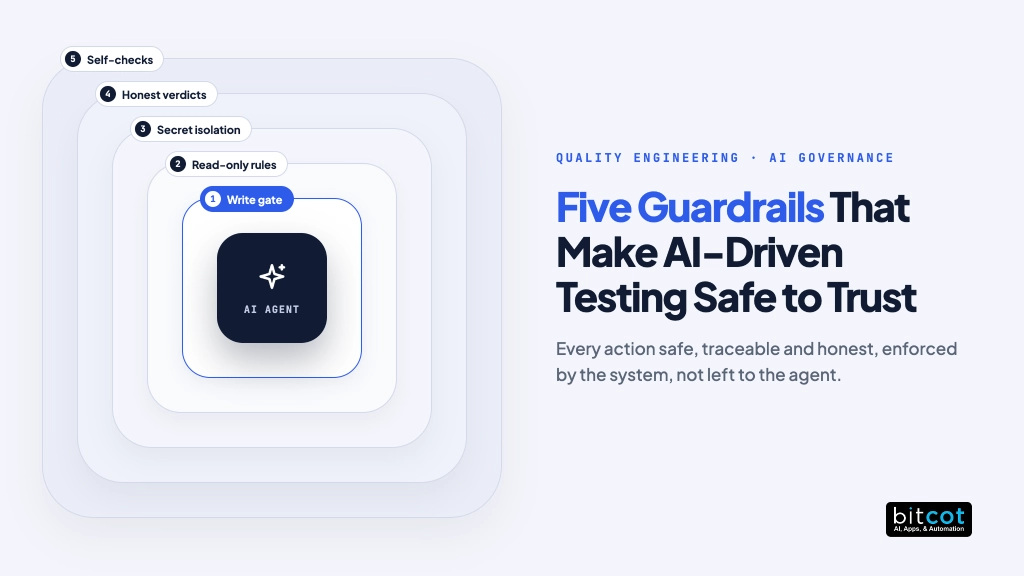
Here are the five guardrails Bitcot built for an enterprise client in a regulated industry, and why each one matters.
Defense in layers
No single control is enough. Each layer below catches what the one before it might miss, and none of them depends on the agent choosing to behave.
Five layers between an AI agent and a consequential actionEvery request from the agent passes through each layer before anything changes.
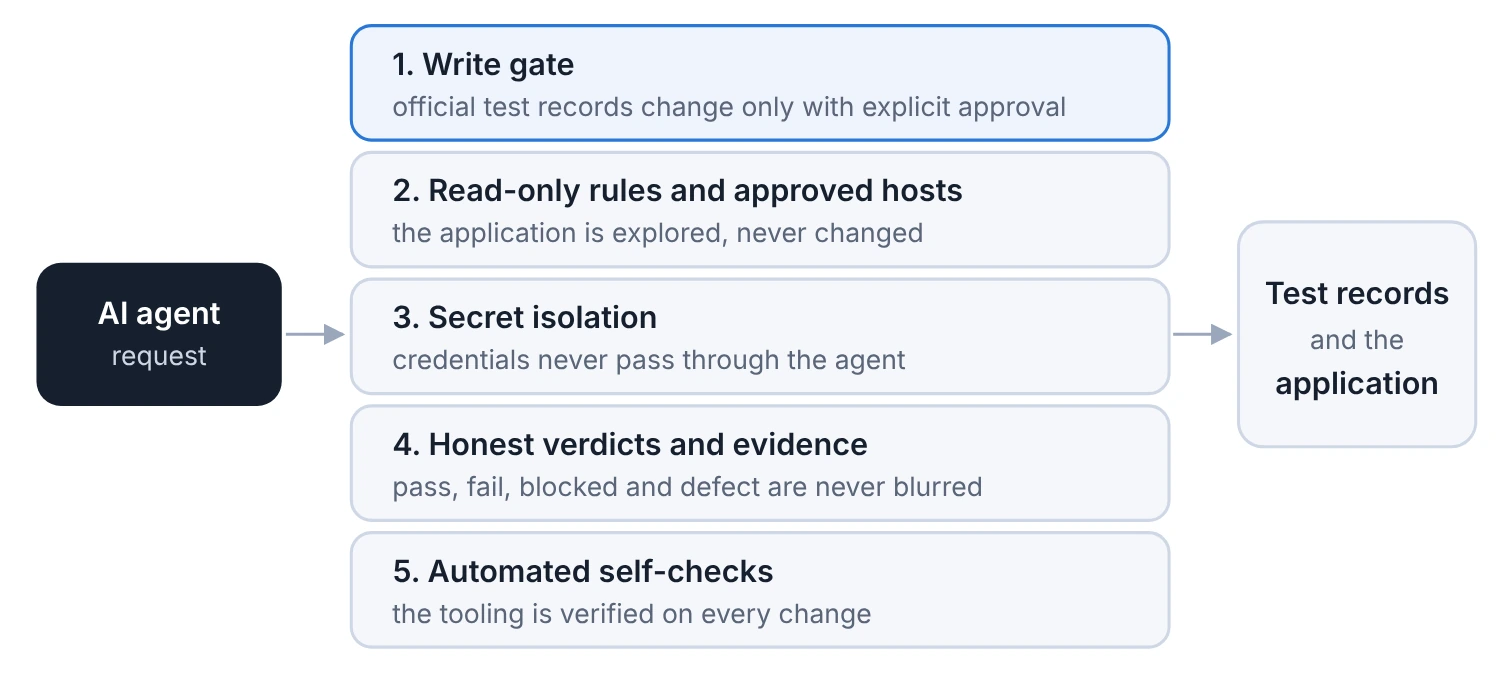
Figure 1. The layers are independent. Even if one were misconfigured, the others would still stand between the agent and a harmful action.
View as text
- Write gate: official test records change only with explicit approval.
- Read-only rules and approved hosts: the application is explored, never changed.
- Secret isolation: credentials never pass through the agent.
- Honest verdicts and evidence: pass, fail, blocked and defect are never blurred.
- Automated self-checks: the tooling is verified on every change.
Guardrail 1: The agent cannot change what it should not
A write gate in front of official records
The most consequential action in any test process is changing the official record: creating, overwriting or deleting test cases in the test management system. In our design, that action is blocked by default. An automated hook intercepts every attempt and allows it only with explicit authorization, from a person on a laptop or from an approved pipeline in continuous integration.
Read-only exploration of the application
When the agent explores the product, it can open, expand and navigate, but it cannot submit, pay, delete or send. Changes are possible only against a short list of test environments that a person has confirmed, and the agent is explicitly forbidden from editing that list. Anything outside it is blocked and named in the run report.
Protected human work
Some files belong to people, such as a reviewer’s notes or a hand-tuned configuration. A second hook stops the agent from editing them, so a regeneration step can never quietly overwrite human judgment.
Guardrail 2: Secrets never leave the vault
Where a credential is allowed to travelThe AI agent sits outside the credential’s path entirely.
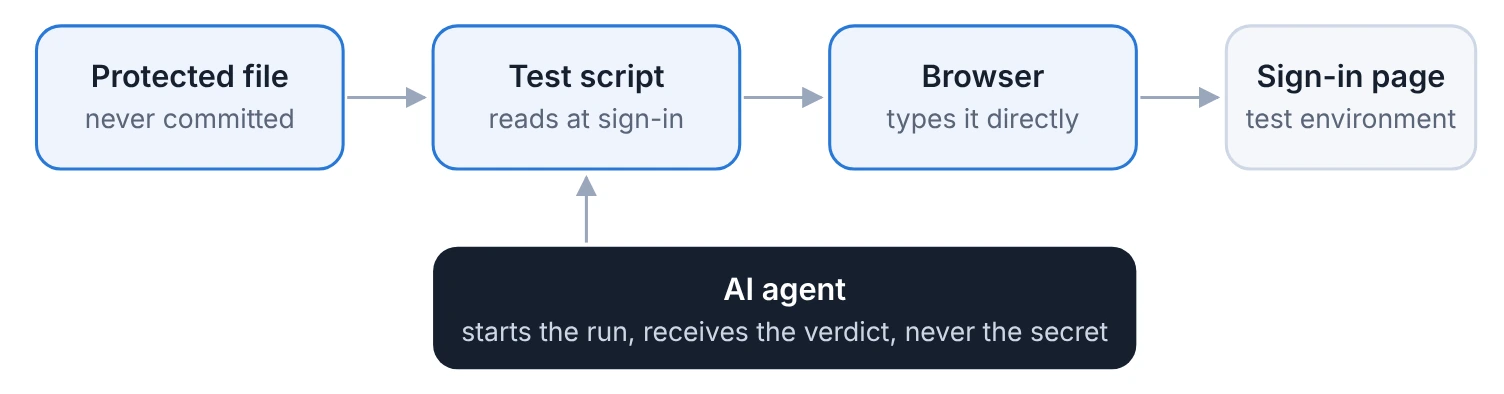
Figure 2. The agent can start a signed-in run, but the credential itself never enters a prompt, a tool call or a log.
View as text
- Protected file: never committed.
- Test script: reads at sign-in.
- Browser: types it directly.
- Sign-in page: test environment.
AI agent: starts the run, receives the verdict, never the secret.
- No secrets in code. Passwords and access tokens live in protected local files and environment settings. Every example file is a placeholder, and its name says so.
- The right account, every time. An automated check confirms that each test user always signs in with its own credential and never falls back to another account’s login.
- Recordings are cleaned. Session recordings start only after sign-in and are scrubbed of passwords and session data before they are saved.
- Every change is scanned. An automated secrets scan runs across the whole codebase on every change, with redaction on, so even a failing scan never prints what it found.
- Evidence cannot leak by accident. A layout check reports any captured screenshot or recording that version control would not ignore.

Guardrail 3: Results are honest by design
An AI agent that is eager to finish may be tempted to report a skipped step as a success. We designed the reporting vocabulary so that honesty is the default and ambiguity has nowhere to hide.
| Verdict | When it is used | Why it matters |
|---|---|---|
| Pass | The step ran and matched the expected result. | A pass always means real evidence exists. |
| Fail | The step ran and the test case itself is wrong. | The case gets fixed, not the product. |
| Blocked | The step could not run: missing account, data or feature flag. | Data gaps are never reported as product defects. |
| Application defect | The product broke a rule the case states. | The case is kept as written; the defect is logged. |
| Not performed | An action was deliberately not taken because it cannot be undone. | Reviewers see exactly what still needs a manual test. |
A test report is only valuable if a “pass” always means the step really ran and really passed.
One more rule supports honest results: a rejected password is never retried. The run stops with a clear message instead of looping into an account lockout and producing a cascade of misleading failures.
Guardrail 4: Every run leaves a clear trail
Every action the agent takes against the application produces evidence in a predictable place, organized by test case, feature and type of user, following one standard structure across every project. Snapshots are numbered in the order they were taken. Reports identify users by role and position, never by name.
When something goes wrong, a person can open one folder and reconstruct exactly what happened without asking the agent. For auditors, that is the difference between “the AI said it passed” and “here is the evidence that it passed”.
Guardrail 5: The tooling tests itself
AI tooling tends to fail quietly. An instruction refers to a script that was renamed. Two copies of a helper slowly drift apart.
An update ships without a new version number, so some teams never receive it. We built an automated check for each of these failure modes, and all of them run on every proposed change.
Automated checks by what they protectEleven checks run on every change to the tooling. None of them needs access to a secret.

Figure 3. Integrity checks confirm files exist, configuration is valid, shared copies match and versions are raised. Workflow checks confirm examples stay complete and results post correctly. Privacy checks confirm correct sign-in, masked account maps and no committed secrets.
| Check | What it protects |
|---|---|
| Reference integrity | Every file and script the instructions mention actually exists. |
| Valid configuration | Every instruction file declares its name and purpose, and every data file parses. |
| Consistency | Shared helpers stay byte-for-byte identical wherever they are used. |
| Versioning | Every change ships with a new version, so every team receives it. |
| Package validation | Every package passes the AI platform‘s own validator. |
| Worked examples | The reference specification stays complete and correct. |
| Test-case structure | Cases are filed in the right module and family. |
| Result reporting | Each kind of run posts its own result, never another run’s. |
| Correct sign-in | Each test user signs in with its own credential. |
| Masked account maps | Names and numbers are masked, and partial captures are refused. |
| Secrets scan | No credential can enter the codebase. |
Because none of these checks needs a secret, they run on every change from every contributor, including first-time contributors whose changes could not otherwise be trusted.
The human role does not disappear
Guardrails are not about removing people. They are about putting people exactly where their judgment matters most:
- Approving writes to the official test record.
- Confirming test environments before any change is allowed against them.
- Reviewing requirements and promoting them from draft to reviewed.
- Deciding disputes when the code and the live application disagree.
- Running manual-only tests for actions that cannot be undone.
Everything else, the repetitive exploration, drafting, validation and reporting, is where the agent earns its keep.

A readiness checklist for your team
Before letting AI agents drive your test process, ask whether you can answer yes to each of these:
| Question | Guardrail |
|---|---|
| Can the agent change official test records without approval? | Write gate |
| Can the agent change data in the application it is testing? | Read-only rules, approved hosts |
| Does any credential pass through a prompt or a log? | Secret isolation |
| Can a skipped step ever be reported as a pass? | Honest verdicts |
| Could a person reconstruct any run from its evidence alone? | Evidence trail |
| Is the tooling itself checked on every change? | Self-checks |
If any answer is uncertain, that is the place to start.
Frequently Asked Questions
What are AI testing guardrails?
AI testing guardrails are controls that make safety a property of the system instead of a choice the AI agent makes. In this design, there are five layers: a write gate, read-only rules with approved hosts, secret isolation, honest verdicts, and automated self-checks. Each layer catches what the one before it might miss.
What is the difference between a failed step and a blocked step?
A failed step ran and showed that the test case itself is wrong, while a blocked step could not run at all. A blocked step usually means a missing account, data, or feature flag, so data gaps are never reported as product defects. A third verdict, application defect, is used when the product broke a rule the case states.
How does a write gate work for AI-driven testing?
A write gate blocks changes to the official test record by default. An automated hook intercepts every attempt to create, overwrite, or delete test cases. It allows the change only with explicit authorization, from a person on a laptop or from an approved pipeline in continuous integration.
Can AI-assisted testing be used in regulated industries?
Yes, these guardrails were built for an enterprise client in a regulated industry. Every run leaves evidence in a predictable place, organized by test case, feature, and type of user, and reports identify users by role and position, never by name. For auditors, that evidence replaces the claim that the AI said a test passed.
Do guardrails remove people from the test process?
No, guardrails put people exactly where their judgment matters most. People approve writes, confirm test environments, review requirements, decide disputes, and run manual-only tests for actions that cannot be undone. The agent handles the repetitive exploration, drafting, validation and reporting.